

TL;DR:
- Expansion revenue is the extra recurring income generated from existing customers through upsells, cross-sells, add-ons, and usage increases. It is essential for increasing net revenue retention and overall growth without acquiring new customers. Tracking expansion separately encourages more profitable, sustainable growth and reveals opportunities to maximize customer lifetime value.
Expansion revenue is defined as the additional recurring revenue generated from existing customers beyond their original purchase, including upsells, cross-sells, add-ons, and usage increases. It is the growth that comes not from winning new accounts but from deepening the value you deliver to customers you already have. For business leaders focused on customer lifetime value and profitability, understanding what is expansion revenue is one of the highest-leverage moves available in 2026. Expansion MRR is a strong indicator of product value and customer momentum, making it a metric every growth-focused team should track with precision.
What is expansion revenue and how do you calculate it?
Expansion revenue is the extra recurring revenue your existing customers generate after their initial contract or purchase. Expansion revenue excludes any revenue from new customer accounts entirely. It counts only growth inside your current customer base through upsells, cross-sells, seat additions, feature upgrades, and usage increases.

The standard measurement unit is Expansion MRR (Monthly Recurring Revenue). The formula is straightforward:
Expansion MRR = Sum of all upsells + cross-sells + add-ons + usage increases from existing customers in a given month
To calculate the Expansion MRR rate, use this formula:
Expansion MRR Rate = (Expansion MRR in period ÷ MRR at start of period) × 100
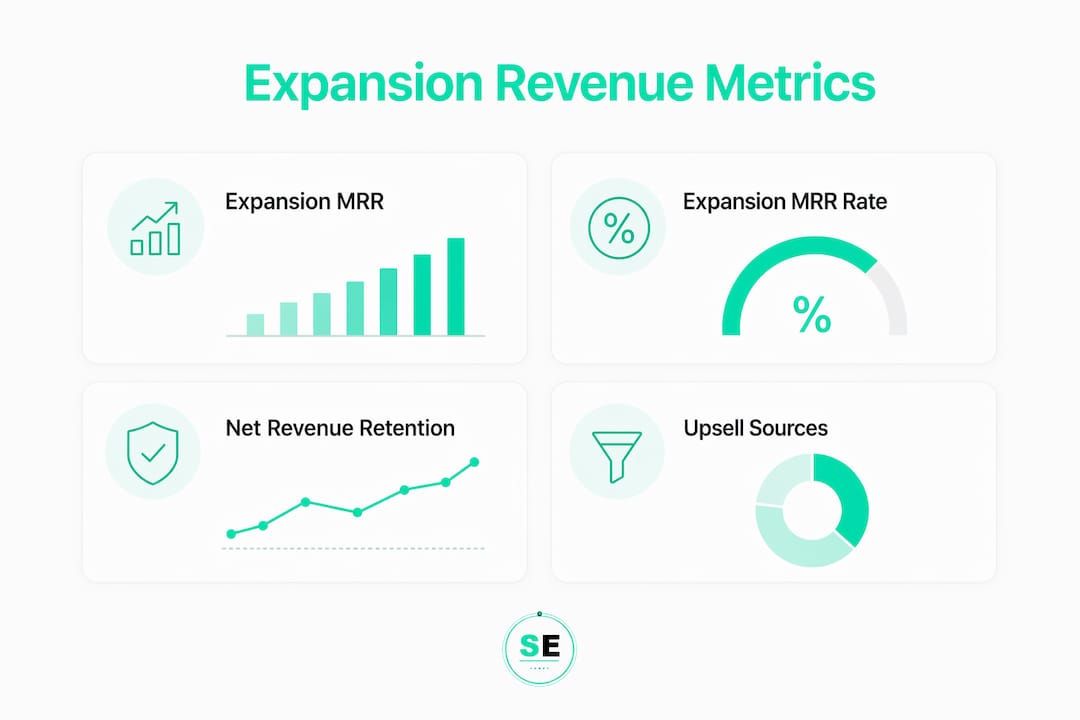
Expansion MRR rate uses starting MRR as the denominator, which keeps the calculation grounded in your actual baseline. That matters because it prevents inflated growth rates caused by mixing in new customer revenue.
| Metric | Formula | What it tells you |
|---|---|---|
| Expansion MRR | Sum of upsells, cross-sells, add-ons from existing customers | Raw dollar growth from current accounts |
| Expansion MRR Rate | (Expansion MRR ÷ Starting MRR) × 100 | Growth rate from existing customers only |
| Net Revenue Retention (NRR) | (Starting ARR + Expansion − Contraction − Churn) ÷ Starting ARR | Overall revenue health including expansion and loss |
One critical nuance: cohort consistency. Inaccurate cohort tracking can overstate expansion revenue by accidentally including reactivated or churned-and-returned customers. Always define your cohort at the start of the period and hold it fixed throughout.
Pro Tip: Track expansion MRR in a separate line item from new business MRR in your revenue model. Mixing them together hides the true quality of your growth and makes forecasting unreliable.
Why expansion revenue matters for sustainable growth
Expansion revenue is the engine behind Net Revenue Retention above 100%. The NRR formula is: (Starting ARR + Expansion − Contraction − Churn) ÷ Starting ARR. When expansion is large enough to outpace churn and contraction, NRR exceeds 100%. That means your existing customer base grows in value even if you sign zero new deals in a given month.
This dynamic has a direct effect on unit economics and profitability. Selling to existing customers carries 60–70% higher conversion rates and lower cost compared to acquiring new customers. That efficiency gap is enormous. Every dollar of expansion revenue costs a fraction of what a new-logo dollar costs to generate.
The strategic implications go further:
- Expansion offsets churn. A business losing 5% of revenue to churn but generating 8% expansion MRR is growing net revenue, not shrinking it.
- Expansion signals product-market fit. Customers who pay more over time are telling you the product delivers real value.
- Expansion improves forecasting accuracy. Predictable upsell and add-on patterns make revenue models more reliable than acquisition-only projections.
- Expansion extends customer lifetime value. Each upgrade extends the revenue contribution of a single customer relationship.
"Expansion MRR is one of the strongest signals of product value, customer momentum, and long-term retention success." — Stripe
For established subscription businesses, up to 40% of new ARR can come from expansion within existing customers. That is not a rounding error. It is a primary growth channel that many businesses underinvest in because they are focused on acquisition.
Common sources and examples of expansion revenue
Expansion revenue comes from four main categories. Each one represents a different way an existing customer increases their spend with your business.
| Expansion type | Definition | Example |
|---|---|---|
| Upsell | Customer upgrades to a higher tier or plan | Moving from a basic plan to a premium plan with more features |
| Cross-sell | Customer adds a complementary product or service | Adding a marketing automation module to an existing CRM subscription |
| Add-on | Customer purchases a discrete additional feature or unit | Buying extra user seats, storage, or API calls |
| Usage-based expansion | Customer's spend increases as their usage grows | A logistics company paying more as shipment volume rises |
What does not count as expansion revenue is equally important to understand. Revenue from a brand-new customer account is new business revenue, not expansion. A reactivated churned customer requires careful classification depending on your cohort rules. Expansion revenue focuses exclusively on growth inside accounts that were already active at the start of the measurement period.
Practical scenarios where expansion revenue drives real growth:
- A dental practice management platform charges per provider seat. As a dental group adds locations, seat count grows automatically.
- An HVAC software company offers a premium analytics add-on. Customers who adopt it pay 30% more per month than base subscribers.
- A logistics platform charges per shipment processed. As a trucking company scales its fleet, monthly revenue from that account scales with it.
These examples share a common thread. The customer's success directly generates more revenue for the vendor. That alignment is what makes expansion revenue so durable compared to one-time upsell tactics. You can explore real expansion revenue examples across multiple verticals to see how this plays out in practice.
How to build expansion revenue into your growth strategy
Tracking expansion revenue separately is the first requirement. Separate tracking prevents you from conflating growth quality with churn effects and gives your team a clear picture of true revenue health. Without it, a business with high churn can look like it is growing simply because new business masks the losses.
The most effective operational tool is the ARR bridge. An ARR bridge attributes every revenue change to one of four buckets: new business, expansion, contraction, or churn. It turns your revenue model from a single number into a story about what is actually happening inside your customer base.
Key actions to build expansion revenue into your growth program:
- Assign ownership. Designate a customer success or account management team responsible for expansion targets, not just retention.
- Score accounts for expansion readiness. Use product usage data, support ticket frequency, and engagement signals to identify accounts most likely to upgrade.
- Build expansion triggers into your product. Usage limits, feature gates, and capacity thresholds naturally prompt customers to expand when they hit them.
- Tie compensation to expansion MRR. Sales and success teams respond to incentives. If expansion is not in the comp plan, it will not get prioritized.
- Review expansion cohorts quarterly. Track which customer segments expand most reliably and double down on acquiring more customers who match that profile.
Pro Tip: Build your recurring revenue analyzer dashboard to show expansion MRR, contraction MRR, and churn MRR as three separate lines. Leaders who see all three together make faster, better decisions than those who only see net revenue change.
Avoiding common measurement pitfalls is just as critical as building the right processes. Reactivations, plan downgrades, and currency adjustments can all distort expansion figures if your categorization rules are not airtight. Define the rules once, document them, and apply them consistently across every reporting period.
Key takeaways
Expansion revenue is the most capital-efficient growth lever available to any business with an existing customer base, and tracking it separately from new business and churn is what turns it from a concept into a competitive advantage.
| Point | Details |
|---|---|
| Core definition | Expansion revenue is additional recurring revenue from existing customers via upsells, cross-sells, add-ons, and usage growth. |
| Calculation method | Expansion MRR Rate = (Expansion MRR ÷ Starting MRR) × 100, using only existing customer accounts. |
| NRR connection | Expansion pushes Net Revenue Retention above 100%, meaning your customer base grows in value even without new deals. |
| Cost efficiency | Selling to existing customers carries 60–70% higher conversion rates than acquiring new accounts. |
| Measurement discipline | Track expansion separately from churn and new business to avoid misreading your true revenue health. |
Why most businesses leave expansion revenue on the table
I have worked with business leaders across a wide range of industries, and the pattern is almost always the same. They know their new customer acquisition numbers cold. They can tell you cost per lead, close rate, and average deal size without hesitation. Ask them their expansion MRR rate and you get a pause.
The reason is cultural, not analytical. Most revenue teams are built around acquisition. The sales motion, the comp plan, the pipeline reviews — all of it points toward new logos. Expansion gets treated as a bonus that customer success handles informally, not a primary growth channel with its own targets and accountability.
That is a costly blind spot. When you consider that existing customer conversion rates run 60–70% higher than new acquisition, the math on where to focus attention becomes obvious. Yet most businesses I see are spending the majority of their growth budget chasing cold prospects while their existing accounts sit underserved and under-monetized.
The fix is not complicated. It requires treating expansion as a first-class revenue motion with its own metrics, its own owners, and its own review cadence. The businesses that do this well do not just grow faster. They grow more profitably, with better NRR, stronger retention, and customers who stay longer because they are getting more value over time. Understanding how revenue leakage occurs is often the first step toward realizing how much expansion potential is already sitting in your accounts.
— Bernard
How Signalengine helps you capture expansion revenue
Your existing customers are your best growth opportunity. Signalengine's AI-powered revenue intelligence platform watches your customer base continuously, scores accounts by behavior, and flags expansion signals before your team would ever notice them manually.

Signalengine detects churn risk, identifies accounts ready to upgrade, and surfaces revenue gaps across your entire customer base — all without you having to dig through reports. It is built for SMBs across 12 verticals including HVAC, logistics, dental, real estate, and landscaping. You get 31 AI-powered tools starting at $49/month. No analyst required. No complex setup. Just clear signals telling you exactly where your next dollar of expansion revenue is hiding.
Ready to Stop the Revenue Leak?
Signal Engine gives small and local businesses 31 AI-powered tools to score leads by buying intent, predict churn before it happens, auto-generate email and SMS campaigns, and recover missed calls automatically — all in one dashboard starting at $49/month.
Start your free 7-day trial — no credit card required. Setup takes 5 minutes.
FAQ
What is the definition of expansion revenue?
Expansion revenue is the additional recurring revenue generated from existing customers through upsells, cross-sells, add-ons, and usage increases. It excludes revenue from new customer accounts entirely.
How do you calculate expansion MRR rate?
Expansion MRR Rate = (Expansion MRR in the period ÷ MRR at the start of the period) × 100. Only include revenue changes from customers who were active at the start of the measurement period.
What is the difference between expansion revenue and new business revenue?
New business revenue comes from customers who did not exist in your base at the start of the period. Expansion revenue comes only from customers who were already active and chose to spend more.
How does expansion revenue affect Net Revenue Retention?
Expansion revenue is the variable that pushes NRR above 100%. The NRR formula adds expansion to starting ARR and subtracts contraction and churn. Strong expansion can make a business grow net revenue even while losing some customers.
What are the most common examples of expansion revenue?
The most common sources are plan upgrades (upsells), additional product purchases (cross-sells), extra user seats or storage (add-ons), and usage-based billing increases as customers grow their own operations.