

Buyer intent signals are observable actions and events that, when stacked and matched to your ideal customer profile, predict which accounts are actively moving toward a purchase. A pricing page visit means little alone. A pricing page visit from a director-level contact at a company that just raised funding, viewed three days ago, means a lot. Stack the signals, score them against fit, and you know exactly who to call first.
TL;DR:
- Combining multiple signals from the same account, especially multi-stakeholder engagement, significantly increases the likelihood of a near-term purchase.
- High-strength signals include demo requests and repeated pricing page visits by decision-makers, which should trigger immediate outbound response within the same day.
- Only a small number of key signals, such as funding events or product usage spikes, are needed to accurately predict buying intent, reducing unnecessary noise.
- First-party data insights, paired with recent third-party signals and fit criteria, create the most reliable and timely triggers for sales activation.
- Speed of response is critical; automating routing rules for high-tier signals to ensure same-day outreach improves conversion rates dramatically.
Table of Contents
- What Counts as a Buyer Intent Signal (and What Doesn't)?
- Where Do Buyer Intent Signals Actually Come From?
- Which Signals Are Strong, Which Are Weak, and Why?
- How Do You Score and Stack Buyer Intent Signals?
- How Should Teams Turn Scores Into Action?
- What Data Infrastructure Do You Need to Run This?
- Where Do Intent Signals Show Up in Real GTM Plays?
- What Goes Wrong With Buyer Intent Programs?
- How Signal Engine Scores Buyer Intent for Small Teams
- What Most Teams Get Wrong About Intent Scoring
- Ready to Stop the Revenue Leak?
- Sources
- FAQ
What Counts as a Buyer Intent Signal (and What Doesn't)?
A buyer intent signal is any observable action or event that indicates a prospect is researching, evaluating, or preparing to buy. That's the working definition, but the boundaries matter more than the definition. A signal is not the same thing as engagement, and confusing the two is the single most common mistake revenue teams make when they build their first scoring model.
Engagement measures whether someone is paying attention. Intent measures whether they're moving toward a decision. A prospect who opens every newsletter for six months but never visits your pricing page is engaged, not in-market. A prospect who visits your pricing page twice in one week after months of silence is showing intent, even with zero newsletter opens.
Explicit signals are direct statements of interest: a demo request, a "contact sales" form fill, a reply to an SDR asking for a proposal. These are unambiguous but rare, because most buyers now research well before they talk to a rep. Gartner's research found a majority of B2B buyers actually prefer a rep-free buying experience, which means explicit signals arrive later in the journey than most teams assume.
Implicit signals are behavioral clues that don't announce intent outright: repeated visits to a features page, a download of a comparison guide, a spike in product usage. Implicit signals need context to mean anything. Recency and fit turn a raw behavior into a usable signal.
The core categories worth instrumenting:
- Verbal signals: direct statements from a prospect or their team, in a call, email, or chat, expressing timeline, budget, or pain.
- Behavioral signals: on-site and in-product actions, from page visits to feature usage to content downloads.
- Third-party signals: research activity happening outside your own properties, on review sites, forums, or intent data networks.
- Technographic and trigger signals: firmographic changes like new funding, executive hires, or a technology swap that create urgency or budget.
Buyer behavior signals only become customer intent analysis once you layer in who the person is and how recently they acted. A senior buyer visiting three times this week outweighs a junior contact visiting once six weeks ago, even if the raw click counts favor the junior contact.
Where Do Buyer Intent Signals Actually Come From?
First-party signals live on properties you control, and they're the strongest data you'll ever get because you own the context around them. Website behavior, product usage, form submissions, and email engagement all fall here. A prospect who fills out a form gives you their identity for free. A prospect who returns to your pricing page a third time gives you timing. Both matter, but first-party data wins on trust because there's no attribution guesswork involved.
Third-party sources extend your visibility past your own domain. Intent data providers aggregate research activity across publisher networks and infer which companies are searching for solutions like yours. Review platforms are a major channel here. G2 profile views, comparison searches, and category browsing on review sites are a common way prospects research anonymously before ever hitting your site. The tradeoff is that third-party feeds are noisier and decay fast. Research on buying-signal behavior shows intent surges from third-party sources lose their value within days, not weeks, which means a "hot" account flagged by a data provider on Monday can go cold by the following week if nobody acts.
Technographic and trigger-event data round out the picture:
- Funding events: a new raise often means new budget within two to four quarters.
- Leadership hires: a new VP of Operations frequently means a fresh vendor review within their first 90 days.
- Tech stack changes: a company swapping CRMs or adding a competing tool signals an active evaluation cycle.
- Headcount growth in a specific department: rapid hiring in sales or support often precedes tooling investment in that function.
None of these sources work well in isolation. A funding event with no follow-up behavior is a maybe. A funding event paired with three people from the same company visiting your site in the same week is a real account to prioritize. This is the foundation of intent-based marketing strategies that actually hold up under scrutiny: source diversity, filtered through fit and recency, not any single feed treated as gospel.
Which Signals Are Strong, Which Are Weak, and Why?
Not every signal deserves the same reaction. Ranking signals by strength keeps your team from treating a blog subscriber the same way it treats a champion who just looped in procurement.
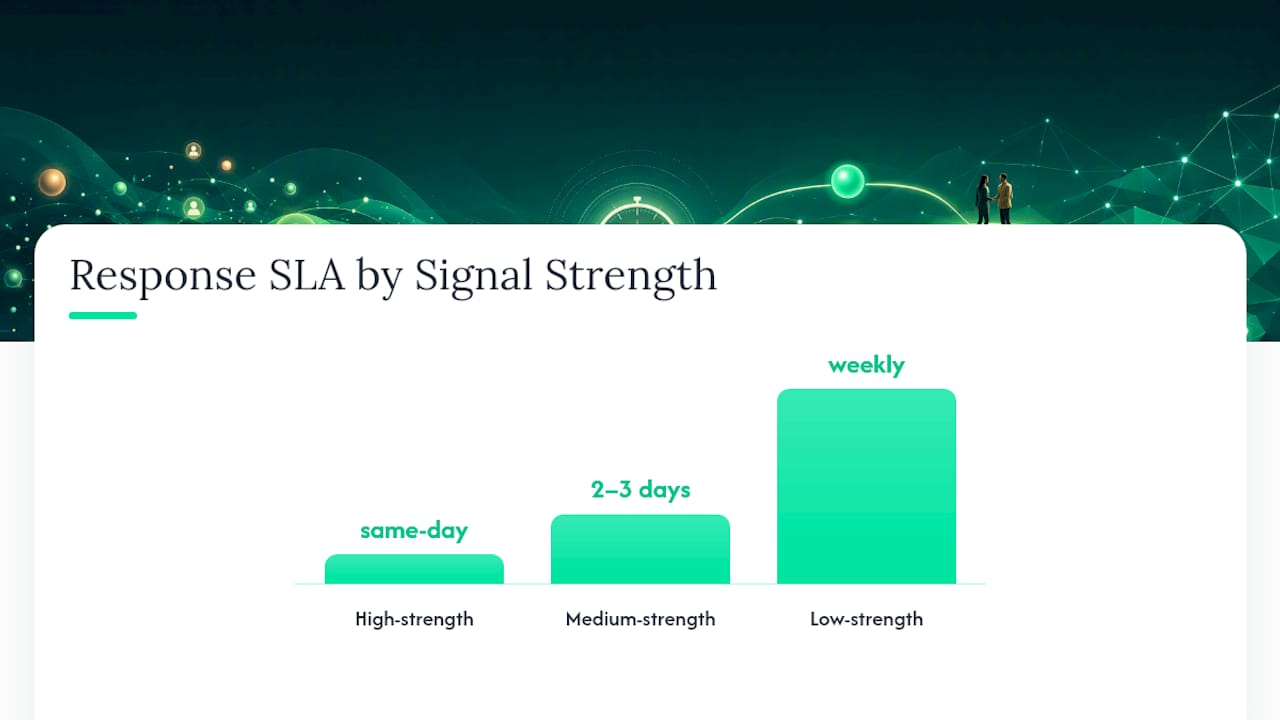
High-strength signals (act same-day):
- Demo or trial request from a decision-maker or influencer.
- Repeated pricing-page visits (two or more within a week) combined with a competitor comparison download.
- Multiple stakeholders from the same account engaging within a short window.
- A verbal statement of timeline or budget during any live conversation.
Medium-strength signals (act within two to three days):
- A single high-value content download (ROI calculator, buyer's guide).
- Attendance at a webinar or product demo, without follow-up questions.
- A trigger event (funding, new hire) with no direct engagement yet.
Low-strength signals (batch into nurture, review weekly):
- A single blog visit or newsletter open.
- A generic contact form with no specific ask.
- Passive third-party research activity with no on-site corroboration.
Research consistently shows why the high tier gets same-day treatment: comparison research, demo requests, and multi-stakeholder engagement are among the most predictive signals of near-term buying activity that revenue teams can track.
Pro Tip: Multi-stakeholder detection is the most underused technique in intent scoring. Instead of scoring contacts individually, roll signals up to the account level. Three different people from the same domain hitting your pricing page in one week is a far stronger buying signal than one person visiting five times.
Here's how the tiers play out in practice. A mid-market logistics company has its ops director download a comparison guide (medium signal). Two days later, a second person from the same domain, listed as "finance," requests a demo (high signal, and now multi-threaded). That combination should trigger an SLA-bound response, not a generic nurture email. Compare that to a solo marketing manager who opens three newsletters and visits the blog twice: real engagement, but nowhere near ready-to-buy, and it should stay in nurture until something changes.
How Do You Score and Stack Buyer Intent Signals?
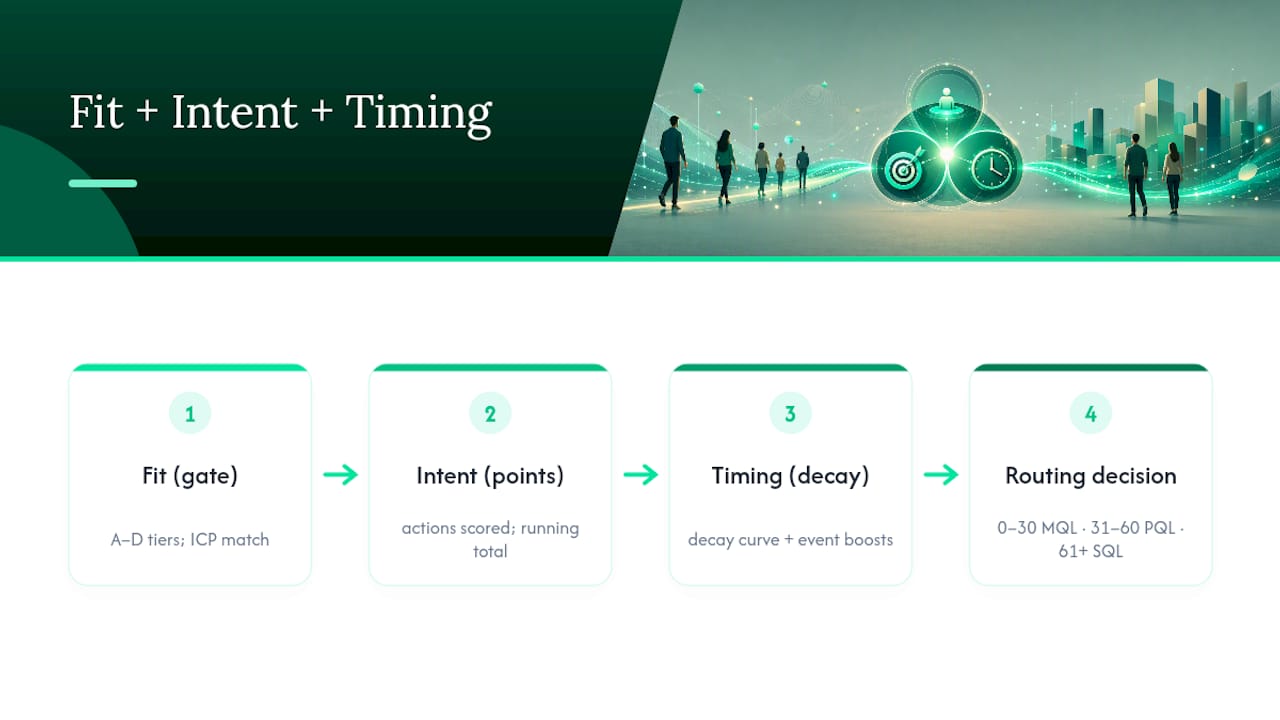
The simplest model that works reliably is Fit plus Intent plus Timing. Each dimension answers a different question, and none of them should be scored alone.
Fit measures whether the account matches your ideal customer profile: industry, company size, tech stack, geography. Fit is usually graded on a letter or tier scale (A through D, or High/Medium/Low) rather than a raw number, because fit doesn't change week to week the way behavior does. A partner resource on building buyer personas is a useful starting point if your ICP definition is still loose.
Intent measures the accumulated weight of behavioral and third-party signals, usually as a running point total. Each action earns points based on the strength tiers above: a demo request might be worth 25 points, a pricing page revisit 10, a single blog read 2.
Timing applies a decay curve and event boosts on top of the raw intent score. A signal from yesterday should outweigh the same signal from three weeks ago. Vendor guidance on buying-signal programs consistently recommends starting with three to five prioritized signals rather than trying to weight forty variables on day one, because an overbuilt model is harder to trust and harder to debug when it misfires.
Here's a simplified points structure using generic labels, the kind you could build in a spreadsheet by Friday:
Set your routing thresholds off the combined Fit and Intent score, not intent alone. A common structure: 0 to 30 points stays in marketing nurture (MQL territory), 31 to 60 becomes a product-qualified lead worth an automated sequence, and 61-plus becomes a sales-qualified opportunity that routes straight to an account executive with a same-day SLA. Fit acts as a gate, not just a multiplier. A Tier A account hitting 61 points gets a phone call. A Tier D account hitting the same score might just get an automated email, because even a hot signal from a bad-fit account rarely closes.
This is where stacking earns its reputation. Guides analyzing large buying-signal datasets report that accounts with multiple independent signals convert at five to ten times the rate of accounts flagged on a single signal alone. A stacked score isn't just additive noise reduction. It's the difference between a false alarm and a real buyer.
How Should Teams Turn Scores Into Action?
A scoring model that doesn't change what your team does the next morning is just a report nobody reads. Assign clear ownership and response times to each tier before you launch, not after the first hot lead sits untouched for three days.
- High-tier signals (61+ points, Fit A or B): route directly to an account executive with a same-day SLA. No queue, no round-robin delay.
- Medium-tier signals (31 to 60 points): route to an SDR for a personalized, multi-touch cadence within 48 hours, mixing email, LinkedIn, and a phone attempt.
- Low-tier signals (0 to 30 points): stay with marketing automation for nurture, with a weekly review to catch anything trending upward.
- Existing customers showing expansion signals: route to customer success, since usage-based signals like hitting a plan limit or inviting new teammates predict upsell readiness better than most outbound triggers.
Speed matters more than most teams assume. Practitioner guidance on lead response consistently points to same-day and even same-hour contact producing dramatically higher connect rates than next-day follow-up. An SLA is only as good as the alert that triggers it, which is why routing rules need to fire automatically rather than depend on someone checking a dashboard.
Personalization hooks should reference the actual signal, not a generic template. If an account downloaded a comparison guide against a named competitor category, the outreach should reference the evaluation directly: "Saw your team was comparing options for X. Here's what most buyers get wrong when making that call." Future-pacing language, framing the conversation around what happens after the purchase rather than the purchase itself, tends to outperform feature-focused pitches because it assumes the sale rather than pitching it.
Pro Tip: Ownership language beats permission language in intent-driven outreach. "I'm reserving 15 minutes on Thursday for your team" reads as confident and specific. "Would you have any time to chat sometime?" reads as an afterthought and gets ignored at three times the rate in most SDR benchmarking.
A segmentation-by-intent framework can help formalize these routing rules so they don't live only in one rep's head.
What Data Infrastructure Do You Need to Run This?
None of the scoring above works without clean plumbing underneath it. The minimum requirement is identity resolution: the ability to tie an anonymous website visitor, a form-filled lead, and an existing CRM contact back to the same person and the same account. Without that, your "multiple stakeholders visited this week" signal is just three disconnected rows in three different systems.
Practical integration patterns that make this work at SMB scale:
- CRM custom fields for Fit tier, running Intent score, and last-touch timestamp, updated automatically rather than by hand.
- Webhook triggers that fire the moment an account crosses a scoring threshold, pushing an alert into Slack or a task into the rep's queue.
- CDP-style score objects if you're managing multiple product lines or business units, so scores don't collide across teams.
- Enrichment layers that attach firmographic and technographic data to a raw form fill within seconds, so a rep isn't manually looking up company size before deciding to call.
Combining first-party and third-party signals is where most of the real lift happens, but it also introduces the biggest privacy consideration. First-party data collected through your own forms and cookies generally falls under consent frameworks you control directly. Third-party intent data, especially anything tied to identifiable individuals, needs to be evaluated against regulations like the GDPR in the EU and the CCPA in California, both of which govern how personal data is collected, matched, and used for outreach. Work with whoever owns compliance at your company before piping third-party identity data into automated outreach sequences, particularly if any signal source resolves down to a named individual rather than an anonymized account. A resource on how prospect intent data works for revenue teams is a solid next read if your plumbing is still mostly manual.
Where Do Intent Signals Show Up in Real GTM Plays?
Account-based marketing uses trigger events as the outbound starting gun. A funding announcement or a new VP hire at a target account justifies a personalized, multi-threaded outbound push, typically hitting three to five contacts at once rather than a single lead. A layered signal approach across channels reduces the odds of chasing a trigger event that never turns into real engagement.
Inbound triage flips the model. Instead of waiting for marketing to hand off a lead, hot accounts get flagged the moment they cross the scoring threshold, and an SDR reaches out within the hour rather than the standard next-business-day queue. This is where the ABM checklist and inbound process should share the same scoring backbone, so a lead doesn't get treated differently depending on which team touched it first.
Expansion and churn plays run off product usage instead of website behavior. A customer hitting a plan limit, inviting new teammates, or spiking usage in a specific feature is showing the same kind of intent signal as a prospect visiting a pricing page twice, just inside your product instead of on your marketing site. On the flip side, a sudden usage drop is a churn signal worth the same urgency as a hot buying signal, just routed to customer success instead of sales. Teams that want a structured way to catch declining usage before a cancellation should look at a churn detection framework built for B2B accounts.
What Goes Wrong With Buyer Intent Programs?
The most common failure is overweighting a single signal. A prospect who visited a pricing page once, six weeks ago, is not "sales-qualified" just because pricing pages feel like a strong signal in theory. Signals decay, and treating stale data as fresh is how reps end up chasing accounts that went cold weeks earlier.
The second most common failure is acting too slowly on the signals that are genuinely fresh. Third-party intent surges in particular have a short shelf life, and a well-scored account that sits in a queue for four days has often already made a decision, sometimes with a different vendor.
The third failure is ignoring fit entirely. A high-intent score from a company outside your ICP, wrong size, wrong industry, wrong budget tier, is not worth the same urgency as a high-intent score from a company squarely inside it. Fit is the gate; intent is the accelerator.
Watch for these specific mistakes:
- Scoring individual contacts instead of rolling signals up to the account level.
- Treating every third-party data provider hit as equally reliable, regardless of source quality.
- Building a 40-variable model before validating that a 5-variable version even works.
- Never testing whether the scoring model actually improves outcomes versus a simpler process.
On measurement, track contact rate, meeting-to-opportunity conversion, and pipeline velocity by signal tier, not just by lead source. If your high-tier accounts aren't converting to meetings at a meaningfully higher rate than your low-tier accounts, the model needs recalibration, not more signals bolted on.
The most disciplined way to validate any of this is a holdout test: route half of qualifying accounts through the new scoring model and leave the other half on the old process, then compare conversion after 60 to 90 days. Stacked, multi-signal accounts converting at five to ten times the rate of single-signal accounts is a strong enough effect that a properly run holdout should show a clear difference within one quarter, not a year.
How Signal Engine Scores Buyer Intent for Small Teams
Small revenue teams don't have a data science department, and they shouldn't need one to run a Fit plus Intent plus Timing model. Some revenue intelligence platforms build that model directly into a dashboard to handle lead scoring, churn prediction, and campaign automation without a spreadsheet in sight, starting at competitive prices.
Verticals like real estate, HVAC, and dental practices use the same scoring logic covered above, just tuned to their sales cycles. A dental practice tracking new-patient form fills and insurance verification requests scores intent almost identically to a B2B software team tracking demo requests, just with a shorter timing window.
A five-minute quick-start checklist for any team new to intent scoring:
- Pick your three to five strongest signals first, not forty.
- Define Fit tiers for your ICP before you touch scoring points.
- Set a same-day SLA for your highest tier and actually enforce it.
- Route expansion and churn signals to customer success, not sales.
- Review your scoring thresholds every 90 days against real conversion data.
For teams that want the quick-start version spelled out further, booking meetings from buyer intent data and building an SMB intent action plan are both worth a closer read before you touch a scoring spreadsheet.
What Most Teams Get Wrong About Intent Scoring
Most advice on buyer intent signals treats sophistication as the goal: more data sources, more variables, more granular scoring. That's backwards for almost every small revenue team I've studied through this research. The teams that actually convert faster start with three to five signals, get the routing SLA right, and only add complexity once the simple version proves itself.
The conventional wisdom also underweights speed relative to precision. A slightly imperfect score acted on within the hour beats a beautifully weighted score that sits in a queue for three days, because third-party intent surges and multi-stakeholder windows close fast. Chasing model accuracy while ignoring response time is optimizing the wrong variable.
If you take one thing from this, prioritize the SLA before the spreadsheet. Get a same-day response rule working for your highest tier first. Refine the scoring weights later, once you can see what's actually converting.
— Bernard
Ready to Stop the Revenue Leak?
Signal Engine gives small and local businesses 31 AI-powered tools to score leads by buying intent, predict churn before it happens, auto-generate email and SMS campaigns, and recover missed calls automatically, and all in one dashboard starting at $49/month. The Fit plus Intent plus Timing model covered throughout this piece isn't a spreadsheet exercise inside Signal Engine Growth: it runs automatically, scoring every account the moment a signal fires so your team acts in hours, not days.
Start your free 7-day trial, no credit card required, and Setup takes 5 minutes.
Sources
- The Complete B2B Buying Signals Guide: 40 Signals That Predict Pipeline (2026) | Salesmotion
- B2B Buying Signals: How to Spot, Score, and Convert Them | Leadfeeder
- 30+ Examples of Buying Signals (And How to Act on Each One) | Common Room
- Gartner press release: 61 percent prefer a rep-free buying experience
FAQ
What Are Buyer Intent Signals?
Buyer intent signals are observable actions or events, like a pricing page visit, a demo request, or a funding announcement, that indicate a prospect or account is actively researching or preparing to make a purchase.
What Are Typical Buying Signals?
Typical buying signals include repeated pricing-page visits, competitor comparison downloads, demo or trial requests, multi-stakeholder engagement from the same account, and trigger events like new funding or leadership hires.
What Are the Different Types of Intent Signals?
Intent signals fall into four main categories: verbal signals (direct statements of interest), behavioral signals (on-site or in-product actions), third-party signals (research activity on review sites or intent networks), and technographic or trigger signals (firmographic changes like funding rounds).
What Is an Intent Signal?
An intent signal is a single observable data point, like a form fill or a webinar attendance, that on its own suggests interest but only becomes a reliable buying indicator once stacked with other signals and matched against account fit and recency.
How Do I Know If a Signal Is Strong or Weak?
Strong signals combine explicit action (a demo request), multi-stakeholder engagement, and recency within days; weak signals are single, low-commitment actions like one blog visit with no corroborating activity. Platforms like Signal Engine Growth apply this stacked-scoring logic automatically so teams don't have to grade signal strength by hand.