

The top differentiators worth testing first are vertical specialization, proprietary frameworks, outcome-based pricing, and data-enabled diagnostics. Firms that combine two of these consistently win more work at higher fees than generalists competing on capability lists alone.
Here's the shortlist to act on today:
-
Vertical specialization: Narrowing to a specific industry or buyer role makes you the obvious choice instead of a safe option. Specialists command a material fee premium and close more reliably than vague generalists.
-
Proprietary framework or named method: A repeatable, branded process signals expertise and makes your approach harder to copy or commoditize.
-
Outcome-based pricing: Tying fees to results shifts the buyer's risk perception and justifies premium rates.
-
Data-enabled diagnostics: A packaged diagnostic that surfaces revenue gaps or churn risk gives buyers a concrete reason to hire you before a full engagement starts.
-
Judgment position: A firm-wide stance on what work you refuse creates conviction. Buyers choose on conviction, not capability lists.
If you're picking one to pilot, start with the differentiator that matches your existing proof points. If you have three strong client results in one vertical, specialization is your fastest path. If you have a repeatable process, package it and name it.
Pro Tip: Before investing in IP development or outcome pricing contracts, test your positioning with messaging alone. Rewrite your website headline and one proposal template around a single differentiator. If close rates improve in 30 days, you have signal worth investing in.
Key Takeaways
The most defensible consulting differentiators combine two dimensions — a practice area plus a vertical or buyer role — and are proven through a structured pilot before being scaled firm-wide.
| Point | Details |
|---|---|
| Start with specialization | Combining a practice area with a vertical or buyer role creates positions buyers can search for and referrers can repeat. |
| Pilot before you build | A 6–12 week pilot with 10–15 target accounts generates enough signal to validate a differentiator before investing in IP or pricing changes. |
| Track four KPIs | Monitor close rate, average deal size, time-to-value, and pilot ROI to decide whether to scale or adjust. |
| Packaging beats theory | Rewriting your proposal and website around one differentiator costs nothing and often moves close rates faster than building new IP. |
| Signalengine accelerates diagnostics | Consultants can use Signalengine's revenue intelligence platform to run scored client diagnostics and support outcome-based pricing from day one. |
Table of Contents
- Consulting service differentiation examples by category
- How do you pick the right differentiator for your firm?
- How to run a 6–12 week pilot to test your differentiator
- Using revenue intelligence as a credible differentiator
- What successful differentiation looks like in practice
- What I'd actually tell you to do in the next 30 days
- Signalengine gives consultants a faster path to data-driven differentiation
- Sources
- FAQ
- Ready to Stop the Revenue Leak?
Consulting service differentiation examples by category
Hinge Marketing has catalogued 21 proven differentiators for professional services firms. The categories below distill the most practical ones, organized by effort and impact.
Category 1: Market and vertical specialization
What it is: You serve one industry, one company stage, or one buyer role. A management consultant who works exclusively with Series B SaaS companies is more referable and more searchable than one who "works with growth-stage businesses."
Why it works: Buyers search for specialists. Referrers remember specialists. The strongest positions combine two dimensions — a practice area plus an industry or stage — which converts search intent into a phrase buyers can repeat.
Implementation steps:
- List your last 10 engagements and identify the 2–3 that produced the best outcomes and referrals.
- Define your two-dimension position: practice area + industry/stage (e.g., "change management for healthcare systems undergoing EHR transitions").
- Rewrite your LinkedIn headline, website homepage, and one proposal template to reflect that position.
Metrics to track: Close rate by vertical, average deal size, inbound referral rate.
Category 2: Buyer-role specialization
What it is: Instead of targeting an industry, you target a specific executive role — CFOs navigating first-time audits, HR directors at companies scaling past 200 employees, or COOs inheriting broken operations.
Why it works: Role-specific messaging speaks to the buyer's exact fear and timeline. It also shortens sales cycles because you're not educating the buyer on why the problem matters.
Implementation steps:
- Identify the one role that has hired you most often and gotten the clearest results.
- Build a one-page case study written from that role's perspective (their problem, your process, the outcome in their language).
- Use that case study as your primary outreach asset for 60 days.
Metrics to track: Meeting-to-proposal conversion rate, time from first contact to signed contract.
Category 3: Proprietary framework or named method
What it is: A branded, repeatable process with a name — "The Revenue Clarity Audit," "The 90-Day Alignment Sprint," or similar. The name signals that you've solved this problem before and have a system for it.
Why it works: Proprietary IP is hard to copy and easy to reference. Pairing proprietary IP with outcome-based commercial models and embedded analytics creates a defensible position that supports premium pricing and stickier client relationships.
Implementation steps:
- Document your current delivery process in 5–7 steps.
- Name the framework and create a one-page visual.
- Add the framework visual to your proposals and website.
Metrics to track: Proposal acceptance rate before and after introducing the framework, client NPS.
Category 4: Fixed-fee and productized services
What it is: You package a defined scope into a fixed price — "90-day operations audit for $18,000" or "monthly fractional CMO retainer at $5,000." No hourly billing, no scope ambiguity.
Why it works: Fixed fees reduce buyer anxiety. They also force you to systematize delivery, which improves margins over time. Pricing and packaging are key differentiation levers — tailoring them to perceived value supports premium fees and clearer buyer choice.
Implementation steps:
- Pick your most repeatable engagement type and define its scope in writing.
- Set a fixed price based on value delivered, not hours spent.
- Create a one-page "product sheet" for that service and test it in three proposals.
Metrics to track: Close rate on fixed-fee proposals vs. time-and-materials, gross margin per engagement.
Category 5: Outcome-based pricing and guarantees
What it is: You tie part of your fee to a measurable client result — revenue generated, cost reduced, or time saved. A guarantee ("if we don't identify $X in recoverable revenue, you pay nothing for phase one") signals confidence.
Why it works: Guarantees shift the buyer's perceived risk and justify higher total fees. Branding, bold offers, and superior content are three practical levers consultants can deploy quickly with relatively low upfront investment.
Implementation steps:
- Define one measurable outcome you can reliably deliver.
- Draft guarantee language with a clear trigger and payout condition.
- Test the guarantee with two or three clients before making it a standard offer.
Metrics to track: Close rate with guarantee vs. without, average contract value, refund/trigger rate.
Category 6: Data-enabled diagnostics
What it is: A packaged diagnostic — typically a 2–4 week assessment — that produces a scored report on a client's revenue health, operational gaps, or churn risk. The diagnostic is often priced as a standalone product that leads into a larger engagement.
Why it works: Diagnostics shorten sales cycles by giving buyers a concrete deliverable before committing to a full project. They also create the proof necessary for outcome pricing. Learn more about AI diagnostics in consulting and how they create repeatable insights.
Implementation steps:
- Define the 5–8 data points your diagnostic will collect and score.
- Build a one-page output template (score, top 3 risks, top 3 opportunities).
- Price the diagnostic at a level that covers your time and positions the full engagement as the logical next step.
Metrics to track: Diagnostic-to-full-engagement conversion rate, time-to-first-win.
Category 7: Visible expert positioning
What it is: One or more partners become publicly recognized authorities — through a podcast, a published framework, speaking at industry events, or a newsletter with a defined point of view.
Why it works: Visible expertise creates inbound leads and justifies premium fees without requiring a sales pitch. It also makes the firm's differentiation harder to replicate quickly.
Implementation steps:
- Pick one channel (newsletter, podcast guest appearances, or LinkedIn long-form posts) and commit to it for 90 days.
- Write or record content that expresses a specific, defensible opinion — not generic advice.
- Measure inbound inquiry volume and quality at 30, 60, and 90 days.
Metrics to track: Inbound inquiry rate, content-sourced pipeline value.
Category 8: Signature client experience
What it is: A defined, repeatable client experience — onboarding ritual, weekly check-in format, end-of-engagement debrief — that clients remember and describe to others.
Why it works: Most consulting firms deliver similar work but wildly different experiences. A signature experience generates referrals and repeat business without additional marketing spend.
Implementation steps:
- Map your current client journey from first call to final deliverable.
- Identify two or three moments where you can add a distinctive, memorable touch.
- Document the experience in a playbook so every team member delivers it consistently.
Metrics to track: Referral rate, repeat engagement rate, client satisfaction score.
Differentiator category comparison
| Category | Speed to market | Required investment | Defensibility | Expected fee uplift |
|---|---|---|---|---|
| Vertical specialization | Fast (30–60 days) | Low (messaging only) | Medium | Medium |
| Proprietary framework | Medium (60–90 days) | Medium (documentation) | High | High |
| Fixed-fee packaging | Fast (30 days) | Low | Medium | Medium |
| Outcome-based pricing | Medium (60 days) | Low to medium | High | High |
| Data-enabled diagnostics | Medium (60–90 days) | Medium (tooling) | High | High |
| Visible expert positioning | Slow (90+ days) | Medium (time) | High | High |
| Signature client experience | Fast (30 days) | Low | Medium | Medium |
Pro Tip: Sequence your experiments. Start with packaging and guarantee language (low cost, fast signal) before investing in IP development or outcome pricing contracts. A messaging test costs nothing and tells you whether buyers respond before you build anything.
How do you pick the right differentiator for your firm?
Not every differentiator fits every firm. The right one depends on your existing proof points, your partners' strengths, and what your buyers are already searching for.
Decision checklist
Work through these five questions before committing to a differentiator:
- Existing proof points: Do you have two or more client results that clearly demonstrate this differentiator? If not, you'll need to build proof before you can sell it.
- Partner experience: Does at least one partner have deep, credible experience in the niche or method you're claiming? A differentiator built on a single person's reputation is fragile.
- Client search behavior: Are your target buyers actively searching for this type of specialist? Vertical and role-specific positions work best when buyers already use those terms.
- Revenue at stake: Is the total addressable market large enough to sustain your growth targets? A niche that's too narrow limits upside.
- Competitive density: How many other firms are claiming the same position? A crowded niche requires a second dimension of differentiation to stand out.
Four red flags that should disqualify a differentiator
- Single-person dependency: If the differentiator lives entirely in one partner's head and can't be documented or transferred, it's a personal brand, not a firm differentiator.
- Unavailable client data: Data-driven differentiators require client cooperation. If your target buyers won't share the data you need, the model breaks.
- Regulatory or legal constraints: Some industries limit what consultants can promise or guarantee. Verify before building outcome pricing around a regulated metric.
- Tiny total addressable market: A niche that generates fewer than 50 reachable buyers per year won't sustain a firm. Run a quick market-size check before committing.
Selection metrics to watch
Once you've narrowed to two or three candidates, use these metrics to decide which to pilot first:
- Time-to-first-win: Which differentiator can generate a signed contract fastest?
- Close rate lift: Which one, based on past proposals, would have changed the most "no" decisions to "yes"?
- Achievable price uplift: Which one supports a fee increase you can defend in a proposal?
- Pilot ROI threshold: Can you recover your pilot investment (time + tooling) within 90 days?
How to run a 6–12 week pilot to test your differentiator
A pilot is a controlled experiment, not a full rollout. The goal is to generate enough signal to decide whether to scale, adjust, or drop the differentiator.
The 8-step pilot plan
- Define scope and target buyer. Pick one buyer segment and one differentiator. Write a one-sentence hypothesis: "If we position as [differentiator], buyers in [segment] will convert at a higher rate."
- Build the minimum-viable deliverable. Create the simplest version of the differentiator that a real buyer would pay for — a one-page framework, a diagnostic template, or a fixed-fee proposal.
- Design the offer and guarantee. Write the offer language and, if applicable, the guarantee trigger and payout condition. Keep it simple enough to explain in 30 seconds.
- Identify 10–15 target accounts. Use your existing network, LinkedIn, or a revenue intelligence tool to identify buyers who match your target profile.
- Run 2–3 outreach experiments. Test different messaging angles (problem-led, outcome-led, framework-led) across email, LinkedIn, and referral channels.
- Conduct 3–5 discovery calls. Use a consistent call structure so you can compare responses across prospects.
- Measure results at week 6. Track meetings booked, conversion rate, average deal size, and qualitative buyer feedback.
- Iterate or scale. If the pilot generates at least one signed contract and positive buyer feedback, scale the messaging and deliverable. If not, adjust one variable and run another 4-week experiment.
Pilot checklist
- Hypothesis written and shared with all partners
- Minimum-viable deliverable built and reviewed
- Offer and guarantee language drafted
- Target account list of 10–15 buyers identified
- Outreach templates written (3 variants)
- Discovery call script updated to reflect differentiator
- KPI tracking sheet set up (meetings, conversion, deal size, time-to-value)
- Case study template ready to capture pilot outcomes
KPIs to track during the pilot
- Meetings booked per outreach attempt
- Discovery-to-proposal conversion rate
- Proposal-to-close conversion rate
- Average deal size vs. pre-pilot baseline
- Time-to-value (days from signed contract to first measurable client outcome)
- Client satisfaction score for pilot clients
- Pilot ROI: (revenue from pilot contracts) / (time invested × your effective hourly rate + tooling costs)
Pro Tip: After each discovery call, ask the buyer: "What made you agree to this call?" Their answer tells you which part of your positioning is doing the work. That's the phrase to amplify in your next outreach wave.
One-page case study template
Use this structure to capture pilot outcomes:
- Client context: Industry, size, and the specific problem they hired you to solve.
- Differentiator applied: Which positioning or method you used and why.
- Actions taken: Three to five specific steps you executed.
- Measurable results: Quantified outcomes (revenue recovered, time saved, conversion lift) with a timeframe.
- Buyer quote: One sentence from the client describing the result in their own words.
Using revenue intelligence as a credible differentiator
Diagnostic data as a front-door differentiator shortens sales cycles and creates the proof necessary for outcome pricing. The mechanics are straightforward: you collect client data, score it against benchmarks, and deliver a prioritized action plan before a full engagement begins.
The operational workflow
A data-driven diagnostic follows four stages:
- Data collection: Gather CRM data, customer transaction history, communication logs, and any available behavioral signals. Tools that automate this step — like those described in identifying client revenue gaps — cut collection time significantly.
- Diagnostic scoring: Score the client against benchmarks across three to five dimensions (churn risk, revenue leakage, pipeline velocity, lead quality, competitive exposure).
- Prioritized recommendations: Rank findings by revenue impact and time-to-value. Deliver the top three as a written action plan.
- Ongoing monitoring and alerts: Set up automated alerts for key signals (a customer going quiet, a competitor price change, a pipeline deal stalling) so the client sees continuous value between engagements.
Sample diagnostic output metrics
| Metric | What it measures | Why it matters to the client |
|---|---|---|
| Churn risk score | Probability a customer leaves within 90 days | Flags revenue at risk before it walks out the door |
| Revenue leakage estimate | Uncaptured revenue from pricing gaps or missed upsells | Quantifies the cost of inaction |
| Pipeline velocity | Average days from lead to close | Identifies where deals stall and why |
| Lead quality score | Behavioral signals predicting purchase intent | Prioritizes sales effort on the highest-value prospects |
Packaging the deliverable
The most effective packaging combines three elements: a diagnostic report (scored findings with benchmarks), a 30-day action plan (three prioritized steps with owners and deadlines), and an outcome guarantee (a specific, measurable result tied to executing the plan). Together, these give the buyer a clear picture of what they're getting and what success looks like.
KPIs to demonstrate value after delivery: conversion lift from lead scoring, reduction in churn rate, realized revenue from recovered opportunities, and time-to-value from diagnostic to first measurable outcome.
Pro Tip: In sales conversations, share the diagnostic framework (the five dimensions you score) but not the scoring methodology. The framework demonstrates expertise and creates curiosity. The methodology is your IP — it's what they're hiring you to apply.
What successful differentiation looks like in practice
Vignette 1: Management consulting firm, vertical specialization
The partners repositioned around "operational efficiency for manufacturers scaling past $50M in revenue," rewrote their website and proposal templates, and launched a 90-day pilot targeting 20 manufacturing companies via LinkedIn and referral outreach.
The key driver: buyers recognized the firm as specialists before the first call, which compressed the trust-building phase.
What to copy: Audit your last 10 engagements, find the vertical where you produced the best outcomes, and rewrite your positioning around it before building anything else.
Vignette 2: IT consulting firm, proprietary framework
A mid-size IT consulting firm was losing proposals to larger firms with bigger brand names. The partners documented their existing cybersecurity assessment process, named it, and created a one-page visual showing the five-stage methodology. They added the framework to every proposal and built a short explainer video for their website.
Close rates on competitive proposals improved noticeably over the following quarter. Buyers reported that the named framework made the firm's process feel more credible and predictable than competitors who described their approach in generic terms.
What to copy: Document your most repeatable process in five to seven steps, give it a name, and add the visual to your next three proposals before investing in any additional IP development.
Vignette 3: HR consulting firm, outcome-based pricing
An HR consulting firm specializing in retention strategy introduced a guarantee: if their 90-day engagement didn't identify a substantial recoverable payroll cost from turnover reduction, the client paid only for direct expenses. The guarantee required the firm to tighten its diagnostic process and define clear measurement criteria upfront.

Average contract value also increased because the guarantee justified a higher base fee.
What to copy: Define one measurable outcome you can reliably deliver, write a simple guarantee around it, and test it with your next two proposals.
Vignette 4: Small-business advisory, data-enabled diagnostics
A solo advisor working with small retail and service businesses built a two-week revenue diagnostic using off-the-shelf tools to score churn risk, pipeline gaps, and missed upsell opportunities. The diagnostic was priced at $2,500 and positioned as a standalone product. Of the first eight clients who purchased the diagnostic, six converted to a follow-on engagement.
More importantly, the diagnostic gave the advisor a concrete, data-backed story to tell in sales conversations, which replaced the generic "here's what I do" pitch.
What to copy: Build a simple diagnostic template using the data your clients already have, price it as a standalone product, and track how many diagnostic buyers convert to full engagements.

What I'd actually tell you to do in the next 30 days
The single experiment worth running right now is a six-week diagnostic pilot. Pick three to five existing or past clients who represent your best vertical, run your diagnostic on their data, and deliver a one-page scored report with a 30-day action plan. You don't need a perfect methodology — you need enough signal to know whether buyers respond to the format and whether the findings justify a follow-on engagement.
During the pilot, collect three proof points: the specific revenue figure your diagnostic surfaced, the time it took from data collection to delivered report, and one direct quote from the client describing what the report showed them. Those three elements become your case study, your proposal language, and your website copy. That's how a six-week experiment turns into a firm-level asset.
Signalengine gives consultants a faster path to data-driven differentiation
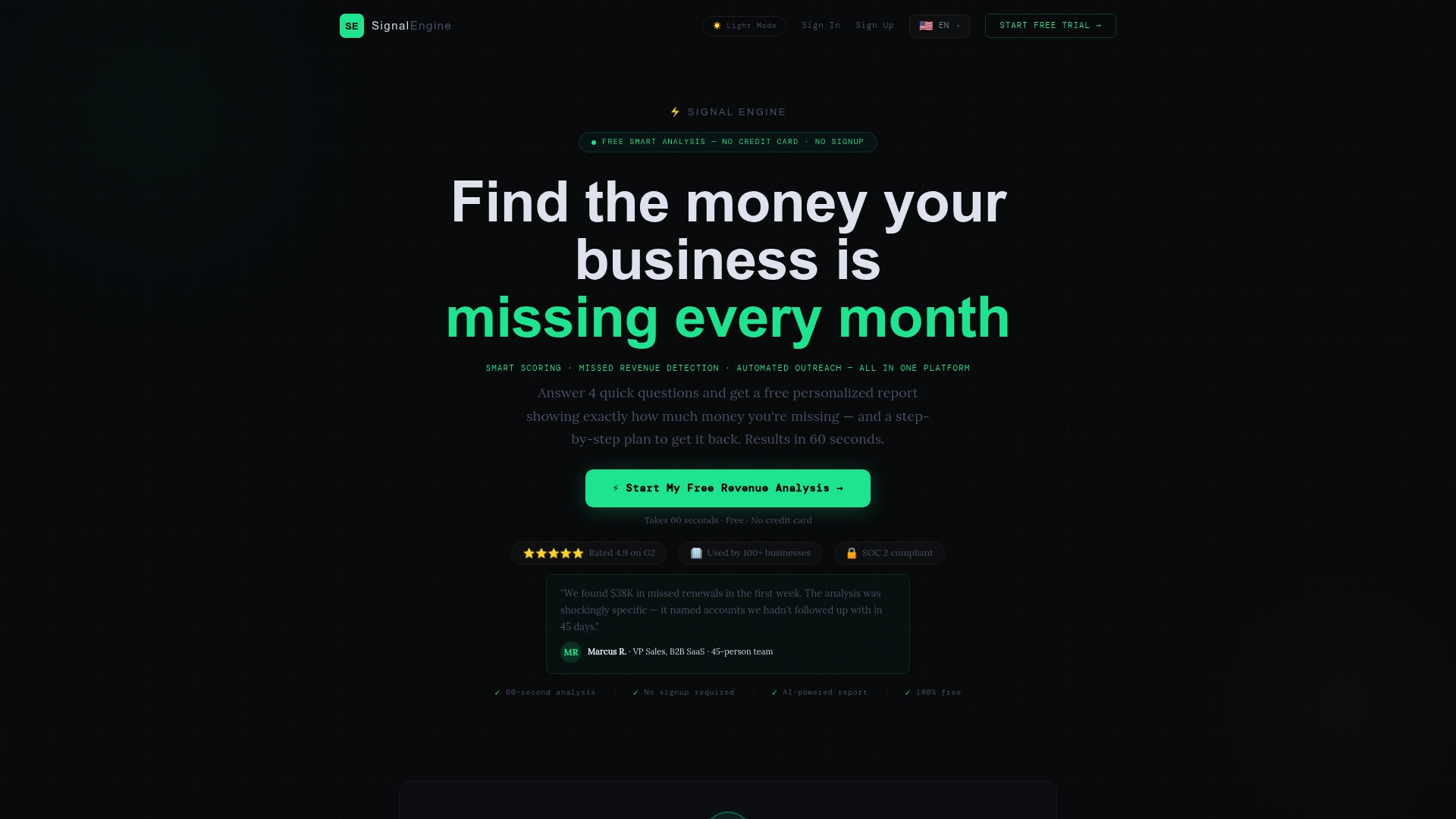
Running a revenue intelligence diagnostic manually takes weeks. Signalengine cuts that to days. The platform scores leads by buying intent, flags churn risk before it becomes visible, monitors competitor signals, and auto-generates email and SMS campaigns — all in one dashboard. For consultants building a data-enabled differentiator, it's a practical tool to embed directly into client pilots without building custom tooling from scratch.
You can use Signalengine's revenue intelligence tools to generate the scored diagnostic reports your clients pay for, then layer in outcome guarantees backed by real data. The platform starts at $49/month, which means the economics work even on a small pilot engagement.
Book a live demo to see how consultants are using it in active client engagements.
Sources
- How to differentiate a consulting firm
- Find your differentiator: 21 ways to gain a competitive advantage for your firm
- Positioning for consulting firms — Specialization playbook
- How to Differentiate Your Consulting Services
- Mastering differentiation strategy: tailoring market success
FAQ
What is a simple example of service differentiation in consulting?
A management consultant who works exclusively with healthcare systems undergoing EHR transitions is differentiated by vertical and project stage. That two-dimension position makes the firm more searchable, more referable, and able to charge a fee premium over generalists.
What makes a good consulting differentiator?
A strong differentiator is specific enough to filter out mismatched buyers, backed by verifiable proof points, and repeatable across multiple engagements. The best ones combine a practice area with an industry, role, or stage so buyers can find you and describe you to others.
How do you differentiate your consulting services without a big budget?
Rewrite your positioning around one vertical or buyer role, add a named framework to your proposals, and test a guarantee on your next two engagements. Branding, bold offers, and superior content are three levers that require time, not significant capital outlay.
How does differentiation affect consulting pricing?
Specialists and firms with proprietary IP consistently command higher fees than generalists. Outcome-based pricing and guarantees further justify premium rates by shifting perceived risk to the consultant. Simon-Kucher's research confirms that aligning pricing structure with perceived value is itself a differentiation lever.
Can a solo consultant realistically differentiate?
Yes. Solo consultants often differentiate faster than firms because they can pivot positioning without internal consensus. A solo advisor who builds a two-week revenue diagnostic and prices it as a standalone product has a concrete, sellable differentiator that larger firms rarely offer at that price point.
Ready to Stop the Revenue Leak?
Signal Engine gives small and local businesses 31 AI-powered tools to score leads by buying intent, predict churn before it happens, auto-generate email and SMS campaigns, and recover missed calls automatically — all in one dashboard starting at $49/month.
Start your free 7-day trial — no credit card required. Setup takes 5 minutes.