

TL;DR:
- A stakeholder alignment checklist is essential for identifying and continuously engaging all key project stakeholders. It helps prevent political friction and project failure caused by misaligned or forgotten stakeholders.
A stakeholder alignment checklist is a structured tool that helps consultants identify, prioritize, and engage stakeholders to achieve project goals. Projects with structured stakeholder engagement achieve 30–40% higher success rates. That number reflects a simple truth: misaligned stakeholders kill projects faster than budget overruns or scope creep. The industry term for this discipline is stakeholder engagement strategy, and the checklist is its operational backbone. This guide gives consultants and project managers a practical, item-by-item framework to map, engage, and maintain alignment from kickoff to closeout.
1. What belongs on a stakeholder alignment checklist for consultants?
The core purpose of any alignment checklist for projects is to make sure no critical stakeholder is missed and no engagement step is skipped. Consultants who skip this structure spend weeks recovering from political friction that a 30-minute setup session would have prevented.
A complete checklist covers five categories:
- Stakeholder identification. List every person or group affected by the project. Use categories: executive sponsors, functional leads, end users, regulators, and external partners. Missing one category is how projects get ambushed late.
- Power-interest mapping. Score each stakeholder on a 1–5 scale for both power (authority to block or approve) and interest (how much the outcome affects them). A score of 5 means highest authority or highest impact.
- Engagement strategy by quadrant. Assign a specific engagement action to each stakeholder based on their quadrant. High power, high interest stakeholders get managed closely. Low power, low interest stakeholders get monitored with light-touch updates.
- Stakeholder register. Create a living document that tracks names, roles, interests, influence levels, and communication preferences. Update it regularly as the project evolves.
- Alignment checkpoints. Schedule formal reviews at each project phase gate. Stakeholder priorities shift. A checkpoint catches drift before it becomes a derailment.
Pro Tip: Build your checklist in a shared workspace so every team member can flag changes in real time. A checklist that lives in one person's inbox is not a checklist. It is a liability.
2. How to map stakeholders fast using the power-interest matrix

A 10-minute mapping exercise using a 2x2 influence-impact grid prevents weeks of political friction. That is not a metaphor. It is a documented outcome from consultants who run this exercise at project kickoff.
Here is how to run it:
- List every stakeholder name. Do not filter yet. Write every person or group you can think of in five minutes.
- Score power on a 1–5 scale. A 5 means the stakeholder can veto or greenlight the project. A 1 means they have no formal authority.
- Score interest on a 1–5 scale. A 5 means the outcome directly changes how they work or what they earn. A 1 means they are barely affected.
- Plot each stakeholder on the grid. Power goes on the vertical axis. Interest goes on the horizontal axis.
- Assign engagement actions by quadrant. Use the table below.
| Quadrant | Power | Interest | Engagement action |
|---|---|---|---|
| Manage closely | High | High | Weekly updates, direct involvement |
| Keep satisfied | High | Low | Regular briefings, no surprises |
| Keep informed | Low | High | Frequent updates, open feedback channels |
| Monitor | Low | Low | Periodic newsletters, light touch |
Pro Tip: Run this exercise with your core project team, not alone. Different team members know different stakeholders. A group session surfaces blind spots in under 15 minutes.
3. What engagement strategies build real stakeholder trust?
Stakeholder management and stakeholder engagement are not the same thing. Management is procedural. Engagement builds trust and moves stakeholders from passive observers to active advocates. That distinction matters because passive stakeholders do not defend your project when it comes under pressure.
Four strategies produce consistent results:
- Translate project language. Executives care about ROI and risk. Frontline staff care about workload and daily routine. Consultants who use the same message for both groups create confusion. Translate every key message into terms that match each stakeholder's world.
- Apply emotional intelligence. Listen before you present. Stakeholders who feel heard are far more likely to support a decision, even one they did not choose. Ask what concerns them most before you explain what the project does.
- Find informal influencers. Informal influencers often wield significant hidden power that formal org charts do not show. The team lead who everyone trusts, the long-tenured analyst who shapes opinion quietly. Identify them early and engage them directly.
- Prioritize ruthlessly. Prioritizing all stakeholders equally leads to inefficiency. Focus your deepest engagement effort on the stakeholders who can most directly affect project outcomes.
"Engagement is the human element that converts stakeholders into active advocates, beyond procedural management." — Harvard Business School Online
Consultants who identify client revenue gaps early apply the same logic: focus effort where the impact is highest, not where it is easiest.
4. What tools and frameworks support consultant-led alignment?
The right tools turn a one-time checklist into a repeatable system. Consultants for stakeholder analysis rely on three core frameworks working together.
Stakeholder register. This is a living document, not a spreadsheet you fill out once. It tracks each stakeholder's name, role, interests, influence level, preferred communication channel, and last contact date. Update it after every significant project event.
Communication plan. A communication plan specifies four things for each stakeholder group: the message, the channel, the frequency, and the owner. Without an owner, communication plans fail. Someone must be accountable for each touchpoint.
RACI matrix layered on the stakeholder map. RACI (Responsible, Accountable, Consulted, Informed) clarifies decision rights. When you layer it on top of your power-interest map, you can see instantly which high-power stakeholders are not yet assigned a clear role. That gap is where projects stall.
| Framework | Primary use | Update frequency |
|---|---|---|
| Stakeholder register | Track engagement history and preferences | After each project phase |
| Communication plan | Assign message, channel, owner per group | Monthly or at phase gates |
| RACI matrix | Clarify decision rights and accountability | At scope changes |
| Power-interest map | Prioritize engagement effort | At organizational changes |
Project management platforms that support shared visibility across these documents reduce the risk of one team member holding critical stakeholder information that others cannot access. Transparency is not a soft benefit. It is a project risk control.
5. How to maintain alignment throughout the project lifecycle
Alignment is not a setup task. Stakeholder drift requires frequent review at phase gates and after organizational changes. A stakeholder who was a strong supporter in month one may be disengaged or hostile by month four if their priorities shifted and no one noticed.
Practices that prevent drift:
- Review your stakeholder map at every phase gate. Ask: has anyone's role, authority, or interest changed? Organizational restructures, leadership changes, and budget cycles all shift stakeholder dynamics.
- Document explicit sign-offs. Verbal agreement is not alignment. Get written confirmation at key milestones. This protects the project and the consultant.
- Close the feedback loop post-implementation. After go-live or project closeout, communicate outcomes back to stakeholders. This builds credibility for your next engagement.
- Protect change champion time. Assigning change champion roles as side projects undermines engagement and delays delivery. Change champions need dedicated time, not leftover hours.
Pro Tip: Schedule a 20-minute stakeholder health check into every project status meeting. Ask three questions: Who has gone quiet? Who has escalated concerns? Who has changed roles? Those three questions catch 80% of alignment problems before they become crises.
6. How to build a stakeholder communication plan that gets used
A communication plan only works if people actually follow it. Most consultants build communication plans that are too complex to maintain. The result is a document that gets ignored after week two.
Keep the plan to one page per stakeholder group. Each row answers four questions: What is the message? How is it delivered? How often? Who sends it? That format takes 30 minutes to build and 5 minutes to update.
Tailor the channel to the stakeholder. Executives respond to concise written briefings and one-on-one conversations. Frontline teams respond to team meetings and direct manager communication. Sending a 10-slide deck to a warehouse supervisor and a two-paragraph email to a CFO are both mistakes. Match the format to the audience.
Review the plan monthly. Communication needs change as the project progresses. A stakeholder who needed weekly updates during design may only need monthly updates during testing. Adjust the frequency to match the current phase, not the original plan.
7. Why consultants should avoid overgeneralizing stakeholder language
Consultants avoid "process language" by translating project impact into terms meaningful to each stakeholder group. Generic language like "this will improve operational efficiency" means nothing to a department head whose team is about to be restructured. It means something very specific to a CFO reviewing cost projections.
The fix is simple. Before any stakeholder communication, ask: what does this person care about most? Then rewrite the message through that lens. A project manager who needs revenue intelligence to advise clients applies the same principle: the right signal for the right audience at the right time.
Key takeaways
A stakeholder alignment checklist works because it forces consultants to map power and interest, assign specific engagement actions, and review alignment continuously throughout the project lifecycle.
| Point | Details |
|---|---|
| Map before you engage | Score every stakeholder on power and interest using a 1–5 scale before planning any outreach. |
| Prioritize high-impact relationships | Focus deep engagement on stakeholders who can directly block or accelerate project outcomes. |
| Keep the register alive | Update your stakeholder register after every phase gate, not just at project start. |
| Protect change champion time | Dedicated time for alignment roles prevents disengagement and project delays. |
| Translate every message | Rewrite each communication in terms that match the specific stakeholder's priorities and concerns. |
What I've learned from watching alignment fail at the finish line
After working through dozens of consulting engagements, the pattern I see most often is not misalignment at kickoff. It is misalignment at month three, when everyone assumes the hard work is done.
Consultants build a solid stakeholder map, run a good kickoff, and then stop updating the register. A VP gets reassigned. A budget cycle shifts priorities. A frontline manager who was a quiet supporter becomes a vocal critic because no one kept them informed during a critical design phase. By the time the project team notices, the damage is done.
The checklist is not a one-time deliverable. It is a discipline. The consultants I have seen succeed consistently are the ones who treat stakeholder review as a standing agenda item, not a recovery exercise.
The other mistake I see regularly is treating all stakeholders as equally important. A strategy that prioritizes everything effectively prioritizes nothing. Spend your deepest engagement effort on the five stakeholders who can most directly affect your outcome. Know their concerns by name. Know what a win looks like from their perspective. Everyone else gets a communication plan. Those five get your attention.
The consultants who get this right do not just deliver projects. They get called back.
— Bernard
Signalengine helps consultants track what matters
Keeping a stakeholder register current, running communication plans on schedule, and spotting disengagement before it becomes a problem all require consistent data. Signalengine's AI-powered revenue intelligence platform gives consultants and project managers the signals they need to act before problems escalate.
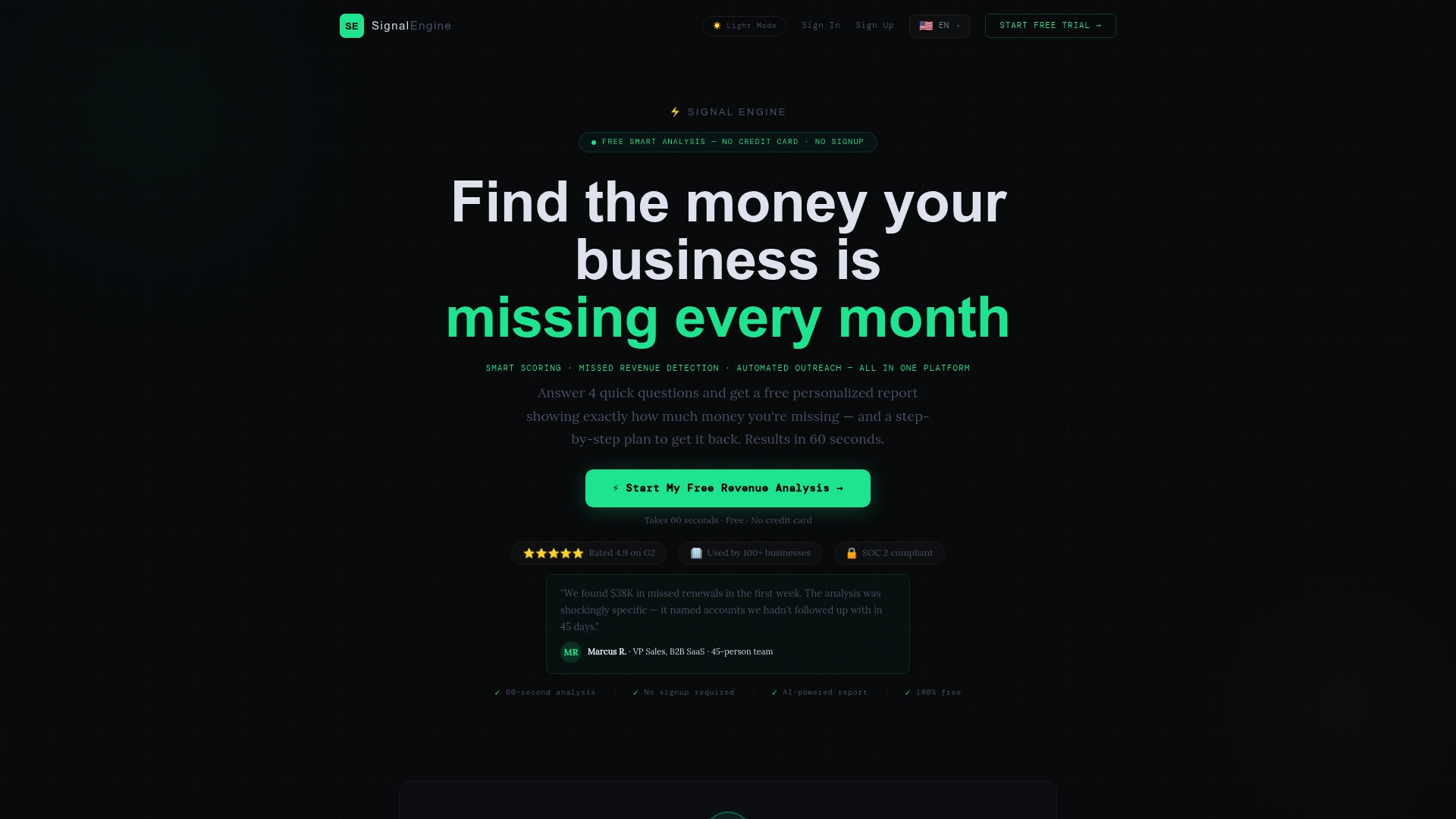
Signalengine scores client behavior automatically, flags disengagement early, and surfaces the contacts most likely to need immediate attention. For consultants managing multiple client relationships at once, that kind of automated visibility replaces hours of manual tracking. Starting at $49/month, it is built for teams that need results without the overhead of enterprise software. Book a live demo to see it in action.
FAQ
What is a stakeholder alignment checklist?
A stakeholder alignment checklist is a structured tool consultants use to identify, map, and engage stakeholders throughout a project. It covers stakeholder identification, power-interest scoring, engagement strategies, and review checkpoints.
How often should consultants update a stakeholder register?
Update the stakeholder register at every project phase gate and after any organizational change. Stakeholder priorities and influence levels shift, and an outdated register creates blind spots.
What is the power-interest matrix in stakeholder mapping?
The power-interest matrix is a 2x2 grid that plots stakeholders by their authority to influence the project and their level of interest in its outcome. Consultants use it to assign targeted engagement actions to each quadrant.
Why do stakeholder alignment efforts fail mid-project?
Alignment fails mid-project because consultants treat it as a setup task rather than a continuous activity. Stakeholder drift, caused by role changes and shifting priorities, requires regular review to catch before it derails delivery.
How many stakeholders should a consultant engage deeply?
Focus deep engagement on the stakeholders who can most directly block or accelerate project outcomes. Prioritizing all stakeholders equally leads to inefficiency and dilutes the impact of your engagement effort.
Ready to Stop the Revenue Leak?
Signal Engine gives small and local businesses 31 AI-powered tools to score leads by buying intent, predict churn before it happens, auto-generate email and SMS campaigns, and recover missed calls automatically — all in one dashboard starting at $49/month.
Start your free 7-day trial — no credit card required. Setup takes 5 minutes.