

Donor retention rate measures the percentage of donors from one period who give again in the next, and it's the single number that predicts whether your fundraising program will survive or slowly bleed out. The sector average sits in the low 40s, while first-time donor retention hovers around 19%, according to Fundraising Effectiveness Project panel data. If you fix one thing this year, fix the speed and quality of your response to first-time gifts.
TL;DR:
- Improving first-time donor retention above sector averages of 19% can significantly boost revenue without increasing acquisition costs.
- Segmenting retention into overall, first-time, and revenue categories reveals hidden trends, such as steady overall retention masking a decline in first-time gift conversion.
- Implementing the 48-hour protocol on all first-time gifts can lift retention by up to 30%, especially when automated through CRM workflows and volunteer outreach.
- Converting even a small percentage of first-time donors into recurring monthly donors dramatically increases long-term retention, since monthly donors retain at rates of 80–90%.
- Using cohort analysis and automated signals for at-risk donors allows small teams to act quickly and effectively before donors lapse, improving retention rates seamlessly.
Table of Contents
- What Does Donor Retention Rate Actually Measure?
- What Counts as a Good Donor Retention Rate in 2026?
- How Do You Calculate Donor Retention Rate?
- Does Retention Vary by Donor Type and Gift Size?
- Which Retention Tactics Actually Move the Needle?
- How Should You Track and Report Retention Internally?
- Why Does the 48-Hour Protocol Work So Well?
- How Do You Convert Donors to Recurring Giving Faster?
- A Board-Level Case for Treating Retention as Strategy
- Where Signal Engine Fits Into Your Retention Strategy
- Sources
- FAQ
- Ready to Stop the Revenue Leak?
What Does Donor Retention Rate Actually Measure?
Donor retention rate tells you what percentage of last year's donors gave again this year. If 100 people gave in 2025 and about 43 of them gave again in 2026, your retention rate matches the sector norm.
That single number carries more strategic weight than most boards realize. Acquiring a new donor typically costs far more than keeping an existing one, so a weak retention rate forces your organization onto a treadmill: you spend heavily on acquisition just to replace the donors who quietly walked away. Improve retention by even a few points and you change your entire revenue trajectory without spending another dollar on new-donor campaigns.
Retention isn't one metric. It's a family of related numbers, and mixing them up leads to bad decisions:
- Overall donor retention — the percentage of all donors from last year who gave again this year, regardless of gift size or history.
- First-time donor retention — the percentage of brand-new donors who give a second gift, historically the weakest link in the chain.
- Revenue retention — the percentage of total dollars retained, which can rise or fall independently of donor-count retention if a few major gifts shift.
Track all three separately. A nonprofit can hold steady overall retention while its first-time conversion quietly collapses, and revenue retention can mask both trends if a handful of large donors are propping up the totals. Once you understand which number is moving and why, you can direct budget toward the actual leak instead of guessing.
What Counts as a Good Donor Retention Rate in 2026?
An overall retention rate near 43% is average. Anything above 55% puts you in top-performer territory, and the strongest organizations run 55–65% overall retention, with first-time retention exceeding 35%, according to Giddings Consulting.
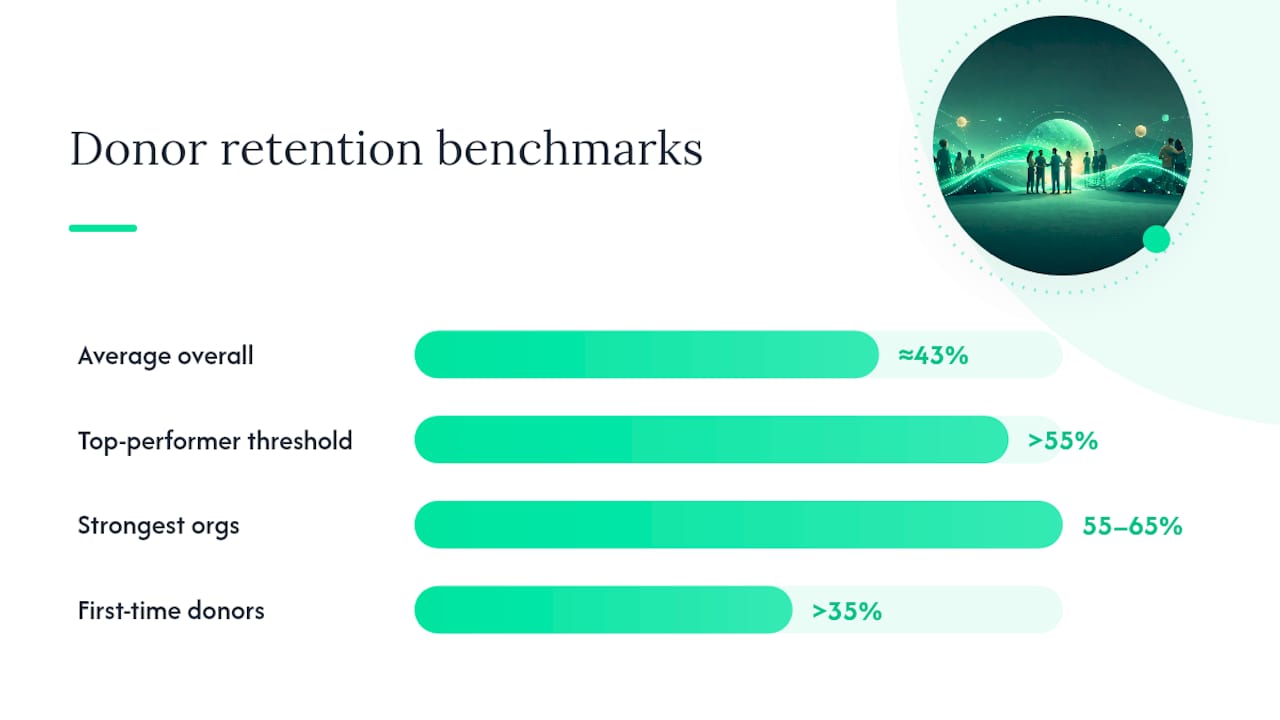
That gap between average and top-quartile performance is where the real budget conversation happens. A five-point retention improvement on a 5,000-donor file with an average gift of $150 translates into hundreds of retained donors and tens of thousands of dollars that would otherwise have to come from expensive new-donor acquisition. Retention math compounds: every point you gain this year keeps paying off next year and the year after, because a retained donor tends to stay retained.
The Fundraising Effectiveness Project's Q1 2026 reporting shows dollars up 4.3% year over year, but retention trends were mixed across donor segments. The report flags the same recurring problem sector analysts have tracked for years: weak first-to-second gift conversion is dragging down otherwise healthy revenue numbers. Growth in total dollars can mask a shrinking, more concentrated donor base, which is a fragile place to build a long-term program.
- Nonprofits reporting flat or declining donor counts alongside rising revenue should treat that as a warning sign, not a win.
- Segments with the weakest retention trends in Q1 2026 reporting were concentrated among newer, lower-dollar donors, which lines up with the persistent first-time retention gap.
How Do You Calculate Donor Retention Rate?
The formula fundraising software and industry glossaries use is straightforward: divide the number of donors who gave in both the current and prior period by the total number of donors who gave in the prior period, then multiply by 100, per Blackbaud's donor retention glossary.
Donor retention rate = (Donors who gave this year AND last year ÷ Donors who gave last year) × 100
Here's how to run it:
- Pull two donor lists from your CRM: everyone who gave in the prior 12-month period and everyone who gave in the current 12-month period.
- Find the overlap, meaning donors who appear on both lists.
- Divide the overlap count by the prior-period total, then multiply by 100.
- Decide your reporting window before you calculate. Some organizations use a strict 12-month window; others use 13 months to avoid misclassifying a donor as lapsed simply because their gift landed a few weeks late, a practice recommended by Virtuous.
- Strip out one-time event ticket buyers or in-kind gifts if your board only wants to see cash-giving behavior, and be consistent about that filter every year.
Working the numbers: say 850 donors gave last year, and 610 of them gave again this year. That's (610 ÷ 850) × 100 = 71.8%, close to the worked example Blackbaud's Knowledge Base walks through using constituent queries. Most CRMs can automate this query once you set the date filters correctly.
Does Retention Vary by Donor Type and Gift Size?
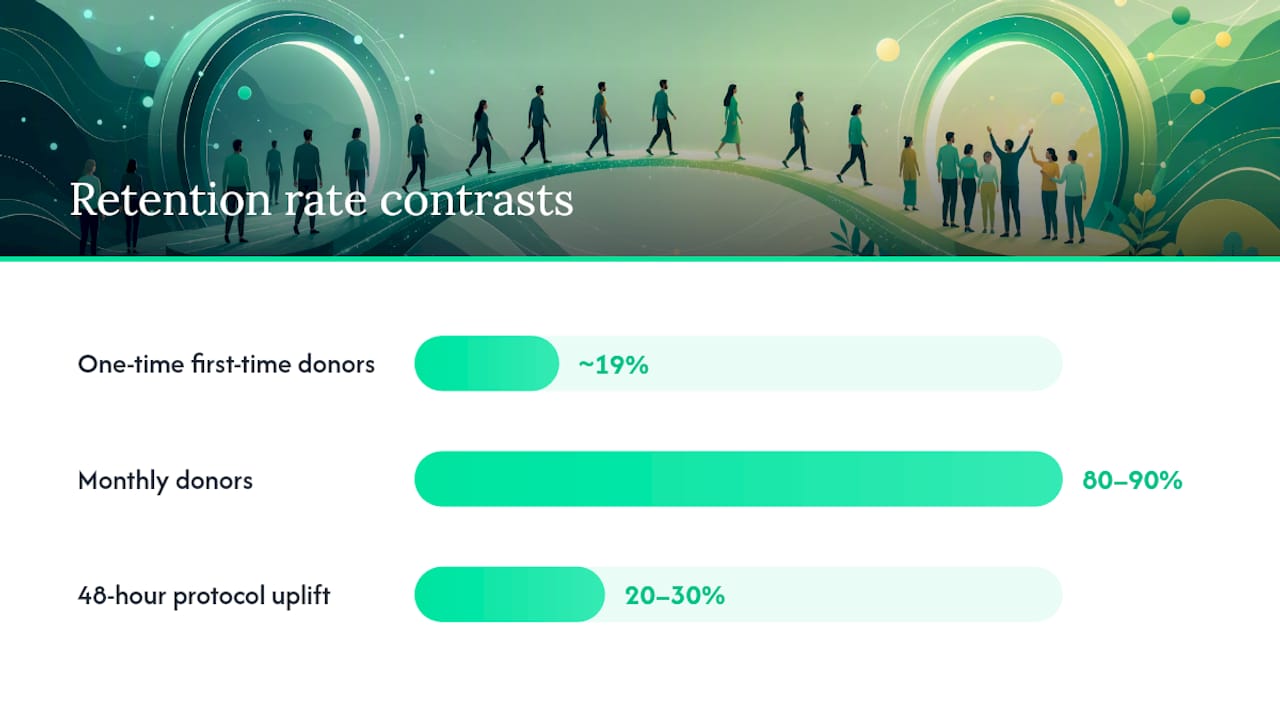
It varies enormously, and treating all donors the same is one of the most common budgeting mistakes fundraising teams make. Monthly and recurring donors retain at rates of 80–90%, dramatically outperforming one-time givers, according to DonorDock. First-time, single-gift donors sit at the opposite end, with sector retention near 19%.
That spread should shape where you put your stewardship budget:
- First-time donors (single gift): roughly 19% retention sector-wide. This is your highest-leverage, lowest-cost improvement opportunity because small process changes move the needle fast.
- Recurring/monthly donors: 80–90% retention. Once someone commits to a recurring gift, they rarely cancel unless something goes wrong operationally (a failed card, a confusing statement, radio silence).
- Repeat annual and major donors: retention climbs with gift history and personal relationship depth, but major donors who feel under-stewarded lapse fast and take large dollar amounts with them when they go.
- Micro donors: often acquired through peer-to-peer or social campaigns, these donors churn at rates closer to first-time givers unless they're moved into a nurture sequence quickly.
Smaller organizations without dedicated major-gift officers should weight investment toward recurring-conversion and 48-hour stewardship rather than trying to replicate a large shop's major-donor cultivation model. Larger organizations with sizable major-donor portfolios get more return from board-driven personal outreach, since a single lapsed major donor can outweigh dozens of lapsed small-dollar donors.
Which Retention Tactics Actually Move the Needle?
Not every stewardship idea is worth your team's limited hours. These five tactics carry the strongest evidence behind them, ranked roughly by impact-per-effort:
- Run the 48-hour protocol on every first-time gift. Automate a receipt within two hours, send a personal (not templated-looking) email within 24 hours, and place a phone call within 48 hours for gifts above your organization's threshold. This sequence can lift first-time donor retention by an estimated 20–30%, according to BoardEffect. It's the single highest-leverage tactic on this list because first-time retention is the sector's weakest point.
- Apply the 70/30 communications rule. Keep 70% of donor touches non-ask content (impact updates, thank-yous, program stories) and only 30% fundraising appeals, a ratio Blackbaud recommends reducing donor fatigue and churn. Donors who only hear from you when you want money start to feel like a line item, not a partner.
- Put board members on the phone for major and mid-level gifts. A personal call from a board member, not a form letter, signals that a gift actually mattered to real people. This doesn't scale to every donor, but it doesn't need to. Reserve it for gifts above a threshold your development director sets.
- Build a recurring-giving onboarding sequence. Because monthly donors retain at 80–90% versus roughly 19% for one-time first-time donors, converting even a modest slice of your file to recurring status changes your retention math more than almost any other single move.
- Sequence lapsed-donor winback carefully rather than blasting everyone at once. Segment by recency (6 months, 12 months, 24+ months lapsed) and vary the message: recently lapsed donors respond to a simple "we missed you," while long-lapsed donors need a reintroduction to your mission before any ask.
Pro Tip: Assign the 48-hour phone call step to a rotating volunteer or board committee, not your one overworked development associate. Small shops that treat this as a shared responsibility sustain the protocol far longer than shops that let it rest on one person's shoulders.
Small and midsize organizations can run every one of these tactics without adopting the tech stack of a national nonprofit, borrowing the same high-impact moves larger shops use and scaling them with automation and clear role assignments, per Giddings Consulting.
How Should You Track and Report Retention Internally?
Cohort analysis is the right lens for retention, and it beats a single blended number every time. Instead of asking "what's our retention rate," ask "what happened to the donors we acquired in Q1 2025, specifically, over the following 13 to 24 months." That longer lookback window catches donors whose giving cycle doesn't align neatly with a calendar year, a distortion Virtuous points to as a common cause of misclassifying active donors as lapsed.
Pair retention with a few supporting KPIs so your board sees the full picture, not just one lagging number:
- Days to second gift — how quickly a first-time donor converts to a repeat donor; shorter is dramatically better.
- Gift frequency — how often an average donor gives per year, a leading indicator of relationship depth.
- Revenue retention — dollars retained versus donor-count retained, since these can diverge in either direction.
A simple dashboard tracking these four numbers by acquisition-month cohort gives your board more signal than a single annual retention percentage ever could. If your team doesn't have a dedicated analyst, a cohort-based retention approach or a lightweight revenue dashboard built without a data team can get you most of the way there.
Why Does the 48-Hour Protocol Work So Well?
The mechanism behind the 48-hour protocol isn't magic. It's timing. A first-time donor's emotional connection to your cause peaks in the days right after they give, and that window closes fast if nothing happens.
Automated receipt within two hours, a personal email within 24 hours, and a phone call within 48 hours for gifts above a set threshold form a sequence that can lift first-time retention by an estimated 20 to 30 percent, largely because it catches donors while their decision to give is still emotionally fresh.
Small shops don't need a call center to run this. Automate the receipt and the first email through your CRM's built-in workflow tools, then route only the threshold-qualifying gifts to a volunteer or board member for the personal call, an approach BoardEffect outlines as workable even for lean teams.
Pro Tip: Set your call threshold low for your first year running this protocol, then raise it once you see how many calls your volunteer team can realistically sustain without burning out.
How Do You Convert Donors to Recurring Giving Faster?
The fastest path to higher lifetime value is converting one-time donors to recurring status before their enthusiasm fades, since monthly donors retain at 80–90% against roughly 19% for first-time single-gift donors.
- Change the ask at the point of acquisition. Language like "Join our monthly giving circle for the impact of $25 every month" outperforms a flat one-time ask by framing recurring giving as membership, not just a bigger commitment.
- Build a 0–90 day onboarding sequence for every new monthly donor. Send a welcome message in week one, a program-impact update in week four, and a personal thank-you touch around day 90 to catch the point where most cancellations happen.
- Watch card-decline and cancellation rates closely in the first quarter. A failed payment that goes unnoticed is the leading cause of "silent lapse" among recurring donors, not intentional cancellation.
- A/B test the recurring ask language on your donation page. Small wording changes in the recurring option's framing routinely move opt-in rates more than redesigning the whole page.
A Board-Level Case for Treating Retention as Strategy
Retention gets treated as a fundraising department problem when it should be a board-level metric, reported alongside net revenue the same way a subscription business tracks churn. A board that only sees total dollars raised has no way to know if the organization is winning new supporters or just running faster to stand still.
The operational fix isn't complicated: assign clear ownership of the 48-hour protocol, build recurring-conversion into your acquisition funnel from day one, and stop treating stewardship as something that happens after the "real" fundraising work is done. Tools that automatically score donor engagement and flag lapse risk before it happens, the same logic Signalengine applies to customer churn in the small-business world, remove the manual tracking burden that keeps understaffed development teams from running this consistently.
— Bernard
Where Signal Engine Fits Into Your Retention Strategy
Everything in this article points to the same operational bottleneck: retention improves when teams catch signals fast and act on them without manual tracking eating up hours every week. That's exactly what Signal Engine was built to do, applying it to the customer and donor relationships small organizations depend on.
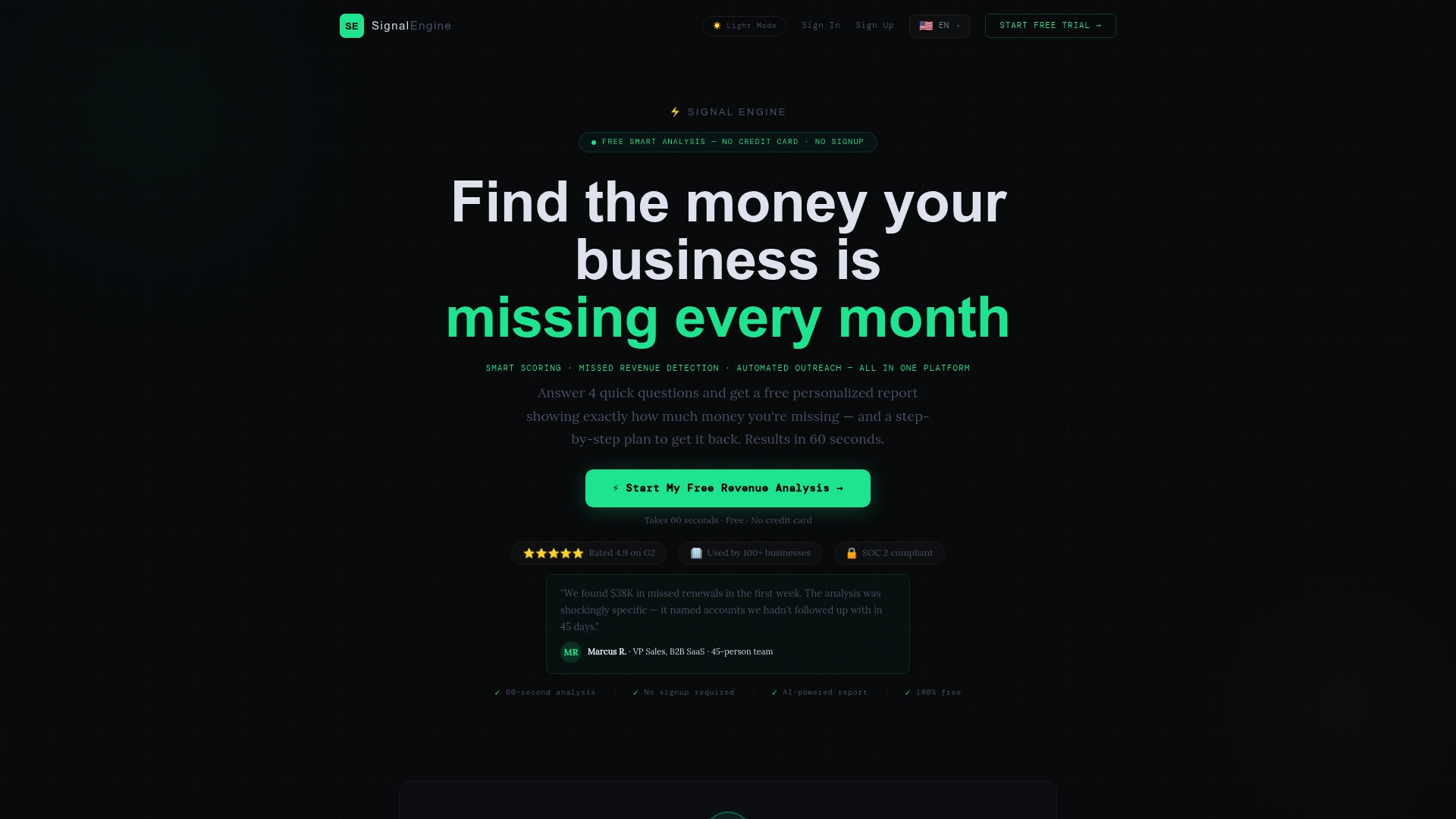
Signal Engine scores every contact on engagement and buy-readiness, flags who's likely to churn before they go quiet, and auto-drafts the outreach so your team reviews and approves instead of writing from scratch. Picture a 48-hour stewardship sequence and a recurring-conversion nudge running automatically the moment a new donor's first gift lands, with a real person only stepping in for the final approval and the phone call. That's the workflow this article recommends, built into one dashboard instead of scattered across spreadsheets and sticky notes.
Every plan includes the full feature set, with no per-seat pricing to worry about as your list grows. Check current plans starting with a free option or see the workflow in action with a live demo. If you'd rather try it hands-on first, start a free trial and see how the churn-scoring engine reads your own donor file.
Sources
The benchmarks and formulas in this article draw on the Fundraising Effectiveness Project's Q1 2026 sector reporting, Blackbaud's donor retention glossary and worked calculation example, and BoardEffect's research on the 48-hour stewardship protocol. Fundraising teams building out CRM-based segmentation may also find this nonprofit CRM overview useful for comparing platform options.
- Blackbaud — Donor retention (glossary)
- AFP — Fundraising Effectiveness Project reports easing donor losses in Q1 2026
- Blackbaud Knowledge Base — How to calculate donor retention rate (example)
FAQ
What Is a Good Retention Rate for Donors?
A good overall donor retention rate is anything above the sector average of roughly 43%, with top-performing organizations reaching 55–65%, according to Giddings Consulting. For first-time donors specifically, sector average retention is closer to 19%, so exceeding 35% puts you in top-quartile territory.
How Do I Calculate My Donor Retention Rate?
Divide the number of donors who gave in both the current and prior period by the total number of donors who gave in the prior period, then multiply by 100, per Blackbaud's glossary. If 850 donors gave last year and 610 gave again this year, your retention rate is (610 ÷ 850) × 100, or 71.8%.
What Is the 33% Rule for Nonprofits?
Rather than rely on an unverified rule of thumb, anchor your targets to the documented sector benchmarks of roughly 43% overall retention and 19% first-time retention instead.
What Is the Current Benchmark for Donor Retention Rates?
Recent Q1 2026 FEP reporting showed dollars up 4.3% year over year, though retention trends stayed mixed across donor segments.
Can Software Help Improve Donor Retention?
Yes. Platforms that automate the 48-hour stewardship sequence, flag at-risk donors before they lapse, and trigger recurring-conversion outreach reduce the manual tracking that causes stewardship gaps in the first place. Signal Engine applies this same churn-scoring and auto-outreach approach for small organizations managing customer and donor relationships without a dedicated analytics team.
Ready to Stop the Revenue Leak?
Signal Engine gives small and local businesses 31 AI-powered tools to score leads by buying intent, predict churn before it happens, auto-generate email and SMS campaigns, and recover missed calls automatically — all in one dashboard starting at $49/month.
Start your free 7-day trial — no credit card required. Setup takes 5 minutes.