

TL;DR:
- A structured renewal recovery process involves scoring accounts at 120 days and launching multi-channel outreach within a week. Automation tools like Signalengine facilitate this by providing real-time scoring, campaign generation, and task automation, reducing manual effort. Regular KPI tracking ensures recovery efforts effectively boost revenue and retention.
Score every missed renewal by ARR, usage depth, and recency, then launch a 7-day multi-channel rescue sequence starting within two hours of detection. That single workflow recovers the most revenue with the least wasted effort.
TL;DR — do these three things in the next 90 minutes:
- Run your triage query — pull every account with a renewal date in the past 120 days where status is not "renewed"
- Score and rank — weight by ARR, last login, payment status, and champion activity to build your top-20 list
- Launch the rescue sequence — email + SMS + call on accounts scoring above your threshold, starting today
Signalengine slots into this first-hour workflow by auto-scoring accounts on churn risk, generating campaign templates, and flagging missed calls the moment they happen. You get a prioritized list before your first coffee is cold.
Pro Tip: Set your triage clock to T-120, not T-30. Renewal risk that surfaces at 90 days almost always existed at six months. Starting at 120 days turns renewals into a formality instead of a fire drill.
Table of Contents
- How do you quickly find and score missed renewals?
- What does a step-by-step recovery playbook look like?
- How does automation scale your renewal recovery?
- How do you stop renewals from being missed again?
- Which KPIs tell you if recovery is actually working?
- US outreach compliance quick-check
- SMB service business: before and after the playbook
- Legal considerations beyond US compliance
- Segment-specific approaches by contract size
- How to handle unresponsive accounts
- Tone and communication strategy for renewal recovery
- How to handle common objections during recovery
- Key Takeaways
- Why systems beat heroics in renewal recovery
- What Signalengine does that spreadsheets can't
- Ready to Stop the Revenue Leak?
- Useful sources
- FAQ
How do you quickly find and score missed renewals?
Start with your data sources. Pull from all of these before you rank a single account:
- CRM renewal date field (filter: renewal date ≤ today, status ≠ renewed)
- Billing system payment events (filter: payment_status = failed OR lapsed)
- Product usage logs (last login date, feature usage breadth)
- Support ticket history (open tickets, silence longer than 30 days)
- Champion activity (last email open, last meeting, contact departure flag)
A simple pseudo-query to get started:
SELECT account_id, account_name, ARR, renewal_date,
       last_login_date, payment_status, last_support_ticket_date
FROM accounts
WHERE renewal_date BETWEEN today-120 AND today
  AND renewal_status != 'renewed'
ORDER BY ARR DESC;
Once you have the list, score each account using this matrix:
| Signal | Weight | Scoring Rule |
|---|---|---|
| ARR / ACV | 35% | >$10K = 10 pts, $5–10K = 7, <$5K = 3 |
| Usage depth (logins/features) | 25% | Active = 10, declining = 5, silent = 0 |
| Payment failure | 20% | Failed = 10, pending = 5, current = 0 |
| Champion activity | 15% | Gone/silent = 10, active = 0 |
| Recency of support ticket | 5% | Open complaint = 5, none = 0 |
Tier assignment: Red (score 25+) = CSM + AE own immediately. Orange (15–24) = CSM owns, AE on standby. Green (<15) = automated nurture sequence only.
A 5-signal health score updated nightly beats complex models for SMBs because it drives action fast. Behavioral signals like login frequency and champion departure predict churn months before renewal.
What does a step-by-step recovery playbook look like?
Teams that diagnose before they dial recover 40–60% of stalled opportunities. Generic follow-ups recover only 10–15%.
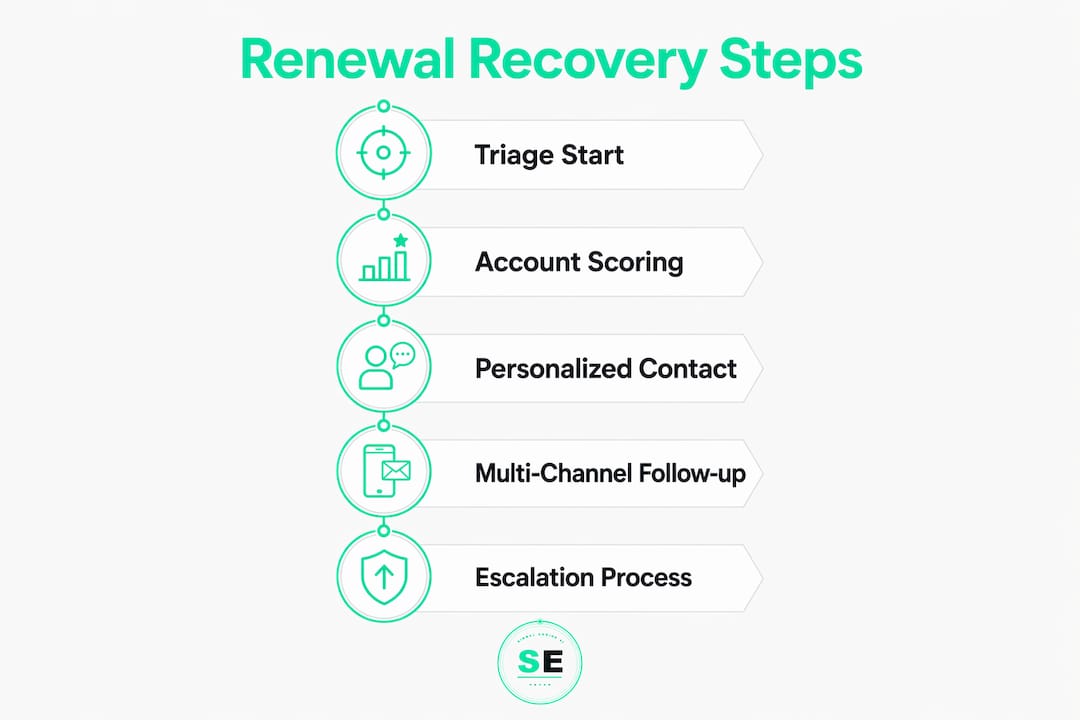
- Day 0 (T+0): CSM sends personalized email to primary contact. Reference the last success metric.
- Day 1: Automated SMS to mobile on file.
- Day 3: AE follow-up call. Leave a voicemail with a specific ask.
- Day 5: Second email from AE. Offer a 15-minute call.
- Day 7: Escalate to VP/manager if no response. Executive outreach lifts re-engagement by 25–35% versus AE-only contact.
Email template — payment failure:
Subject: Quick heads-up on your [Product] account, [First Name] Hi [First Name], your recent payment didn't go through. Your account is still active, but we want to get this sorted before anything changes. [One-click update link]. Takes 30 seconds. Reply here if you'd prefer we handle it another way.
SMS template:
Hi [First Name], this is [Your Name] from [Company]. Your renewal is past due — quick fix here: [link]. Reply STOP to opt out.
Phone script opener: Stop recovery attempts after four to five contacts with no response, or after 21–28 days. Move those accounts to long-term nurture. Pursue hard only when ARR justifies the cost-to-recover and expected retained lifetime value exceeds 2x ACV.
Pro Tip: Personalize every first touch with a named metric: "You processed 847 invoices last quarter using [Feature]." That specificity doubles reply rates versus generic check-ins.
How does automation scale your renewal recovery?
Integration checklist before you launch:
- ✅ CRM renewal date field structured and populated on every account
- ✅ Billing webhook firing on payment_failed events
- ✅ Usage feed syncing nightly (reverse ETL or native integration)
- ✅ Support ticket sync active
- ✅ SMS and email provider connected
- ✅ T-120/T-90/T-60/T-30 task automation enabled
The trigger-to-action flow looks like this:
T-120 fires → Signalengine scores account → CSM task created → health score logged. Payment fails → webhook fires within 2 hours → automated recovery flow launches → Day 1 email sent → retry logic scheduled. T-90 fires → re-score → red accounts escalate to AE queue automatically.
Signalengine handles this with its churn prediction engine, campaign automation (email + SMS), missed-call recovery, and revenue scoring. Setup: connect your CRM, enable the renewal date trigger, select your scoring weights, and activate the campaign template. The T-120/T-90 workflow runs without extra headcount.
Operational fallbacks: If the automation tool goes down, your CRM task list is the manual backup. Build a weekly human-in-the-loop checkpoint — every Monday, a team member reviews the top 10 red accounts to confirm tasks fired correctly.
Pro Tip: Pair automated task generation with your weekly rescue standup. Plans made in meetings that don't exist as CRM tasks disappear by Thursday.
How do you stop renewals from being missed again?
The fix is a structured dunning cadence baked into your ops calendar:
- T-90: Flag account in CRM, assign owner, send first renewal awareness email
- T-60: Email with renewal summary and any open issues
- T-30: Phone call from CSM, confirm intent
- T-15: SMS reminder, confirm payment method is current
- T-7: Final email with renewal document attached
- Expiry: Lapse alert fires, escalation triggers immediately
Billing hygiene checklist:
- Valid card on file for every active account (audit monthly)
- Auto-pay enrolled where the customer consents
- Retry logic set to 3–4 attempts over 14 days for soft declines
- Hard declines (expired/stolen card) routed to direct outreach, not retries
- Payment method update notifications sent 30 days before card expiry
For sensitive renewal conversations, lead with value delivered, not the invoice. "You've saved X hours using [Feature] this year" lands better than "Your payment is due." Keep tone warm and consultative, not transactional.
Pro Tip: Build renewal date as a structured CRM field on every account record and write T-120/T-90/T-60/T-30 tasks automatically. Renewals stop being calendar surprises.
Which KPIs tell you if recovery is actually working?
Track these weekly:
- Recovered MRR — dollar value of renewals closed after lapse
- Recovery rate — % of missed renewals recovered within 30 days
- Days-to-recovery — average days from lapse detection to closed renewal
- Cohort gross retention — recovered cohort vs. control group (no outreach)
- Cost-to-recover — total outreach cost per recovered account (target: <30% of ACV)
- Lapse-rewrite rate — % of lapsed accounts that rewrite at same or higher ACV
Weekly standup dashboard: Show top 10 at-risk accounts by ARR, recovery progress by tier, and failed-retry outcomes. A structured weekly rescue standup improves gross retention by 6–9 points versus solo efforts. Rescues with calendared check-ins close 2.4x more often. For one client, moving the renewal prep from 30 days to 120 days before renewal nearly cut surprise churn in half, making renewals a formality instead of a scramble.
Run simple A/B tests on message timing (Day 1 vs. Day 3 first touch), seniority of sender (CSM vs. VP), and incentive thresholds (no offer vs. one-month credit). Feed winning variants back into your scoring classifier to improve future predictions.
US outreach compliance quick-check
- TCPA: Get prior express written consent before sending marketing SMS or using auto-dialers. Document consent with timestamp and source.
- CAN-SPAM: Use honest subject lines, include your physical mailing address, and provide a working unsubscribe link in every email. Honor opt-outs within 10 business days.
- Do Not Call: Scrub call lists against the National DNC Registry before every campaign. Maintain your own internal DNC list.
- Recordkeeping: Store consent records, opt-out timestamps, and outreach logs for a minimum of four years.
When to involve legal: Government entity accounts, any uncertainty about paid-call consent, or accounts that have explicitly disputed charges.
This guide is general information, not legal advice. Confirm current rules with qualified legal counsel for your specific situation.
SMB service business: before and after the playbook
A mid-size HVAC service company (composite SMB profile, details anonymized) ran this playbook after discovering 22 maintenance contracts had lapsed unnoticed over 90 days.
Timeline: T-120 discovery via CRM query → scored top 10 by ARR → launched 7-day rescue sequence → escalated three accounts to owner-level outreach on Day 7.
| Metric | Before | After (30 days) |
|---|---|---|
| ACV at risk | $41,000 | — |
| Recovered MRR | $0 | $28,700 |
| Gross retention change | 71% | 84% |
| Days to close (avg) | — | 11 days |
What to replicate in your stack:
- Use maintenance contract tracking to surface lapsed service agreements automatically
- Score by ARR first, then usage signals
- Escalate to owner-level on Day 7 for any account above $5K ACV
Legal considerations beyond US compliance
If your customers include international accounts, two frameworks matter most. Canada's CASL requires express or implied consent before any commercial electronic message, with stricter consent documentation than CAN-SPAM. The EU's GDPR governs how you store and process customer contact data used in outreach sequences. Both require clear opt-out mechanisms and prompt honoring of withdrawal requests. For SMBs with primarily US customers, TCPA and CAN-SPAM cover the vast majority of risk. Add CASL and GDPR compliance only when your customer list includes Canadian or EU contacts.
Segment-specific approaches by contract size
High-ACV accounts ($10K+ ARR): White-glove recovery. CSM + AE + executive sponsor all engaged. Custom renewal proposal, business review meeting, and a named escalation path. These accounts justify the most outreach investment.
Mid-market ($2K–$10K ARR): Structured sequence with personal first touch, then automation for follow-ups. Offer a brief renewal call, not a full QBR. Cost-to-recover must stay below 30% of ACV.
SMB/self-serve (<$2K ARR): Fully automated dunning sequence. One personal email on Day 1, then system-driven follow-ups. Human escalation only if the account has high growth potential or strategic value.
For service businesses managing maintenance contracts, a CRM built for contract tracking keeps segment-level ownership clear and prevents high-ACV accounts from falling into the self-serve queue by accident.
How to handle unresponsive accounts
After two unanswered contacts, change the channel. If email got no reply, call. If calls go to voicemail, try SMS. After four contacts across three channels with zero engagement, escalate the account to a senior leader for one final outreach attempt.

The escalation message should be brief and direct: acknowledge the silence, state what's at risk, and offer a single easy next step. If that attempt also fails, move the account to a 90-day win-back nurture sequence and stop active recovery. Chasing a truly unresponsive account past this point costs more than the ACV is worth.
Tone and communication strategy for renewal recovery
Renewal recovery conversations are sensitive. The customer may be embarrassed about a missed payment, frustrated with the product, or simply overwhelmed. Your tone needs to match that reality.
Lead with empathy, not urgency. "I want to make sure we didn't drop the ball on our end" opens more doors than "Your account is past due." Once the conversation is open, shift to value: what they've accomplished with your product, what they'd lose by lapsing, and what you can do to make renewal easy.
Avoid accusatory language in any channel. SMS and email especially can read as aggressive when the subject line or opener leads with a problem. Frame every message around a solution, not a failure.
How to handle common objections during recovery
"We're evaluating other options." Don't panic. Ask what's driving the evaluation and whether there's a specific gap you haven't addressed. This is a buying signal, not a rejection.
"Budget is tight right now." Offer a payment plan or a short-term reduced tier if your pricing allows it. Keeping the customer at a lower ACV beats losing them entirely.
"We haven't been using it much." This is a usage problem, not a price problem. Offer a 30-minute onboarding refresh and point to the two or three features most relevant to their business. Re-engagement often converts to renewal.
"We forgot to renew." Easiest recovery. Send the renewal link immediately and offer to backdate the start date. Remove friction from the payment step and close it in the same call.
Key Takeaways
The most effective missed renewal recovery strategy combines T-120 triage, ARR-weighted scoring, a 7-day multi-channel rescue sequence, and automated task generation to prevent handoff failures.
| Point | Details |
|---|---|
| Start triage at T-120 | Renewal risk that surfaces at 90 days almost always existed at six months — early detection is decisive. |
| Score by ARR and usage | Weight ARR at 35% and usage depth at 25% to rank accounts by recovery priority and effort. |
| Run a 7-day rescue sequence | Email, SMS, and call across 7 days; escalate to VP/executive on Day 7 for accounts above $5K ACV. |
| Automate the recovery clock | Build T-120/T-90/T-60/T-30 CRM tasks automatically so renewals never become calendar surprises. |
| Signalengine for SMBs | Signalengine scores churn risk, auto-generates email and SMS campaigns, and recovers missed calls — starting at $49/month. |
Why systems beat heroics in renewal recovery
Most SMBs treat missed renewals as a people problem. Someone forgot to follow up. The CSM was overloaded. The AE moved on to new business. The real problem is structural: there is no clock running at T-120, no automated score telling you who to call first, and no task in the CRM to prove the conversation happened.
The playbook in this guide works because it replaces memory and heroics with a system. The T-120 trigger fires whether or not anyone remembers to check. The scoring matrix removes the guesswork about who deserves attention. The rescue standup creates accountability because the brief fields are enforced and the follow-ups are calendared.
For SMBs specifically, the math is stark. Recovering one $8,000 ACV account that would have lapsed pays for a year of tooling. The question is never whether recovery is worth it. It is whether your current process is built to catch the accounts before they slip past 30 days.
What Signalengine does that spreadsheets can't
Every workflow in this guide runs faster when the scoring, triggering, and outreach happen automatically. Signalengine gives your revenue team 31 AI-powered tools built specifically for SMBs: churn prediction that flags at-risk accounts before they lapse, campaign automation that sends the right email or SMS at the right moment, and missed-call recovery that catches revenue leaks the moment they happen.
The setup takes five minutes. Connect your CRM, set your renewal date trigger, and Signalengine starts scoring your accounts and generating your recovery queue automatically. No analyst required. No six-figure contract. Just a prioritized list of who to call today and the campaign templates to reach them.
See the full feature set or book a live demo to see the recovery workflow in action.
Ready to Stop the Revenue Leak?
Signal Engine gives small and local businesses 31 AI-powered tools to score leads by buying intent, predict churn before it happens, auto-generate email and SMS campaigns, and recover missed calls automatically — all in one dashboard starting at $49/month.
Start your free 7-day trial — no credit card required. Setup takes 5 minutes.
Useful sources
- Renewal management: stop losing renewals you should win — B2B SaaS RevOps guide on T-120 checkpoints and behavioral health scoring
- The Renewal Rescue Standup — 60-Min Training — structured standup design and cadence rules
- Stalled Opportunity Follow-Up: The Recovery Framework — diagnose-first recovery framework and escalation data
- Stripe Subscription Renewal Failure: How to Recover Revenue Automatically — payment-failure automation and timing guidance
- Missed Renewals in Insurance: How to Stop Them in 2026 — multichannel dunning cadence for service businesses
- Failed Payment Recovery: The Complete Guide for SaaS — decline code reference and recovery timeline data
- Renewal Risk Identification Checklist for Business Leaders — Signalengine's SMB-focused renewal risk checklist
- SaaS Renewal Rate Improvement Workflow: 2026 Guide — T-120/T-90 automation workflow for SaaS teams
- Revenue Recovery Playbook Checklist for Business Leaders — operationalizing recovery playbooks with CRM task generation
- How to Detect B2B Customer Churn Before It Happens — 5-signal health score methodology for SMBs
FAQ
What is the first step in a missed renewal recovery guide?
Run a CRM query to pull every account with a renewal date in the past 120 days where status is not "renewed," then score results by ARR, usage depth, and payment status to build a prioritized action list.
How long does payment recovery take after a subscription lapses?
Automated outreach within two hours of a payment failure yields the highest recovery rates; delays reduce recovery effectiveness.
How many times should you contact an unresponsive account?
Four to five contact attempts across at least three channels over 21–28 days. After that, recovery rates drop below 5% and the account should move to a long-term nurture sequence.
Can Signalengine automate the renewal recovery workflow?
Yes. Signalengine's churn prediction, campaign automation, and missed-call recovery tools handle scoring, outreach sequencing, and task generation automatically, starting at $49/month with a free 7-day trial.
What KPIs should you track for renewal recovery?
Track recovered MRR, recovery rate (% of missed renewals closed), days-to-recovery, cohort gross retention versus a control group, and cost-to-recover per account (target: under 30% of ACV).