

TL;DR:
- Recovery playbooks provide structured plans that speed incident response and protect revenue. They feature triggers, roles, decision logic, automation, and communication tools to minimize downtime and errors. Regular updates, drills, and validation ensure these playbooks remain effective in critical situations.
A recovery playbook is a structured, executable guide that prescribes exact actions, decision points, and roles to restore operations after an incident. The formal industry term is "incident response playbook," and understanding how recovery playbooks work is the difference between a 4-hour fix and a 4-day crisis. These playbooks combine automation, human judgment, and real-time telemetry to cut downtime, protect revenue, and keep customers from walking out the door. For business leaders in HVAC, logistics, dental, real estate, and beyond, a well-built playbook is not a nice-to-have. It is a revenue protection tool.
How recovery playbooks work: structure and core components
A recovery playbook is built from six core components that work together as a system. Each component has a specific job, and removing any one of them creates gaps that slow your response.
- Trigger: The condition that activates the playbook. Examples include a ransomware alert, a payment system outage, or a third-party service failure.
- Orchestrator: The person or automated system that coordinates the response sequence.
- Roles and responsibilities: Named owners for each step. Ambiguity here is the single biggest cause of slow recovery.
- Decision logic: Branching paths that tell responders what to do when conditions change mid-incident.
- Automated actions: Scripts, alerts, and system calls that execute without human input, reducing cognitive load on your team.
- Communication protocols: Pre-written templates for internal updates and customer-facing messages.
Playbooks act as bridges between high-level strategy and precise execution. They let your team focus on complex problem-solving instead of hunting through documentation during a crisis.
A recovery priority matrix is one of the most underused components in business playbooks. It categorizes systems by criticality and assigns recovery time objectives to each tier. P1-critical systems get restored within 4 hours. P4-low-priority systems can wait up to a week. This structure prevents your team from wasting effort restoring a marketing analytics dashboard while your payment processor is still down.

Pro Tip: Link your recovery priority matrix directly to your revenue impact model. If a system going down costs you $500 per hour, it belongs in P1 regardless of its technical complexity.
Version control is non-negotiable. Playbooks updated within 48 hours after each incident, tracked through systems like Git, maintain accurate audit trails and prevent stale instructions from slowing your next response.
| Component | Purpose | Update Frequency |
|---|---|---|
| Trigger conditions | Activates the playbook automatically | Review quarterly |
| Recovery priority matrix | Ranks systems by revenue impact | Review after each incident |
| Automated actions | Executes repeatable steps without human input | Update within 48 hours post-incident |
| Communication protocols | Delivers consistent messaging to customers | Review after each customer-facing incident |
How do recovery playbooks cut downtime and protect revenue?
Speed is the core value of a recovery playbook. A coordinated, step-by-step response reduces the window between incident detection and service restoration. Every minute of downtime has a direct cost attached to it, whether that is lost transactions, idle staff, or customers calling competitors.
Quarterly backup recoverability validation for core systems and monthly validation for high-risk services can cut incident recovery time by 20–40%, reducing failed restores to near zero. That is not a marginal improvement. It means the difference between recovering by noon and recovering by next Tuesday.
Automation is the engine behind fast recovery. When your playbook automates repeatable mitigations, such as isolating a compromised server or triggering a failover, your team skips the manual steps that eat time under pressure. They arrive at the complex decisions faster and with more mental bandwidth.
Recovery checkpoints embedded in playbooks prevent cascade failures by requiring verification before each next step. This is critical. Teams under pressure skip verification steps. A checkpoint forces a pause, confirms the previous step succeeded, and prevents one error from amplifying into a full system failure.
- Faster detection-to-action cycles reduce total incident impact
- Automation handles repeatable steps, freeing your team for judgment calls
- Checkpoints stop errors from compounding during restoration
- Pre-written customer communications preserve trust during outages
- Backup recoverability validation confirms restores work before you need them in a real crisis
What are practical recovery playbook examples for businesses?
Recovery playbooks are not just for enterprise IT teams. Business leaders across industries use them to handle incidents that directly threaten revenue and customer relationships.
Ransomware response playbook. An incident response playbook for ransomware prescribes exact isolation steps, communication sequences, and recovery priorities the moment an attack is detected. With median attacker dwell time reported as low as 10 days in 2026, speed of detection and response is everything.
Third-party service outage playbook. When a payment processor, scheduling tool, or logistics API goes down, your team needs a pre-built response. This playbook covers customer notification, manual workarounds, and escalation paths to the vendor.
Core system restoration playbook. This covers the sequence for restoring your CRM, billing system, or operations platform after a failure. It includes restore validation steps to confirm the system is actually functional before you tell customers it is back online.
Here is a practical drill format that hybrid teams use to rehearse micro-incident recovery:
- Context review (10 minutes): Team reviews the incident scenario and their assigned roles.
- Hands-on mitigation (20 minutes): Team executes the playbook steps in a simulated environment.
- Post-mortem (15 minutes): Team identifies what slowed them down and updates the playbook.
This 45-minute format fits into any team's schedule and builds real muscle memory. Running it monthly means your team responds to real incidents with confidence, not confusion.
Pro Tip: Record every drill session. Watching the replay reveals hesitation points and role confusion that participants do not notice in real time.
You can find a full 30-day client recovery plan framework that maps these drill formats to a structured recovery calendar.
How to create and maintain a recovery playbook in 2026
Building a recovery playbook starts with your most common incidents, not your most catastrophic ones. Leaders who try to document every possible scenario first end up with nothing finished. Start with the three incidents that have already cost you time or money, build those playbooks completely, then expand.
Core steps to build your first playbook:
- Identify the trigger condition and the systems it affects
- Assign a named owner to every step, not a team or department
- Map the decision logic: what happens if step 3 fails?
- Add automated actions for every repeatable step
- Write customer communication templates before you need them
- Set recovery time objectives for each system using a priority matrix
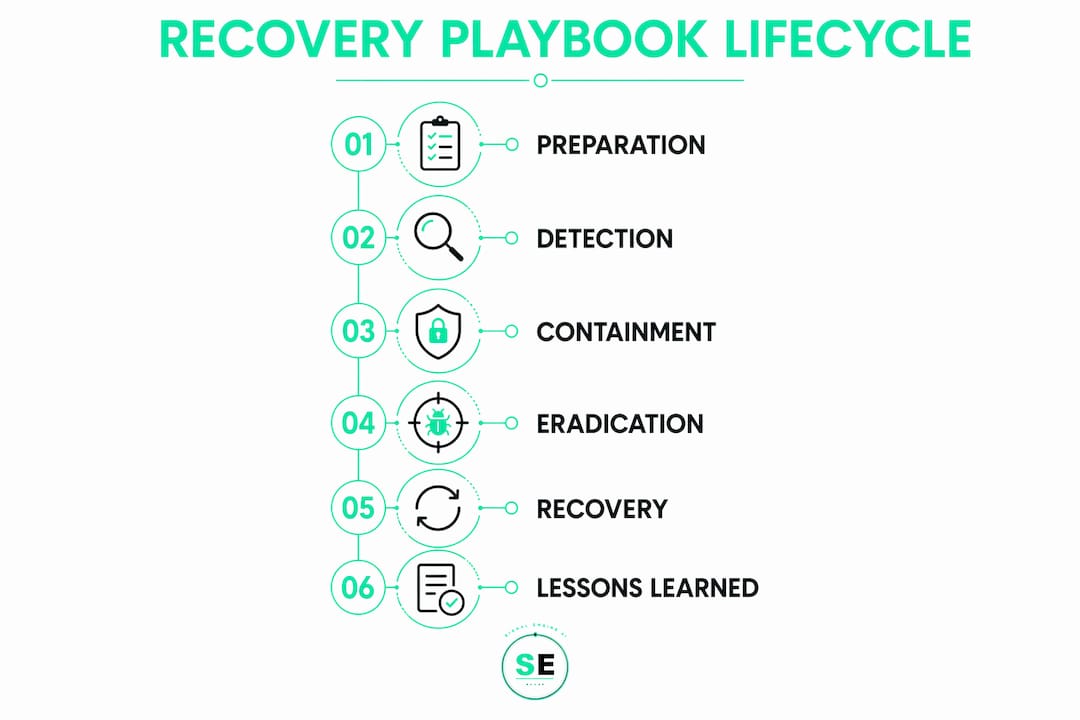
The NIST SP 800-61 framework defines a 4-phase lifecycle for incident response: Preparation, Detection and Analysis, Containment and Eradication and Recovery, and Post-Incident Activity. Aligning your playbook to this structure gives you a proven governance model and makes audits straightforward.
Maintenance is where most playbooks fail. An outdated playbook is not neutral. It actively misleads your team during a crisis. Update every playbook within 48 hours of any incident it was used for. Assign a named owner responsible for each playbook's accuracy. Schedule peer reviews quarterly.
Pitfalls to avoid:
- Outdated contact lists and escalation paths
- Steps written for tools your team no longer uses
- No defined owner for playbook maintenance
- Drills that test the document but not the people
- Automation that runs without a human checkpoint
Automating at-risk account alerts is one practical way to connect your recovery playbook to real-time customer signals, so your team acts before a small issue becomes a lost account.
Pro Tip: Add a reflection prompt at the end of every playbook: "What would have made this faster?" Answers from real incidents are worth more than any theoretical review.
Key Takeaways
Recovery playbooks work because they replace improvised crisis response with a repeatable, verified system that protects revenue, reduces downtime, and keeps customers informed.
| Point | Details |
|---|---|
| Start with structure | Every playbook needs triggers, named owners, decision logic, and communication templates to function. |
| Prioritize by revenue impact | A recovery priority matrix ensures P1 systems restore in 4 hours, not after lower-priority work. |
| Validate before you need it | Quarterly backup recoverability testing cuts recovery time by 20–40% and reduces failed restores to near zero. |
| Update within 48 hours | Stale playbooks cause misinformation; update every playbook within 48 hours of any incident it was used for. |
| Drill with your actual team | 45-minute recurring drills build real response confidence and reveal role gaps before a real crisis does. |
Why most recovery playbooks collect dust instead of saving revenue
I have reviewed recovery plans across dozens of businesses, and the pattern is almost always the same. The playbook exists. It lives in a shared drive. Nobody has touched it since the consultant who built it left. When an incident hits, the team improvises anyway.
The problem is not the document. The problem is that most leaders treat a recovery playbook as a compliance artifact rather than a living operational tool. A playbook that does not get drilled does not get used. A playbook that does not get updated after incidents becomes a liability, not an asset.
The businesses that actually recover fast share one trait: leadership treats the playbook as a product with an owner, a version history, and a release schedule. They run drills. They update after every incident. They connect the playbook to real-time signals so the trigger fires automatically, not after someone notices something is wrong.
The other insight I keep coming back to is the balance between automation and human judgment. Automation handles the repeatable steps fast and without error. But the decision points, the moments where context matters, still need a human. The best playbooks I have seen are explicit about which steps are automated and which require a named person to make a call. That clarity is what separates a playbook that runs in a crisis from one that gets abandoned.
If you are a business leader reading this, the single most valuable thing you can do this week is pick your top three revenue-critical systems and ask: "Do we have a tested, current playbook for each one?" If the answer is no, that is your starting point. Not a full audit. Not a consultant engagement. Just three playbooks, owned, drilled, and updated.
— Bernard
Signalengine turns revenue signals into recovery plays automatically
Recovery playbooks protect what you have already built. Signalengine helps you see what is at risk before it becomes an incident worth recovering from.

Signalengine's AI-powered revenue intelligence watches your customers, scores their behavior, and flags who is about to leave before they do. It identifies revenue leaks across your accounts, auto-generates email and SMS recovery campaigns, and tells your team exactly which accounts need attention right now. For SMBs in HVAC, logistics, dental, real estate, and 8 other verticals, Signalengine connects the early warning signal to the recovery action automatically. You get the playbook trigger built in. See it live and watch it score your real customer data in minutes.
FAQ
What is a recovery playbook?
A recovery playbook is a structured, scenario-specific guide that prescribes exact actions, decision points, and roles for restoring operations after an incident. It combines automation and human steps to reduce downtime and protect revenue.
How do recovery playbooks reduce revenue loss?
Recovery playbooks cut revenue loss by accelerating response time and preventing cascade failures through embedded checkpoints. Quarterly backup validation testing alone can reduce recovery time by 20–40%.
What are the key components of a recovery playbook?
The core components are triggers, an orchestrator, named roles, decision logic, automated actions, and communication protocols. A recovery priority matrix categorizes systems by criticality and assigns recovery time objectives to each tier.
How often should recovery playbooks be updated?
Playbooks should be updated within 48 hours after any incident they were used for. Peer reviews and full audits should happen at least quarterly to catch outdated contacts, tools, and procedures.
What is a recovery priority matrix?
A recovery priority matrix ranks systems by business criticality and assigns target recovery times to each tier. P1-critical systems restore within 4 hours; P4-low-priority systems can wait up to a week.
Ready to Stop the Revenue Leak?
Signal Engine gives small and local businesses 31 AI-powered tools to score leads by buying intent, predict churn before it happens, auto-generate email and SMS campaigns, and recover missed calls automatically — all in one dashboard starting at $49/month.
Start your free 7-day trial — no credit card required. Setup takes 5 minutes.