

A lead scoring model ranks prospects by how likely they are to buy and how well they fit your ideal customer, usually expressed as a 1 to 100 score or a probability percentage. Start with a rules-based model if you have fewer than a few dozen labeled conversions to learn from, then move to predictive scoring once you have enough closed-won and closed-lost history to train against. Keep fit and intent as two separate scores. Combining them into one number hides which lever, targeting or timing, actually needs fixing.
TL;DR:
- Rules-based models are suitable for small teams with limited data, but most should shift to predictive models once they have at least 40 qualified and 40 disqualified leads.
- Separately scoring fit and intent allows more accurate routing, with fit indicating customer profile and intent reflecting active buying signals.
- Predictive models outperform static rules by capturing complex relationships, but they require ongoing monitoring, retraining, and high-quality data hygiene to remain effective.
- The top metric to prove lead scoring success is top-decile lift, showing how much better high-scored leads convert compared to average prospects.
- Small businesses can adopt AI-powered scoring platforms like Signal Engine to automate scoring, routing, and CRM writeback without a dedicated data science team.
Table of Contents
- What Lead Scoring Actually Does for Revenue Teams
- The Model Types, and When Each One Fits
- Why Fit and Intent Need Two Separate Scores
- Building a Lead Scoring Model Step by Step
- Predictive vs. Rules-Based: When the Switch Is Worth It
- The Signals That Matter and How to Keep Them Clean
- Proving the Model Works: Metrics That Matter
- Where Lead Scoring Models Go Wrong
- What to Require From a Lead Scoring Platform
- How Signal Engine Fits Into This Workflow
- Start Small, Prove Lift, Then Scale Up
- Ready to Stop the Revenue Leak?
- Sources
- FAQ
What Lead Scoring Actually Does for Revenue Teams
A score is a shorthand for "how much attention does this lead deserve right now." Most platforms represent it as a number from 1 to 100, though some predictive systems output a raw conversion probability instead, like 0.34 for a 34% chance of closing. Either way, the number exists to answer one question fast: does this lead go to an account executive today, into a nurture sequence, or nowhere at all.
Score-to-routing mapping is where the model earns its keep. A common setup sends scores above 80 straight to a sales rep, scores between 50 and 79 into a warm nurture track with lighter-touch outreach, and anything under 50 into long-term email nurture or no action. Get the thresholds wrong and you either flood your reps with cold leads or bury a hot prospect in a drip campaign until they buy from someone else.
The business outcomes to watch after deployment:
- Faster follow-up on hot leads — reps spend time on prospects who convert instead of chasing everyone equally.
- Higher conversion rate on sales-worked leads because the queue is pre-filtered.
- Shorter sales cycles when reps stop wasting calls on low-fit accounts.
- Better marketing-to-sales handoff quality, measured by how often sales actually works the leads marketing sends.
Track these against a pre-scoring baseline. Without a "before" number, you cannot prove the model did anything.
The Model Types, and When Each One Fits
Not every team needs machine learning on day one. Match the model to your data maturity and team size.
- Rules-based point systems. You assign points for actions and attributes (demo requested: +20, visited pricing page: +10, competitor domain: -15) and set a threshold. Fast to build, easy for sales to understand, and simple to adjust in an afternoon. The tradeoff is maintenance drag. Someone has to keep tuning the weights by hand as buyer behavior shifts.
- Firmographic and demographic scoring. This layer scores stable attributes like company size, industry, and job title. It rarely changes week to week, which makes it a solid foundation for a fit score, but it says nothing about timing.
- Behavioral and engagement scoring. This tracks what a prospect does right now: email opens, page visits, webinar attendance, pricing page revisits. It is volatile by design and answers the timing question fit scoring cannot.
- Negative scoring. Subtracting points for red flags, like a personal email domain, a job title with no buying authority, or a competitor visiting your site, keeps unqualified leads out of your reps' queues without extra manual filtering.
- Predictive machine learning models. These learn weights directly from your historical conversions instead of relying on someone's best guess. Predictive lead scoring outperforms static rules because it captures non-linear relationships and interaction effects, like the fact that a mid-size manufacturing lead who visits pricing twice converts at a very different rate than a similar lead who visits once. Microsoft's own Dynamics 365 documentation sets a practical floor for this approach: you need at least 40 qualified and 40 disqualified leads in your training window before the model has enough signal to learn from.
- Relational models. These read across connected tables (CRM, product usage, billing, email engagement) instead of a single flat lead record. That structure surfaces colleague signals and content-sequence patterns a flat model simply cannot see, and relational approaches can produce substantially higher top-decile lift than point systems once you have the connected data to feed them.
Most teams do not pick one and stay there forever. The realistic path is rules first, predictive next, relational once your data infrastructure catches up.
Why Fit and Intent Need Two Separate Scores
Fit measures whether a lead matches your ideal customer profile: company size, industry, tech stack, budget signals. Intent measures whether they are actively in a buying window right now: pricing page visits, demo requests, competitor research. Blend these into a single number and you get a mediocre score that hides which problem you actually have. A high-fit, low-intent lead and a low-fit, high-intent lead can land on the exact same combined score, but they need completely different plays.
Compute fit and intent as separate sub-scores, then combine them for routing logic instead of for reporting. A multiplicative combination (fit score × intent score) punishes leads that score zero on either axis, which is usually what you want. Additive combination is more forgiving and works better if your fit criteria are broad.
Routing by quadrant looks something like this:
- High fit, high intent → route to an AE immediately, same-day follow-up.
- High fit, low intent → nurture with educational content until intent signals rise.
- Low fit, high intent → light-touch sales qualification call to confirm fit before committing rep time.
- Low fit, low intent → automated nurture only, no manual sales time.
Pro Tip: Show both sub-scores on the lead record, not just the combined number. When a rep sees "Fit: 85, Intent: 22" instead of a flat "54," they instantly know whether to sell or educate.
Building a Lead Scoring Model Step by Step
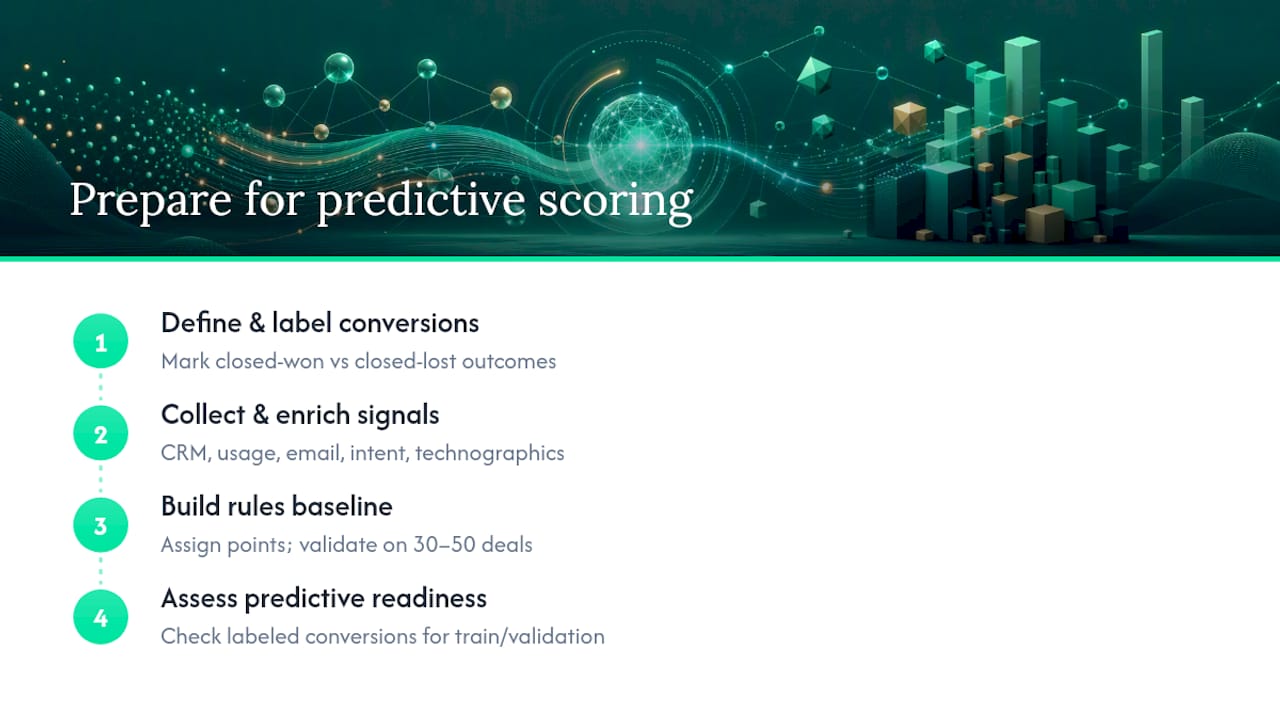
1. Define your conversion event and label historical data. Decide exactly what "closed-won" means for your business (signed contract, first payment, whatever fits) and pull a clean set of past leads tagged with that outcome, plus a matching set of closed-lost leads.
2. Collect and enrich the signals you need. Pull CRM fields, product usage events if you have a free trial or freemium tier, email engagement data, third-party intent data, and technographic details like the tools a prospect already uses.
3. Build a deterministic rules baseline first. Assign point values based on what your sales team already believes matters, then validate that baseline against your last 30 to 50 closed-won and closed-lost deals before you touch anything predictive. This single step catches most of the obvious mistakes cheaply.
4. Check whether you have enough data to go predictive. You need a meaningful volume of labeled conversions, not just leads, split into training and validation sets, with feature windows that reflect how long your sales cycle actually runs.
5. Set thresholds and routing rules, then wire the score to write back into your CRM automatically, along with an explanation of the top two or three factors driving each score.
6. Operationalize monitoring. Log every score, track distribution over time, and set a retrain cadence before you launch, not after something breaks.
The 40/40 threshold: Microsoft's Dynamics 365 predictive scoring requires a minimum of 40 qualified and 40 disqualified leads in your chosen training window before it will even train a model. If you are below that, stay rules-based and keep collecting labels.
Teams that skip step 3 and jump straight to predictive modeling almost always regret it. A rules baseline gives you something to compare the fancy model against, and half the time the fancy model's early output looks suspiciously similar to the rules you already had.
Predictive vs. Rules-Based: When the Switch Is Worth It
Predictive scoring earns its complexity once you have the data to support it, but it is not automatically the better choice for every team. Here is how the tradeoff actually breaks down.
- Minimum data. Treat 40 qualified and 40 disqualified leads as an absolute floor per the Dynamics 365 guidance, but more history produces a more stable model. A company closing five deals a month will wait a long time to hit a comfortable sample size.
- Explainability. Logistic regression stays interpretable and is a reasonable starting model with modest data. Gradient-boosted trees like XGBoost or LightGBM trade some interpretability for accuracy as your data volume grows. Deep learning is rarely worth the added complexity at typical B2B lead volumes.
- Operational cost. Rules-based scoring needs a marketing ops person and a spreadsheet. Predictive scoring needs someone who can monitor drift, retrain models, and explain outputs to a skeptical sales team.
A hybrid approach often makes the most sense: predictive weights where you have enough labeled data, backed by lightweight guardrail rules for edge cases the model has not seen enough of yet.
The Signals That Matter and How to Keep Them Clean
Not every data point deserves equal weight. Prioritize signals in roughly this order:
- First-party engagement — email opens, webinar attendance, content downloads, and especially pricing page or demo-request events, which tend to be the strongest intent signals you own.
- Firmographic data — company size, industry, and revenue band, which anchor your fit score.
- Technographic data — the tools and platforms a prospect already runs, useful for both fit and competitive displacement plays.
- Third-party intent data — external signals showing a company is researching your category. Treat this as a supporting signal, not a standalone trigger, since coverage and accuracy vary by provider.
Data hygiene determines whether any of this actually works. Canonicalize company names so "Acme Inc." and "Acme, Inc." don't split into two separate accounts. Dedupe contacts before they hit your scoring engine. Normalize job titles so "VP of Sales" and "Vice President, Sales" score identically. A model built on messy inputs will confidently produce garbage, and a messy CRM undermines scoring the same way it undermines forecasting.
Proving the Model Works: Metrics That Matter
Three metrics separate a model that works from one that just looks sophisticated: AUC (how well the model ranks converters above non-converters), calibration (whether a score of 70 actually means roughly a 70% chance of conversion), and top-decile lift (how much better your top 10% of scored leads convert compared to your average lead). Precision at k, meaning how many of your top-k scored leads actually convert, is the metric sales cares about most because it maps directly to their daily queue.
Backtest every new model against historical closed-won and closed-lost records before it goes live, and build a lift chart to visualize how conversion rate changes by score decile.
| Metric | What it measures | Good target |
|---|---|---|
| AUC | Ranking quality of scored leads | Above 0.75 is generally solid |
| Calibration | Whether stated probability matches actual outcome | Predicted and actual rates within a few points |
| Top-decile lift | Conversion rate of top 10% vs. baseline | Several times the baseline conversion rate |
| Precision@k | Real conversion rate of top-k leads | Matches your sales team's real close rate on that segment |
A well-calibrated model should show a strong top-decile lift, with your best-scored leads converting at multiples of your baseline rate. That lift number is also the fastest way to get sales leadership to trust the model, because it translates directly into "these are the leads worth calling first."
Monitor score distribution and feature drift monthly, and treat quarterly revalidation as the minimum acceptable cadence, not an aspirational one.
Where Lead Scoring Models Go Wrong
Most scoring failures are process failures, not math failures.
- Set-and-forget models. Weights that made sense a year ago rarely still reflect current buyer behavior, and rules-based systems degrade quietly because nobody notices until pipeline quality drops. Revalidate at least quarterly.
- One confusing combined score. If reps cannot tell whether a 60 means "decent fit, weak timing" or the reverse, they will eventually stop trusting the number entirely. Show fit and intent separately.
- Inconsistent conversion definitions. If sales and marketing disagree on what counts as closed-won, your training labels are garbage before the model ever runs. Standardize the definition in writing.
- Sales distrust. Reps ignore scores they cannot explain. Surface the top two or three factors behind each score, and lead with top-decile lift numbers when you present the model, since that is the evidence that actually changes minds.
Pro Tip: Put the revalidation date on your team calendar the same day you launch the model, not three months later when someone finally notices conversion rates slipping.
What to Require From a Lead Scoring Platform
Vendors and in-house builds tend to fall into a few buckets: CRM-native scoring tools bundled into platforms like Dynamics 365 or Salesforce, standalone AutoML tools, dedicated revenue intelligence platforms, and newer relational ML systems that read across connected tables instead of flat lead records.
Whichever category you evaluate, require these capabilities before you sign anything:
- CRM writeback so scores and their explanations live where reps already work.
- Real-time scoring rather than overnight batch updates that miss same-day intent spikes.
- Explainability on every score, not just an aggregate accuracy report.
- Automated retrain scheduling so the model doesn't silently drift for a year.
- Native integrations with your CRM, email platform, and any product usage data you track.
RevOps should also confirm data security practices and access controls before connecting production CRM data to any third-party scoring tool.
How Signal Engine Fits Into This Workflow
Some revenue intelligence platforms build the scoring and routing pieces of this playbook directly into one dashboard rather than a stack you have to wire together yourself. Such solutions can cover several stages of the workflow above without extra engineering lift:
- Real-time scoring that updates as prospects engage, instead of waiting on an overnight batch job.
- Automated playbooks that suggest the next action once a lead crosses a routing threshold.
- CRM writeback so scores and explanations show up where reps already work.
- Churn detection running alongside lead scoring, since retention and acquisition pull from the same behavioral signal set.
Teams evaluating lead scoring software built for small business budgets can use this as a lighter-weight alternative to assembling separate tools for scoring, playbooks, and CRM sync.
Start Small, Prove Lift, Then Scale Up
Visibility beats sophistication in the first 90 days. Get scores writing back to your CRM and show top-decile lift before you touch anything predictive. Run a simple experiment: build a rules baseline, validate it against 30 to 50 recent deals, then only consider predictive modeling once that baseline holds up. Bring sales into the threshold conversation early. A model they helped calibrate is a model they will actually use.
— Bernard
Ready to Stop the Revenue Leak?
Signal Engine gives small and local businesses 31 AI-powered tools to score leads by buying intent, predict churn before it happens, auto-generate email and SMS campaigns, and recover missed calls automatically — all in one dashboard starting at $49/month.
You don't need a data science team to run the kind of build-and-validate playbook this article just walked through. Signal Engine handles the scoring, the routing, and the CRM writeback automatically, so your reps see fit and intent broken out on every lead the moment it crosses a threshold, without anyone hand-tuning point values in a spreadsheet. Compare Signal Engine Growth pricing against what it would cost to hire even a part-time RevOps analyst to maintain a rules-based system by hand, and once you have your scoring model running, pair it with a lead nurturing strategy to keep the high-fit, low-intent quadrant warm until they're ready to buy.
Start your free 7-day trial — no credit card required. Setup takes 5 minutes.
Sources
- Configure predictive lead scoring - Microsoft Dynamics 365
- How to build a lead scoring model (Clay)
- Kumo
FAQ
What Is a Lead Scoring Model?
A lead scoring model ranks prospects using points, probabilities, or both to indicate how likely they are to convert and how well they match your ideal customer profile, typically expressed as a number from 1 to 100.
How Much Data Do I Need for Predictive Lead Scoring?
Microsoft's Dynamics 365 guidance sets a practical floor of 40 qualified and 40 disqualified leads in your chosen training window; below that, stick with a rules-based model.
Should Fit and Intent Be the Same Score?
No. Combining fit and intent into one number hides which problem you have, targeting or timing, so most teams score them separately and combine them only for routing logic.
How Often Should I Retrain a Lead Scoring Model?
Quarterly revalidation is the practical minimum, since rules-based weights and predictive model accuracy both drift as buyer behavior changes.
What Metric Proves a Lead Scoring Model Is Working?
Top-decile lift, the conversion rate of your top 10% scored leads compared to your baseline rate, is the clearest signal, and it is also the number that tends to convince skeptical sales teams to trust the score.
Can Small Businesses Use Predictive Lead Scoring?
Yes, once they have enough labeled conversion history; platforms like Signal Engine's lead scoring tools are built specifically for small teams that need real-time scoring without a dedicated data science hire.