

Real-time lead scoring delivers faster qualification, sharper prioritization, and measurable revenue gains that batch scoring simply cannot match. The core difference is timing: batch models refresh scores overnight or weekly, while real-time systems score a lead the moment they fill out a form, open an email, or visit a pricing page. That gap matters because practitioner data shows scoring within 2 to 5 minutes preserves the conversion advantage of fast follow-up, while delays past 30 minutes erode it fast.
Here's what you can expect to measure once real-time scoring is running:
- Conversion lift in the 15% to 50% range depending on how mature your scoring model is
- Faster speed-to-lead, often cut from hours to minutes
- Fewer false-positive MQLs clogging your sales team's queue
- Reps spending less time guessing which lead to call first
Key Takeaways
Real-time lead scoring works because it shortens the gap between buyer intent and rep action, and that gap is where most revenue quietly leaks away.
| Point | Details |
|---|---|
| Speed-to-lead is the core lever | Score leads within 2 to 5 minutes to preserve the full conversion advantage. |
| Separate fit from intent | Score account fit and buying intent independently, and show both to reps. |
| Expect measurable lift | Conversion improvements commonly range from 15% to 50% depending on model maturity. |
| Govern the model, don't just launch it | Retrain every 4 to 8 weeks and require intent bundles to avoid false positives. |
| Start small with Signal Engine Growth | Signal Engine Growth automates scoring and churn prediction for SMB teams from day one. |
Table of Contents
- Real-Time Lead Scoring Benefits Sales Teams Feel Immediately
- How Real-Time Lead Scoring Actually Works
- A Pilot Playbook for Testing Real-Time Scoring
- Metrics and ROI You Can Actually Defend to Finance
- Where Real-Time Scoring Pilots Go Wrong
- How Signal Engine Puts This Into Practice for SMBs
- Ready to Stop the Revenue Leak?
- Sources
- FAQ
Real-Time Lead Scoring Benefits Sales Teams Feel Immediately
The advantages of real-time lead evaluation show up in three places: how fast you respond, who you call first, and how much revenue that combination generates. Here's the breakdown by benefit, with the mechanics behind each one.
1. Speed-to-lead becomes a built-in habit, not a hope
Speed-to-lead is the single biggest lever in this list. Practitioner research consistently shows that responding to leads within minutes rather than hours dramatically improves qualification rates. Real-time scoring makes that window achievable because a rep doesn't have to wait for a lead to show up on a report. The score, and the routing decision behind it, happens the moment the signal fires.
Pro Tip: Set your internal SLA at 5 minutes for hot-scored leads and track how often reps actually hit it. Most teams find the gap between their stated SLA and their real average response time is the first thing worth fixing.
2. Prioritization gets specific instead of generic
Old-school lead scoring often collapses everything into one number. Better systems separate fit (does this account match your ideal customer profile) from intent (is this person actively behaving like a buyer right now). Practitioner guidance backs treating fit and intent as separate dimensions, because a perfect-fit account with zero recent activity is a very different lead than a mid-fit account that just requested three demos in a week. Reps need to know which is which, and they need to see why a lead scored the way it did, not just the number itself.

3. Conversion and revenue impact are the real payoff
This is where the business case lives. Practitioner-reported outcomes put AI-driven scoring conversion lift between 15% and 50%, with the wide range reflecting differences in data quality, model maturity, and how well routing is set up downstream. A team going from spreadsheet-based scoring to a real-time model with clean enrichment tends to land toward the higher end of that range in the first two quarters.
By the numbers: Teams that shrink their lead response window from hours to minutes see qualification rates climb sharply, according to aggregated practitioner benchmarks on real-time scoring performance.
4. Sales productivity climbs because guesswork disappears
Reps waste hours every week manually sorting leads, checking who filled out what form, and guessing who's worth a callback. Real-time scoring routes the hottest leads straight to the right rep's queue, often with the scoring drivers attached. That's time returned to actual selling. Combine that with automated outreach sequencing and the productivity gain compounds, since the rep isn't just prioritized correctly, they're also freed from manual follow-up tasks.
5. Funnel hygiene improves across the board
Marketing teams have long struggled with false MQLs, leads marked "qualified" that sales immediately rejects. Real-time scoring reduces this because it's evaluating live behavior instead of a stale weekly snapshot. A lead that goes cold after an initial spike gets deprioritized automatically instead of sitting in the MQL bucket for a week. Nurture flows also get smarter: leads that aren't ready yet get routed to a drip sequence instead of a sales call, which keeps both funnel stages honest.
6. Forecasting accuracy tightens up
When lead quality signals update live, pipeline forecasts stop lagging reality. Sales leaders get a more current read on which deals are actually moving, because the underlying lead and account scores reflect this week's behavior, not last month's. That accuracy matters most during board reporting and quota planning, when a stale pipeline view can lead to bad hiring or spending decisions.
How Real-Time Lead Scoring Actually Works
Optimizing lead scoring starts with understanding the mechanical loop underneath it. Real-time systems run on four data types feeding a continuous cycle:
- Behavioral signals — page visits, email opens, demo requests, pricing page views
- Firmographic data — company size, industry, revenue band
- Technographic data — what software stack a prospect already runs
- Third-party intent data — buying signals pulled from outside your own website, like intent data aggregators tracking research behavior across the web
Those signals flow through a loop: capture, enrichment, score, route, and CRM writeback. A lead fills out a form (capture), the system pulls in company and contact details from an enrichment provider (enrichment), a model or rules engine assigns a score (score), the CRM assigns it to the right rep or queue (route), and the score along with its drivers gets written back into the CRM record (writeback) so the rep sees it without leaving their normal workflow.
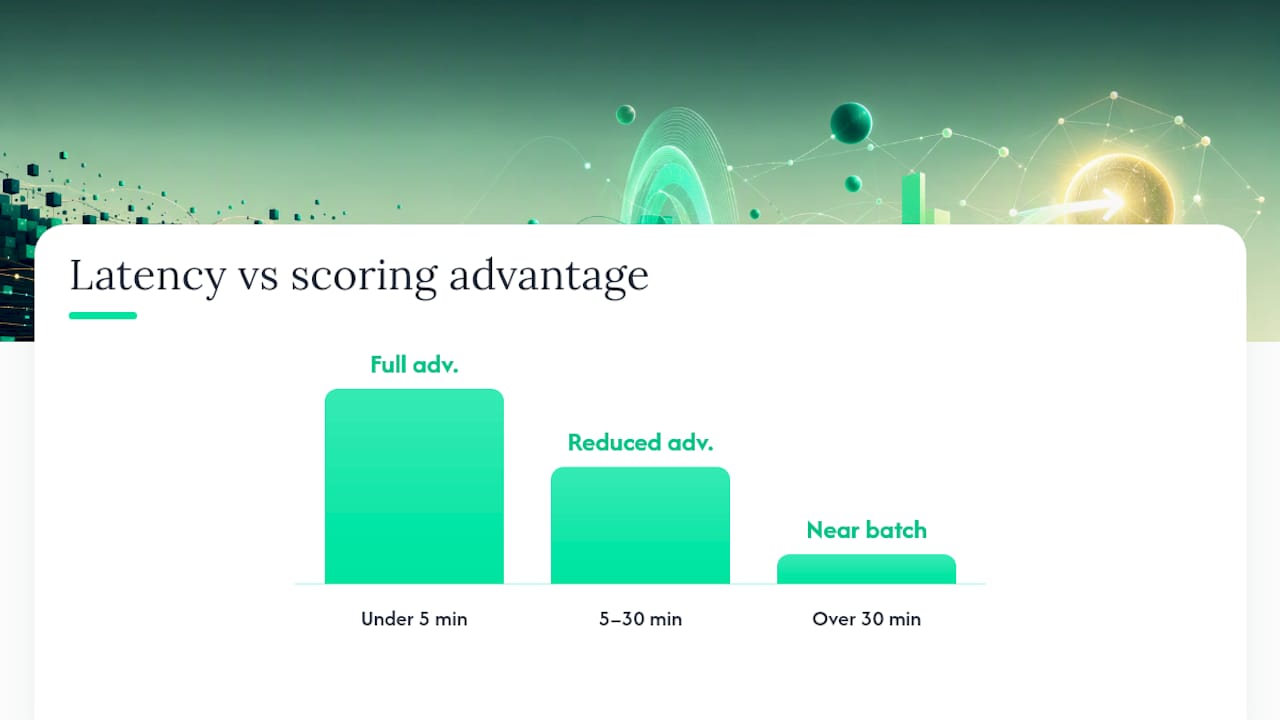
Operational "real time" has a specific definition worth knowing. Practitioner benchmarks put it at 2 to 5 minutes from capture to scored record, not truly instantaneous. That window still preserves nearly all of the speed-to-lead advantage. Push past 30 minutes and the benefit starts collapsing toward what batch scoring already delivers.
| Latency Window | Practical Effect |
|---|---|
| Under 5 minutes | Full speed-to-lead advantage preserved |
| 5 to 30 minutes | Advantage still present but diminishing |
| Over 30 minutes | Performance converges toward batch scoring |
Three technical factors determine whether you actually hit that window: API latency on your enrichment provider, match rate (how often the enrichment call actually finds usable firmographic data), and how fast the CRM writeback completes. A slow enrichment API or a low match rate is usually the first thing to break a real-time scoring pilot, according to operational analysis of enrichment bottlenecks.
The last piece, driver visibility, is what turns a score from a black box into something reps trust. Surfacing the top three factors behind a score directly in the CRM record, rather than burying them in a separate dashboard, is one of the clearest differentiators between scoring systems that get adopted and ones reps quietly ignore.
A Pilot Playbook for Testing Real-Time Scoring
You don't need a company-wide rollout to prove this works. A tight pilot answers the ROI question in weeks, not quarters.
- Pick one channel and one ICP segment. Don't try to score every lead source at once. Choose your highest-volume channel, inbound demo requests, for example, and one ideal customer profile segment you already understand well.
- Define fit versus intent scoring logic. Decide what firmographic traits count as "fit" and what behaviors count as "intent" before you write a single scoring rule. If you're training a machine learning model instead of using rules, this is also when you build your labeled training set from historical won and lost deals.
- Set SLA targets and baseline metrics before you flip the switch. Record your current speed-to-lead average and your current MQL to SQL conversion rate. Without a baseline, you can't prove the pilot worked.
- Choose your enrichment and routing architecture. Confirm the enrichment provider's API latency and match rate meet your speed requirements, and verify CRM writeback actually populates the fields reps will see.
- Run it, measure it, then iterate. Give the pilot enough lead volume to be statistically meaningful, generally a few hundred scored leads at minimum, before drawing conclusions. Plan to retrain or recalibrate the model every 4 to 8 weeks as buying behavior shifts.
Pro Tip: Run the pilot on a single sales pod first, not your whole team. It's easier to diagnose whether a problem is the model or the reps when you're only debugging one group's workflow.
Metrics and ROI You Can Actually Defend to Finance
Justifying the investment means tracking three tiers of metrics: operational, model quality, and business outcome.
Operational metrics tell you if the system is running as designed:
- Speed-to-lead (time from capture to first rep contact)
- SLA compliance rate (percentage of leads contacted within your target window)
- Time-to-first-touch by channel and by rep
Model and quality metrics tell you if the scoring itself is accurate:
- MQL to SQL conversion rate broken out by score band (your top band should convert meaningfully better than your bottom band, or the model isn't working)
- Enrichment match rate (how often the system actually finds usable firmographic data)
Business outcome metrics are what you bring to a budget conversation:
- Conversion lift, typically in the 15% to 50% range depending on maturity
- Sales cycle length, measured before and after the pilot
- Revenue per rep, calculated as closed revenue divided by active reps over the same period
Adoption context: AI-driven automation use among marketers continues to expand, with Statista tracking rising adoption of AI automation use cases across marketing functions, a sign that real-time scoring is moving from early-adopter territory into standard practice.
Present your results as a straightforward before-and-after comparison. Baseline speed-to-lead, baseline MQL to SQL rate, and baseline revenue per rep on one side; the same three numbers from your pilot period on the other. That framing is what makes finance teams say yes to a full rollout instead of asking for another quarter of data.
Where Real-Time Scoring Pilots Go Wrong
Most failed pilots don't fail because the technology doesn't work. They fail because of predictable calibration and trust problems.
- Black-box scores kill adoption. If reps can't see why a lead scored an 85, they'll stop trusting the number within a few weeks.
- Single-signal spikes create false positives. One pricing page visit shouldn't spike a score to "hot." Require intent bundles, multiple corroborating behaviors, before triggering a high score, and apply decay windows so old activity stops counting after a set period.
- Stale enrichment data quietly degrades accuracy. If your enrichment provider's data hasn't refreshed in months, your firmographic scoring is working off outdated information.
- Missing CRM context frustrates reps. A score with no explanation attached is a number reps will eventually ignore.
The fixes are mostly governance, not technology. Build a retrain cadence (every 4 to 8 weeks is a reasonable starting point), close the loop by having reps label outcomes so the model learns from real wins and losses, and enforce your SLA targets the same way you'd enforce a quota.
Compliance deserves a mention here too. If your scoring and outreach touch email campaigns, your team still needs to follow CAN-SPAM requirements for commercial messaging. If you operate in a healthcare-adjacent vertical and any scored data touches protected health information, HIPAA's security and privacy rules apply to how that data gets stored and used, not just how it's marketed. A partner guide on responsible lead data handling is worth a read before you scale any automated outreach layered on top of your scoring.
Pro Tip: Build your decay window and intent bundle rules before you launch, not after your first false-positive complaint from a rep.
How Signal Engine Puts This Into Practice for SMBs
Signal Engine Growth was built for the exact problem this article describes: small and midsize revenue teams that need real-time lead scoring but don't have a data science team to build it. The platform automatically scores leads by buying intent, predicts churn before it happens, and writes results straight back into your workflow, no manual exports, no waiting on IT.
For SMB pilots, expect a fast path to value:
- Setup measured in minutes, not weeks
- Automated scoring live from day one, no model training required upfront
- Churn prediction and buying-intent scoring running side by side in one dashboard
- Pricing starting at Signal Engine Growth, built for teams without enterprise budgets
A 30-day pilot with Signal Engine typically looks like this: connect your CRM and lead sources in the first week, let the signal scoring engine run against live traffic for two to three weeks, then compare your speed-to-lead and MQL to SQL numbers against your pre-pilot baseline.
This article was written with input from Bernard, drawing on the operational and revenue-focused principles outlined above.
Where To Start (and Where To Wait)
If you're deciding where to spend the next quarter's effort, start with inbound demo requests and pricing page visitors. Those are your clearest buying-intent signals, and scoring them in real time produces the fastest, most visible wins.
Hold off if your CRM is a mess. Real-time scoring built on top of duplicate records, missing fields, or years of unqualified junk data will just make bad decisions faster. Clean the data first.
Smaller teams, five to twenty reps, tend to see value quicker than large enterprise sales orgs, mostly because there's less internal process to rewire. SMB verticals with high lead volume and short sales cycles, HVAC, real estate, dental, are where I'd point a first pilot every time.
Ready to Stop the Revenue Leak?
Signal Engine gives small and local businesses 31 AI-powered tools to score leads by buying intent, predict churn before it happens, auto-generate email and SMS campaigns, and recover missed calls automatically — all in one dashboard starting at $49/month.
Start your free 7-day trial — no credit card required. Setup takes 5 minutes.
Sources
For deeper reading on the compliance side, the FTC's CAN-SPAM compliance guide covers commercial email obligations, and HHS HIPAA guidance addresses protected health information handling. For adoption context, Statista's AI automation data tracks marketer usage trends, and Coefficient's lead scoring breakdown covers fit versus intent scoring in more depth.
- CAN-SPAM Act: A compliance guide for business
- HIPAA for professionals: laws & regulations
- AI automation use cases by marketers worldwide
- Coefficient
FAQ
How much should you pay for lead scoring software?
Pricing varies widely by feature depth and lead volume, but SMB-focused platforms like Signal Engine Growth start at $49 a month, far below enterprise platforms that typically require annual contracts and dedicated implementation teams.
Can you give an example of lead scoring in action?
A prospect who visits your pricing page, opens two emails, and matches your ideal customer profile's company size would score higher than someone who only downloaded a single blog post, because the combination of fit and intent signals outweighs a single low-intent action.
How does real-time lead scoring actually work?
It runs a continuous loop: a lead's behavior gets captured, enriched with firmographic and technographic data, scored by a model or rules engine, then routed to a rep with the score written back into the CRM, usually within 2 to 5 minutes.
What is the best CRM for tracking scored leads?
The best fit depends on your existing stack, but the more important factor is whether your scoring tool writes scores and drivers directly back into whatever CRM you already use. Signal Engine's scoring approach is built to integrate with common CRMs rather than requiring you to switch platforms.
What counts as a good conversion lift from real-time scoring?
Practitioner-reported outcomes typically fall between 15% and 50%, with results toward the higher end usually tied to clean enrichment data and a well-calibrated fit-versus-intent model.