

Pipeline hygiene is the ongoing discipline of keeping CRM opportunity data accurate, current, and complete: correct stages, realistic close dates, no duplicate records, and no deals rotting untouched for weeks. Clean it up and your forecast accuracy climbs fast, because reliable forecasting depends on the underlying data quality, not just the model you run it through. The single fastest win: a weekly hygiene routine paired with two automations, a push counter and a stale-deal auto-close rule.
TL;DR:
- Most teams rely on weekly pipeline hygiene routines and automation to prevent stale deals, duplicate records, and inaccurate stage or close date data.
- Implementing a push-counter and auto-park rules for stagnant opportunities can significantly reduce phantom pipeline within a quarter.
- Tracking five key metrics weekly—stage accuracy, close-date concentration, stale percentage, duplicate rate, and required-field completion—directly improves forecast reliability.
- Automation should flag issues rather than automatically delete deals, with manual review or manager override for high-stakes opportunities.
- Clear ownership by reps, managers, and RevOps, along with a phased rollout of automation, ensures sustainable pipeline hygiene without eroding trust.
Table of Contents
- What Counts as Good Pipeline Hygiene?
- Priority Fixes and Automation Recipes to Run This Week
- What Metrics Actually Signal Healthy Pipeline Hygiene?
- How Do You Automate Hygiene Without Breaking Trust?
- Who Owns Pipeline Hygiene on Your Team?
- An Applied Example: Mapping Hygiene Practices to Signal Engine
- Why I'd Never Fully Automate Pipeline Judgment Calls
- Ready to Stop the Revenue Leak?
- Sources
- FAQ
What Counts as Good Pipeline Hygiene?
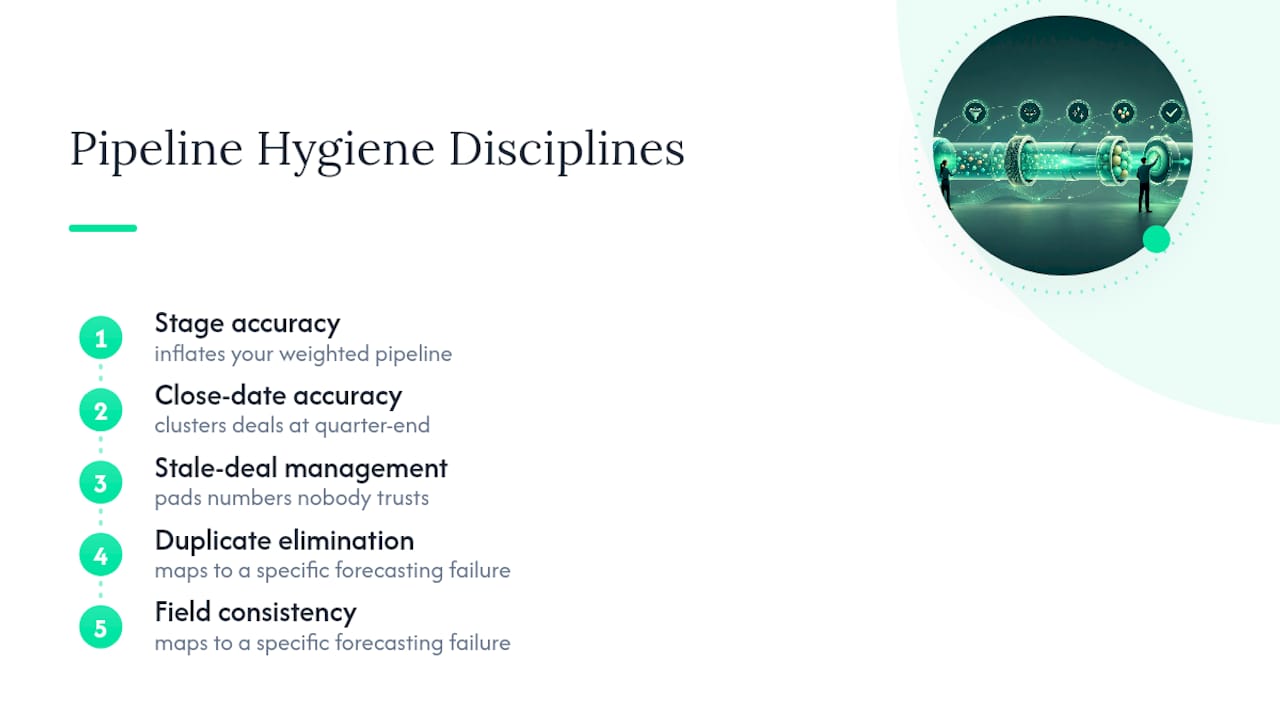
Good pipeline hygiene comes down to five disciplines: stage accuracy, close-date accuracy, stale-deal management, duplicate elimination, and field consistency. Fairview's framework treats these as the core components of pipeline hygiene, and it holds up because each one maps to a specific forecasting failure. Wrong stage assignment inflates your weighted pipeline. Bad close dates cluster deals at quarter-end regardless of reality. Stale deals sit in "active" status for months, quietly padding numbers nobody trusts.
Here's the uncomfortable part: most teams already know this. What they lack isn't awareness, it's a repeatable weekly cadence and the automation to enforce it without turning RevOps into a full-time data-janitor role. That's where the fixes below come in.
Priority Fixes and Automation Recipes to Run This Week
You don't need a six-month cleanup project. You need a short list of fixes, run in order, this week.
- Fix close-date discipline first. Pull every open deal with a close date inside the current or next fiscal period and flag any that haven't moved stage in 30+ days. Close-date concentration at quarter-end is one of the most common hygiene failures RevOps teams see, and it's the fastest one to correct manually before automating.
- Build a push-counter field. Every time a rep moves a close date forward without a stage change, increment a counter on the opportunity. Three or more pushes without progress triggers a manager review flag, not an auto-delete.
- Auto-park stage-0 stagnant opportunities. Deals sitting in early stages with zero activity for 21+ days get auto-moved to a "parked" status rather than staying in active pipeline math. This alone can cut phantom pipeline meaningfully within a quarter when paired with manager sign-off.
- Lock down opportunity creation. Require deal source, next step, and expected close date before a rep can save a new opportunity. Half of your future hygiene problems start at creation, not decay.
- Enforce next-step and timestamp every stage entry. No "next step" field, no forward progress. Timestamp each stage transition so stage-duration alerts (covered below) have something to measure against.
- Run a monthly de-duplication pass. Match on account name plus close-date proximity, flag likely duplicates, and route them to the account owner for a manual merge rather than an automatic one.
- Stand up a hygiene scorecard on the admin dashboard. One view, refreshed weekly, showing stage accuracy, stale percentage, and duplicate count per rep.
Pro Tip: Never let automation silently delete or reassign a deal. Flag it for the rep or manager first. A deal that looks stale might be a slow enterprise sale, and killing it automatically breaks trust in the entire system.
Communication matters here as much as the rules themselves. Roll these out with a short note explaining why the push counter exists and what triggers a manager conversation, not a punishment.
What Metrics Actually Signal Healthy Pipeline Hygiene?
Five numbers tell you almost everything: stage accuracy, close-date concentration, percentage of stale pipeline, duplicate rate, and required-field completion. Track these weekly, not quarterly.
- Stage accuracy: the share of deals whose CRM stage matches actual buyer behavior, verified through call notes or meeting activity.
- Close-date concentration: what percentage of open pipeline shares the exact same close date. Anything above 25% clustered at period-end is a warning sign.
- Stale percentage: deals with no logged activity in 14+ days. Industry estimates put 40 to 60% of pipeline in a typical B2B CRM in stale territory when nobody's enforcing hygiene.
- Duplicate rate: duplicate opportunities per 100 active deals.
- Required-field completion: percentage of open deals with next step, close date, and deal source populated.
The weekly audit itself takes about 45 minutes. A manager pulls the stale-deal report Monday morning, a rep works the list before Wednesday, and the manager reviews outcomes (updated, parked, or genuinely still active) by Friday. Run this every week and your hygiene scorecard starts feeding directly into forecast confidence, because leadership stops discounting the numbers by a mental "fudge factor."
How Do You Automate Hygiene Without Breaking Trust?
Automation only works if it flags problems, not deletes them. Here's the implementation order that keeps reps on your side.
- Build the push-counter field as a custom number field, incrementing on any close-date change without a corresponding stage move. Filter your manager dashboard on counter ≥ 3.
- Add stage-entry timestamps to every opportunity stage, then set an alert when a deal exceeds your average stage duration by 50% or more.
- Set auto-park thresholds separately from auto-close thresholds. Park means "hidden from active pipeline, still owned." Close-lost means "gone." Never auto-close; only auto-park, with a manager override checkbox to pull it back.
- Auto-fill enrichment fields like company size or industry from your data provider on creation, refreshed monthly, so reps aren't manually typing static data.
- Pull activity signals from call logs and calendar data, not just CRM manual entries. Reps forget to log activity; your phone system and calendar rarely do.
The most common pitfall: rolling out enforcement before reps trust the rules. Running automations in flag-only mode for two to four weeks, reviewing what would have triggered, and adjusting thresholds before flipping on enforcement avoids the backlash that kills adoption.
Pro Tip: Start with three automations only: push counter, stage-0 auto-park, and required-field enforcement. Layer in stage-duration alerts and duplicate detection after the first three are running clean.
Who Owns Pipeline Hygiene on Your Team?
Hygiene fails when it's everyone's job and no one's responsibility. Split it clearly.
- Reps own daily updates: next steps, activity logging, close-date accuracy on their own deals.
- Managers own the weekly audit, stale-deal review, and any override on auto-parked opportunities.
- RevOps owns the automation rules, the scorecard, field requirements, and quarterly threshold recalibration.
Treating hygiene as a systems problem instead of a discipline problem is the mindset shift that actually works. System-level enforcement combined with manager review outperforms relying on rep willpower alone. Pair that with light incentives, recognition for the cleanest pipeline each month, a one-time "amnesty" window when you first roll out new rules, and adoption climbs without resentment. Pilot the rules on one team for a month before rolling out company-wide, and measure adoption by push-counter trigger rate dropping over time, not just by scorecard color.
An Applied Example: Mapping Hygiene Practices to Signal Engine
Some revenue intelligence platforms surface the exact signals this playbook depends on: stale-deal flags, push-counter tracking, and duplicate detection, pulled automatically instead of built by hand in spreadsheet formulas.
- Automated weekly scorecards replace manual pipeline pulls, which is the 30/90/180-day hygiene support model many SMB revenue teams use to phase in enforcement.
- During a weekly audit, a manager can pull a ranked list of the top 10 hygiene issues (oldest stale deals, highest push counts, most likely duplicates) instead of sorting a raw export.
- The pipeline tracking layer ties these signals to deal intelligence, so a flagged deal comes with context, not just a warning.
This is one applied example of the recipes above in action, not the only path. The principles, weekly cadence, flag-first automation, manager review, matter more than which platform runs them.
Why I'd Never Fully Automate Pipeline Judgment Calls
Automation should catch the obvious cases, the deal that's been in "negotiation" for 90 days with no activity, not the six-figure enterprise deal moving slowly through legal review. High-stakes or complex deals still need a human look before anything gets parked or flagged as suspect. Run new rules in flag-only mode first, watch what they catch, and adjust thresholds before enforcement goes live. Automation without governance just moves the mess somewhere new.
— Bernard
Ready to Stop the Revenue Leak?
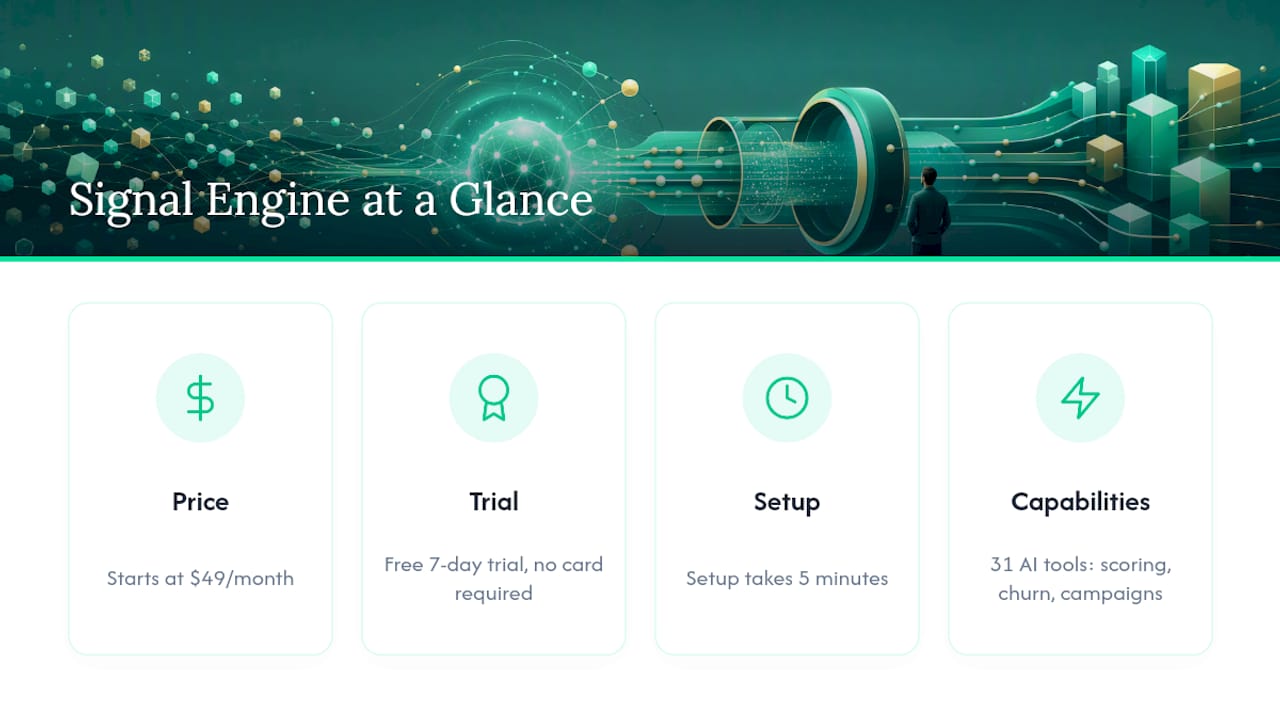
Signal Engine gives small and local businesses 31 AI-powered tools to score leads by buying intent, predict churn before it happens, auto-generate email and SMS campaigns, and recover missed calls automatically, all in one dashboard starting at $49/month. If you're already running the audit routine above by hand, Signal Engine Free turns the stale-deal sweep, push-counter tracking, and duplicate flags into a scorecard that builds itself every week.
For teams weighing whether to build this in-house or adopt a platform, the revenue intelligence tools built for small business start at the same price point as a single lost deal.
Start your free 7-day trial, no credit card required. Setup takes 5 minutes.
Sources
For deeper detail beyond this playbook: Fairview's pipeline hygiene glossary covers the five-discipline framework; Prospeo's automation playbook details rollout sequencing; ORM's revenue analytics glossary covers stale-pipeline benchmarks; FlowForce's hygiene mistakes guide covers governance pitfalls; and Crono's weekly audit guide offers a four-field audit checklist.
- Pipeline Hygiene: Definition — Fairview
- Pipeline Hygiene: The 2026 Playbook for Clean Data
- Pipeline Hygiene: Data Quality, Currency, and Cleanliness Standards
FAQ
What Does Pipeline Hygiene Mean?
Pipeline hygiene means keeping CRM opportunity data accurate and current, correct stages, realistic close dates, no duplicates, and no abandoned deals still marked active.
What Are the Five Stages of a Sales Pipeline?
Most B2B pipelines run through prospecting, qualification, proposal, negotiation, and closed (won or lost), though exact stage names vary by company and CRM setup.
What Does Pipeline Mean in Sales Work?
In sales, a pipeline is the set of open opportunities moving through defined stages toward a close, used to forecast future revenue based on stage and probability.
Can Automation Replace Manual Pipeline Reviews Entirely?
No. Automation should flag stale deals, push counters, and duplicates for review, but complex or high-value opportunities still need a manager's judgment before any status change.