

A PQL (product qualified lead) is someone who has used your product enough to show real buying readiness. An MQL (marketing qualified lead) is someone who has engaged with your marketing and fits your ideal customer, but hasn't used the product yet. The difference is the signal: MQLs raised a hand with content, PQLs proved interest with behavior. If you run a free trial or a free plan, PQLs are usually your hottest leads. If you don't, MQLs are your starting point.
This guide covers both definitions, the signals behind each, how to route them, the benchmarks teams quote, and how a small team can decide which model to run.
TL;DR
- MQL = qualified by marketing engagement (downloads, webinars, pricing page visits, form fills) plus fit with your ideal customer.
- PQL = qualified by in-product behavior on a free plan, trial or limited tier that shows the user reached real value.
- PQLs tend to convert better and faster because they have already experienced the product. They exist only if you offer a trial or free tier.
- Small teams should start with a simple yes/no PQL rule and keep MQL scoring for visitors who haven't signed up.
- Hand off fast, with context. A rep who sees what the lead actually did can open with something specific.
Table of Contents
- What PQL and MQL mean
- PQL vs MQL at a glance
- The signals that make a PQL
- The signals that make an MQL
- Why PQLs usually convert better
- When to use PQL, MQL, or both
- How to hand off PQLs and MQLs to sales
- How to tell whether your qualification is working
- Our perspective
- Put buying signals to work
- FAQ
- Sources
- Ready to Stop the Revenue Leak?
What PQL and MQL mean
An MQL is a person whose marketing engagement passes a scoring threshold. The engagement includes things like downloads, webinar attendance, pricing page visits and form fills, plus fit with the ideal customer profile. Typical examples are ebook and template downloads, webinar registrations, newsletter subscriptions and contact form submissions.
A PQL is a user or account whose behavior inside the product, on a free plan, trial or limited tier, shows they have reached value and look ready to buy more. In plain terms, a PQL has experienced meaningful value in the product. Nobody had to guess from an ebook download.
Think of it this way:
- MQL: "This person is interested in what we do."
- PQL: "This person already uses what we do, and it's working for them."
If you want the marketing-to-sales handoff side of the picture, our guide to MQL vs SQL and how to hand off leads covers the third stage in that chain.
PQL vs MQL at a glance
| MQL | PQL | |
|---|---|---|
| Qualified by | Marketing engagement plus fit | Product usage plus fit |
| Typical signals | Downloads, webinars, form fills, pricing page visits | Activation, repeat use, inviting teammates, hitting plan limits |
| Needs a trial or free plan? | No | Yes |
| What the lead already knows | Your messaging | Your product |
| Typical first sales conversation | Discovery | Upgrade or expansion, based on what they already do |
| Scoring style | Point-based scoring | Often a yes/no rule with mostly binary inputs |
The core split, as one product-led growth source puts it, is that MQLs show interest while PQLs have experienced value. PQLs also need to be getting significant value, which is the extra bar on top of the fit and intent checks used for MQLs.
The signals that make a PQL
Product signals differ by product, but they fall into a few families:
- Activation: the user finished setup or reached the "aha" moment.
- Depth: usage is climbing toward a plan limit.
- Team spread: they invited colleagues.
- Hand-raising: pricing page visits, support requests, or questions about limits.
These are the kinds of signals described in a PQL definition cheat sheet. Two well-known examples show how specific a threshold can be. Slack reportedly found that teams exchanging 2,000 messages had genuinely tried the product, and Dropbox's signal was a user placing one file in the product during their first session.
Some companies call any trial signup a PQL. Others require a key action, such as uploading a financial document during an accounting software trial. The second approach is stricter and usually gives sales a cleaner list.
How to pick your PQL threshold
Start from your customers, not from a template:
- List the paying customers you're happiest with.
- Look at what they did in their first one to two weeks.
- Find the actions most of them share: connecting a data source, using a core feature on several different days, inviting a teammate, hitting a limit.
- Turn the two or three strongest actions into your rule.
This mirrors the advice to base criteria on actions retained paying customers took early. Review the rule every quarter. If sales says the leads are cold, tighten it. If sales is starving, loosen it.
The signals that make an MQL
MQL scoring combines two things:
- Fit: industry, company size, role, location, whether they look like your best customers.
- Intent: what they did, such as a pricing page visit, a demo form, a webinar or a guide download.
Fit without intent is a contact list. Intent without fit is a student downloading your ebook. You need both before a lead is worth a rep's time. If you're building this from scratch, our lead scoring setup guide for small businesses walks through it, and the piece on buyer intent scoring dimensions shows which behaviors deserve the most weight.
Why PQLs usually convert better
A PQL has already seen the product work. As one payments company's guide notes, the sales team only has to convince them to upgrade. An MQL still has to be convinced the product is worth trying at all.
Benchmark figures circulate widely. Vendor and agency write-ups put PQL-to-paid conversion around 20% to 30%, and one RevOps guide reports PQLs closing at 15% to 25% versus 2% to 5% for MQLs, with a median close time of 14 days against 45. Treat these as directional. Your own numbers depend on your price, your audience and how you define each stage, so track your baseline before you compare.

When to use PQL, MQL, or both
Here is the practical decision for a small business.
Use PQLs when:
- You offer a free trial, a free plan or a freemium tier.
- Your product can be understood by using it, without a sales call.
- You can see usage data per user or account.
Use MQLs when:
- There is no self-serve trial: the buyer needs a quote, a site visit or a demo first (think HVAC, dental, logistics, real estate).
- Most of your leads arrive through content, ads, referrals, calls or forms.
- You want to rank visitors who haven't signed up for anything.
Use both when you have a free tier and also a lot of top-of-funnel traffic. MQLs cover people who haven't touched the product. PQLs cover people who have. The two feed the same sales queue, with different openers.
A good rule of thumb: the closer a lead is to real usage, the more weight usage should carry. A person who visited your pricing page twice is interesting. A person who visited it after inviting three teammates is a priority.
Don't over-engineer it
One source suggests that binary PQL definitions work better for most companies below Series B, and scoring pays off once volume reaches around 500 signups a month. For a small team that means a short checklist beats a 40-rule scoring model. Start with "did they do these two things in the product, and do they fit?" Add points later.
How to hand off PQLs and MQLs to sales
Qualification is only half the job. The handoff decides whether the lead turns into revenue.
Route by fit and by what the lead knows
A sensible routing pattern:
- PQL, strong fit, team usage: straight to an account executive or whoever closes. Within one business day is a reasonable target.
- PQL, weak fit or a single user: keep in product-led nurture with automated tips and prompts.
- MQL, strong fit: to a sales development rep or the owner for discovery, because they showed interest but never used the product.
- MQL, weak fit: marketing nurture only.
Getting the rules written down matters more than the exact model. This overview of inbound lead routing rules, models and setup steps is a helpful reference when you map who gets which lead.
Open with the behavior
A PQL handoff goes wrong when the message ignores what the lead did. One guide says the rep should see exactly what the user has done in-product, because generic "noticed you signed up" outreach kills conversion. Compare:
- Weak: "Saw you signed up. Want a demo?"
- Strong: "You've connected your customer list and invited two teammates this week. Want help setting up the follow-up flow before your trial ends?"
The second message proves you pay attention. It also needs no research from the rep, because the context came with the lead. For more ideas on tailoring outreach, this piece on lead nurturing strategies pairs well with a PQL playbook.
The best moment often comes when an account suddenly adds several users in a short window. That usually means an internal champion is rolling the tool out, and a timely message about team plans lands well.
Who should make the call
For smaller deals, rep-led outreach from a development rep makes sense. For much larger contracts, going straight to an account executive is often better, according to one analysis of product-qualified accounts. Most small service businesses sit at the first end: the owner or one salesperson handles everything, so speed matters more than org charts.
How to tell whether your qualification is working
Watch four numbers:
- Share of signups that become PQLs. A commonly quoted healthy range is 5% to 15%. Too loose floods sales with random leads. Too tight, around 0.5%, starves them.
- PQL-to-paid conversion. Compare it with your MQL-to-customer rate.
- Time to close. PQLs should close faster.
- Sales feedback. If reps ignore the list, the rule is wrong, whatever the dashboard says.
For a deeper look at proving a scoring model works, see our guide to lead scoring models and proving lift in 90 days.
Our perspective
Most small businesses don't have a lead problem. They have a signal problem. Leads come in, someone follows up when there's time, and the ones who were ready to buy last Tuesday go quiet by Friday.
We built Signal Engine around that gap. It scores customers and prospects on buy-readiness from the behavior it can see, flags who is about to churn, and drafts the next action. Nothing reaches a real customer until you approve it with one click.
The PQL idea is right: behavior beats guesswork. Whether the behavior is a trial login, a repeat visit, a reply to a text or a missed call, the question is the same. Who is ready now, and what should you say to them? You shouldn't need a data team to answer it.
Our advice: write down your two or three strongest buying signals this week, score against them, and follow up inside a day. That alone beats most elaborate scoring setups.
Bernard
Put buying signals to work
Signal Engine is built to score every lead and customer on buy-readiness, catch churn early and draft the next outreach for your approval. It works whether your signal is product usage, a pricing page visit or a missed call. Our lead scoring software is designed for small teams that don't have time to dig through data.
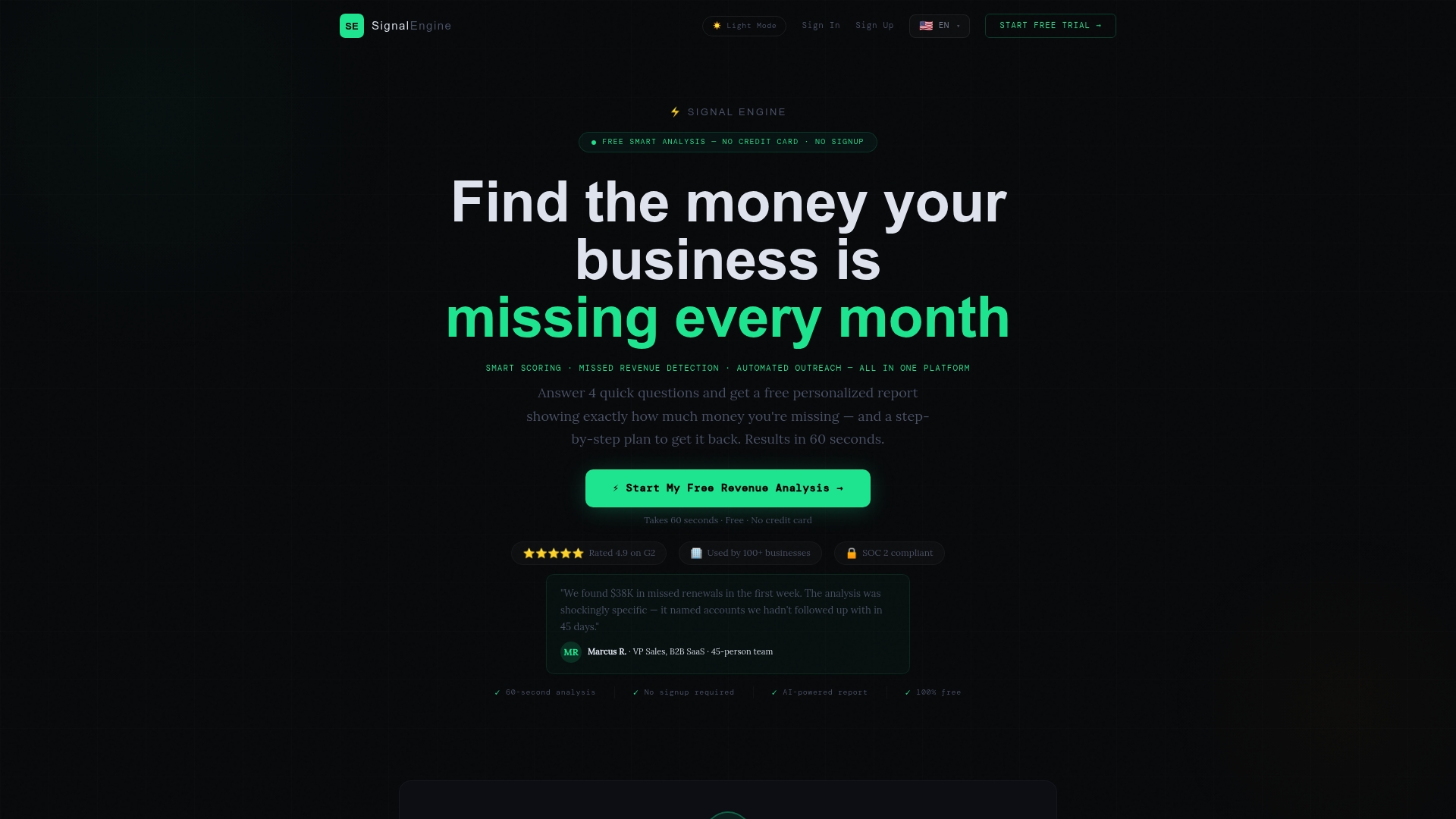
You can see how it works in the live demo or compare plans on the pricing page.
FAQ
What is the main difference between a PQL and an MQL?
The signal. An MQL qualifies through marketing engagement, like downloads, webinars and form fills, plus fit. A PQL qualifies through product usage on a trial or free plan. PQLs have already experienced value, so the sales conversation starts from what they do rather than what they read.
Can a business without a free trial use PQLs?
Not in the strict sense, because a PQL depends on in-product behavior. If you sell services or need a demo first, use MQL-style scoring built on the signals you do have: pricing page visits, form fills, calls and replies. You can add PQLs later if you launch a trial or free tier.
Is a PQL better than an MQL?
Usually a PQL is closer to buying, and published benchmarks suggest higher conversion and faster closes. But they aren't competing. MQLs fill the top of the funnel with people who haven't tried anything yet, and the best setups use both.
How many signups should become PQLs?
One commonly cited range is 5% to 15% of free signups. If almost everyone qualifies, the rule is too loose. If almost no one does, it's too tight. Adjust it using sales feedback and your own conversion data.
What comes after a PQL or MQL?
An SQL, a sales qualified lead, which a rep has vetted and accepted. Our MQL vs SQL guide explains that step.
Sources
- Product-Qualified Lead (PQL) | Demand Spring
- PQL vs MQL: Product vs Marketing Qualified Leads
- How to Define PQLs: A Cheat Sheet for Product-Led Growth
- MQL vs SQL - Marketing and Sales Qualified Leads Guide | Amplitude
- What Is a Product-Qualified Lead? | Shopify
- Product Qualified Lead (PQL): Definition, Examples | Vemetric
- Product-qualified leads (PQLs) | Paddle
- Product-Qualified Lead (PQL): Definition & Benchmarks | AdSights
- Product qualified leads: where PQL scoring breaks | Ziellab
- Product-Qualified Lead (PQL): Definition, Scoring | Startup Fundraising
- Product-Qualified Accounts: Why PQAs Are Replacing MQLs
- Inbound Lead Routing: Rules, Models and Setup Steps
- Lead nurturing explained: Boost conversions with effective strategies
Ready to Stop the Revenue Leak?
Signal Engine gives small and local businesses 31 AI-powered tools to score leads by buying intent, predict churn before it happens, auto-generate email and SMS campaigns, and recover missed calls automatically — all in one dashboard starting at $49/month. Start your free 7-day trial — no credit card required. Setup takes 5 minutes.