

An MQL (marketing-qualified lead) is a prospect who has engaged with your marketing and looks interested. An SQL (sales-qualified lead) is a prospect that sales has vetted and judged ready for a direct sales conversation. MQLs come first, and they become SQLs once they hit a score threshold or show stronger buying signals, followed by a sales check. The hard part is not the definitions. It is deciding where the line sits in your business and making sure no good lead falls through it.
TL;DR
- MQL = interest. The lead downloaded, subscribed or attended. Marketing owns and nurtures it.
- SQL = intent plus fit. The lead asked for a demo or pricing, and sales confirmed a real buying case. Sales owns it.
- Define both in writing. Companies draw the line differently, so your definitions, score threshold and follow-up time limit matter more than any textbook version.
- Benchmarks are wide. Median MQL-to-SQL conversion for enterprise B2B sits around 13 to 26%. Use it as a sanity check, not a target.
- Leaks happen at the handoff. Slow follow-up and vague criteria cost you the leads you already paid for.
Table of Contents
- What is an MQL?
- What is an SQL?
- MQL vs SQL side by side
- Which comes first, MQL or SQL?
- How to decide when an MQL becomes an SQL
- What is a good MQL-to-SQL ratio?
- Where the MQL-to-SQL handoff leaks revenue
- Is the MQL model still the right model?
- Our perspective: stop counting leads, start reading signals
- How Signal Engine handles the handoff
- Choosing your MQL and SQL rules by business type
- A simple one-week plan to fix your handoff
- FAQ
- Sources
- Ready to Stop the Revenue Leak?
What is an MQL?
A marketing-qualified lead is someone who has shown enough interest through marketing activity to deserve continued attention, but is not yet ready for a sales call. Typical MQL behavior, per Shopify's guide, includes downloading a whitepaper or subscribing to a newsletter.
More examples you will recognize from your own inbox:
- Downloaded a buyer's guide or checklist
- Attended a webinar or watched a recorded one
- Opened several emails and clicked through to your blog
- Visited your site repeatedly and read three or four articles
- Followed you on social and filled out a short form
None of these says "I want to buy this month." They say "I am learning." That is why an MQL goes into nurturing, not onto a rep's call list. Marketing keeps feeding it relevant content until a predefined threshold, such as a lead score or a specific action, triggers a handoff to sales for review.
What is an SQL?
A sales-qualified lead is a prospect that sales has looked at and decided is worth a direct conversation. The signals are stronger and more personal. Examples from the same Shopify guide: requesting a demo or asking about pricing.
In practice, an SQL usually has several of these:
- Asked for a demo, quote or estimate
- Replied to a sales email with a real question
- Visited the pricing page more than once
- Matches your ideal customer profile (right size, right type, right location)
- Has a need you can name and a person who can say yes
One useful way to think about it comes from the Revenue Puzzles lifecycle playbook: MQL and SQL are decisions, not levels of "heat." An MQL decision asks whether marketing has enough evidence to justify sales attention. An SQL decision asks whether sales has verified a credible buying case. That framing keeps you from arguing about whether a lead is "warm enough" and pushes you to ask what evidence you actually have.
MQL vs SQL side by side
| MQL | SQL | |
|---|---|---|
| Stage | Earlier in the funnel | Later, closer to a deal |
| Main signal | Engagement with content | Buying intent and fit |
| Typical actions | Whitepaper download, newsletter signup, webinar | Demo request, pricing inquiry, reply to a rep |
| Owner | Marketing | Sales |
| Next step | Nurture with relevant content | Discovery call, proposal, quote |
| Who decides | Score or rule | A person on the sales side |
| Risk if mishandled | Sent to sales too early, reps lose trust | Left waiting, lead goes to a competitor |
The ownership split is the standard model: marketing owns and nurtures MQLs, sales owns SQLs and focuses on selling. Small teams often blur it, because the owner is both marketing and sales. The labels still help, because they force you to separate "interested" from "ready."
Which comes first, MQL or SQL?
MQL comes first. A typical path looks like this:
- A stranger finds you (search, referral, ad, a Google Business listing).
- They engage and become a lead.
- Marketing nurtures them. They cross your threshold and become an MQL.
- Sales reviews the lead, makes contact and checks need, budget, authority and urgency.
- If it holds up, the lead becomes an SQL. Then comes an opportunity, then a close.
Not every lead follows this order. A homeowner whose furnace just died calls you directly. That person skips the MQL stage entirely and is an SQL the moment they ask for a quote. Do not force a straight line on buyers who do not behave like one.
How to decide when an MQL becomes an SQL
The honest answer is that there is no universal rule. Companies define MQLs and SQLs differently, so your first job is to define what each means for your organization. Here is a simple way to do it.
Step 1: Describe your best customers
Pull your last 20 to 30 paying customers. Note their size, type, location, what they did before buying and how long it took. This is your fit profile, and it is the basis for everything else.
Step 2: Pick behavior signals and weight them
Not every action matters equally. A pricing-page visit says more than a blog view. A reply to an email says more than an open. Behavioral indicators, lead-score thresholds, response time and sales capacity can all inform the MQL-to-SQL transition. If you want a framework for scoring intent, our guide to buyer intent scoring and its six dimensions walks through it, and the lead scoring setup guide for small business shows how to put numbers on it.
Step 3: Set the threshold and the qualification checks
Choose a score at which a lead becomes an MQL and a second condition that makes it an SQL, such as a demo request or a confirmed need. Leads typically fail sales qualification when they lack a defined need, budget, authority or urgency. Write those four checks into your process so a rep can accept or reject a lead in a minute.
Step 4: Agree on a response-time promise
A two-way service-level agreement (SLA) sets a timeframe for sales follow-up. Marketing promises a quality standard for what it sends. Sales promises to act within a set window, and to say why when it rejects a lead. For a small team, this can be one sentence on a shared doc: "Every demo request gets a call or text within one business hour."
Step 5: Review monthly
Look at which MQLs became SQLs and which SQLs closed. Adjust the score weights. If reps keep rejecting leads, your threshold is too low. If almost nothing reaches sales, it is too high.
What is a good MQL-to-SQL ratio?
The calculation is simple: divide the number of SQLs by the number of MQLs in the same period, then multiply by 100.
Worked example: you generate 400 MQLs in a quarter and sales accepts 72 of them as SQLs. 72 ÷ 400 = 18%.
For context, MarketingProfs reports that for enterprise B2B, median MQL-to-SQL conversion is around 13 to 26%. The same source puts SQL-to-opportunity at roughly 50 to 62%, and opportunity-to-close at roughly 15 to 30%.

Chained together, those medians show why the top of the funnel feels expensive. Using the figures above at the low end, 100 MQLs would give about 13 SQLs, about 7 opportunities and 1 to 2 closed deals. That is rough arithmetic on enterprise medians, not a forecast for a four-person plumbing company with a short sales cycle.
A few cautions when you read any benchmark:
- Your definition changes the number. A loose MQL definition produces a low ratio. A strict one produces a high ratio and fewer leads. Neither is automatically better.
- Enterprise medians are not small-business medians. Local service businesses often have shorter cycles and phone-first buyers.
- Track the trend, not the snapshot. A ratio that rises after you tighten scoring means something. A single number compared with a blog post does not.
Where the MQL-to-SQL handoff leaks revenue
A misaligned handoff can waste resources, overlook high-potential leads and drag down conversion. Here are the leaks we see most often in small businesses.
- Slow follow-up. The lead asked for pricing at 9 a.m. and heard back the next afternoon. By then they had talked to someone else.
- No shared definition. Marketing thinks a webinar attendee is ready. Sales thinks they are a tire-kicker. Both are partly right, and nobody wrote it down.
- Missed calls and forms. A call that rings out is an SQL that never got counted. For service businesses, this is often the biggest leak of all.
- No feedback loop. Sales rejects a lead and never says why, so marketing sends more of the same.
- Dropping rejected leads. A lead that is not ready today is not dead. Send them back to nurture instead of deleting them.
That last point matters. Companies that excel at lead nurturing generate 50% more sales-qualified leads at 33% lower cost. The same article argues that nurturing should guide prospects through their awareness journey with relevant sequences instead of stopping after one offer. If you are building those sequences, this overview of lead nurturing strategies is a good place to start, and our HVAC lead nurturing playbook shows what a nurture track looks like for a local trade.
Is the MQL model still the right model?
It depends on how you sell. Some B2B marketers are shifting away from MQL-focused metrics toward qualified buying groups and longer-term customer relationships. The same piece argues for moving beyond chasing MQL volume and focusing on engagement quality and letting buyers control their journey.
That does not mean the vocabulary is useless. It means the labels should serve you, not the other way around. A few practical adjustments:
- If you sell to companies with several decision-makers, score the account, not just the person. Our account-based marketing checklist covers that.
- If you sell to households or local businesses, you may need only two states: "interested" and "ready to talk." That is an MQL and an SQL by another name.
- If most of your revenue comes from existing customers, the key signal is not a new lead at all. It is a current client going quiet. Churn warnings matter as much as lead scores.
Our perspective: stop counting leads, start reading signals
We built Signal Engine for small service businesses that do not have time to dig through data. Here is what that taught us about MQLs and SQLs.
First, the label is less important than the evidence behind it. A lead score is only useful if it reflects what real buyers in your industry do before they buy. A dental practice, an HVAC contractor and a church all have different signals. That is why we built industry-specific modes instead of one generic dashboard.
Second, speed beats sophistication. A basic definition with a fast response will outperform a perfect model with a 24-hour lag. Real-time scoring helps because it tells you who is hot while they are still on the page. We cover that in our piece on real-time lead scoring benefits.

Third, nothing should reach a customer without a human saying yes. Our platform drafts the next action and holds it for one-click approval. You keep control of every message, and you skip the blank-page problem.
Fourth, qualification does not end at the sale. The same signals that tell you a lead is ready also tell you when a customer is slipping away. If you run a service business, build both into one routine.
— Bernard
How Signal Engine handles the handoff
Signal Engine scores every contact on buy-readiness, so your MQL threshold and your SQL triggers are based on real behavior instead of guesswork. It flags customers who are about to churn, recovers missed calls, and drafts email and SMS follow-ups for your approval. Every plan includes every feature, with no per-seat pricing. Growth is $149/month and Scale is $297/month, and there is a free plan to start with. You can see how it works in our lead scoring software overview.
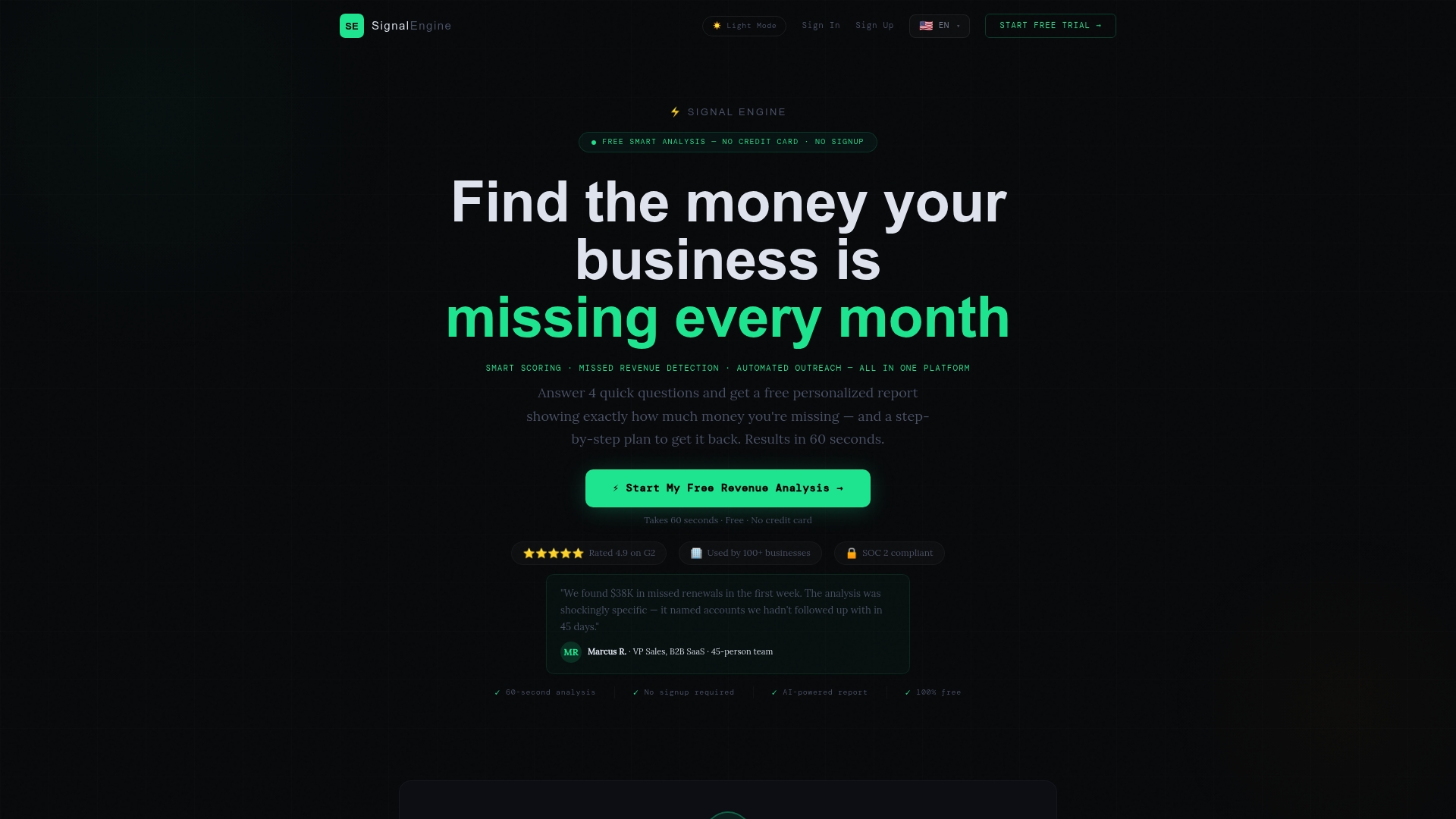
Want to see it on your own pipeline first? Try the live demo or compare options on the pricing page.
Choosing your MQL and SQL rules by business type
The definitions shift with your sales motion. Use these as starting points, then adjust to your data.
| Business type | Likely MQL | Likely SQL |
|---|---|---|
| Local home services | Opened a seasonal offer, clicked a maintenance reminder | Called, texted or booked an estimate |
| Dental or medical practice | Read a service page, joined an email list | Requested an appointment or consultation |
| Agency or consultancy | Downloaded a guide, attended a webinar | Replied with a scoped project need and budget |
| Small SaaS | Signed up for a newsletter or free trial | Hit key product usage and asked about pricing |
| Church or nonprofit | Visited, signed up for updates | Asked to join a group, volunteer or give |
Two of these rows deserve a note. In home services, the gap between MQL and SQL can be a single phone call, so missed-call recovery is the most important handoff you have. For SaaS, product usage is often a stronger SQL signal than any content download, which is why we wrote about automating churn intervention for SaaS teams alongside lead scoring.
If you want to test whether your scoring actually works, our guide to lead scoring models and proving lift in 90 days shows how to compare scored and unscored leads.
A simple one-week plan to fix your handoff
You do not need a new system to start. Try this:
- Day 1: Write your MQL and SQL definitions in two sentences each.
- Day 2: List the five behaviors that most often come before a purchase.
- Day 3: Assign a rough point value to each and set a threshold.
- Day 4: Agree on a response-time promise and who owns each lead stage.
- Day 5: Check how many leads in the last 30 days went unanswered for more than a day.
- Weekend: Pick one lead type to nurture instead of discard.
Then watch the ratio. If you want to go deeper on what prospects do before they convert, see our guide on how to analyze prospect engagement.
FAQ
What is the main difference between an MQL and an SQL?
An MQL has shown interest through marketing engagement, such as downloading content or subscribing. An SQL has shown buying intent, such as requesting a demo or asking about pricing, and sales has confirmed there is a real opportunity. In short, MQL means "interested," and SQL means "ready to talk to sales."
Can a lead skip the MQL stage?
Yes. A prospect who calls or books a quote on the first visit can become an SQL immediately. This is common in local service businesses. The MQL stage exists for people who need nurturing first, not as a gate everyone must pass.
What is a good MQL-to-SQL conversion rate?
For enterprise B2B, median MQL-to-SQL conversion is around 13 to 26%. Your own number depends heavily on how strictly you define an MQL and how fast you follow up. Compare yourself to your own past quarters before you compare to anyone else.
Who is responsible for MQLs and SQLs?
Marketing generally owns and nurtures MQLs, and sales owns SQLs. A written agreement on definitions and follow-up times keeps the handoff clean. If you are a one-person team, you still benefit from separating the two jobs on your calendar.
Should small businesses use MQLs and SQLs at all?
Yes, in a simple form. You do not need a complex model, but you do need a clear line between "interested" and "ready to buy," plus a fast response when someone crosses it. Start with two definitions and one scoring rule, then refine from real results.
Sources
- MQL vs. SQL: Key Differences and Handoff Tips, Shopify
- MQL glossary, Kentico
- How to define lead lifecycle stages, Zapier
- MQL vs SQL: Complete Guide to Lead Qualification, GTM Quest
- Lead Lifecycle Architecture Playbook, Revenue Puzzles
- How to Win CFO Approval With ROI-Driven Marketing Campaigns, MarketingProfs
- Lead-Nurturing Using the Awareness Stages, MarketingProfs
- Jon Miller's 2025 B2B Marketing Predictions, MarketingProfs
Ready to Stop the Revenue Leak?
Signal Engine gives small and local businesses 31 AI-powered tools to score leads by buying intent, predict churn before it happens, auto-generate email and SMS campaigns, and recover missed calls automatically — all in one dashboard starting at $49/month.
Start your free 7-day trial — no credit card required. Setup takes 5 minutes.