

Cost per lead sits near $448 blended, though sourcing changes that number fast. The single lever that moves every number on this page is speed: agents who respond within five minutes qualify leads at dramatically higher rates than those who wait even half an hour.
TL;DR:
- Responding to leads within five minutes increases qualification chances by about 21 times and is critical for securing high-converting prospects.
- Referral and sphere leads deliver the highest conversion rates and cost almost nothing beyond relationship maintenance, making them the most cost-effective channels.
- Portal leads have the lowest conversion rates, typically between 0.4% and 1.2%, requiring high volume and rapid automated responses for success.
- Tracking key metrics like contact rate, lead-to-appointment, and cost per lead per source enables brokers to identify performance gaps and set realistic, data-driven benchmarks.
- Using AI lead scoring and automated follow-up sequences can improve conversion rates by up to 41%, especially when combined with disciplined response-time strategies.
Table of Contents
- Real Estate Lead Benchmarks: National Averages and What "Good" Looks Like
- Conversion and Cost Benchmarks by Lead Source
- Speed-to-Lead and Follow-Up Persistence: The Operational Benchmarks That Actually Move Numbers
- How Teams and Brokerages Should Set and Track Lead Benchmarks
- How AI Lead Scoring Turns These Benchmarks Into Real Gains
- Benchmarks for Lead Retention and Repeat Client Conversion
- Author Perspective: Where to Focus in the Next 180 Days
- Ready-to-Use Lead Scoring: Signal Engine Growth
- Sources
- FAQ
- Ready to Stop the Revenue Leak?
Real Estate Lead Benchmarks: National Averages and What "Good" Looks Like
Most agents have no idea whether their numbers are actually bad. They just feel bad, because closing 1 out of 100 leads sounds terrible until you learn that's roughly where the market average sits.
A raw internet form fill counts as a lead in most CRMs, even though it converts nothing like a referral from a past client. That's why averages without context mislead more than they help.
Rates vary based on four factors that matter more than most agents realize:
- Lead exclusivity. A lead sold to five agents simultaneously converts at a fraction of the rate of one sold to you alone.
- Funnel stage. Someone who just started browsing Zillow converts differently than someone who requested a same-week showing.
- Agent experience. Seasoned agents with a defined follow-up cadence outperform newer agents working the same lead pool by wide margins.
- Market conditions. Tight inventory markets push buyer leads to act faster; slow markets stretch nurture timelines considerably.
Use these rough thresholds to self-audit where you stand.
The gap between the bottom and top of that range isn't talent. It's process. Two agents can buy the exact same portal leads and see wildly different results because one calls back in four minutes and the other calls back the next morning.
Conversion and Cost Benchmarks by Lead Source
Not all leads are created equal, and treating them like they are is the fastest way to waste a marketing budget. Here's how the major channels actually stack up.
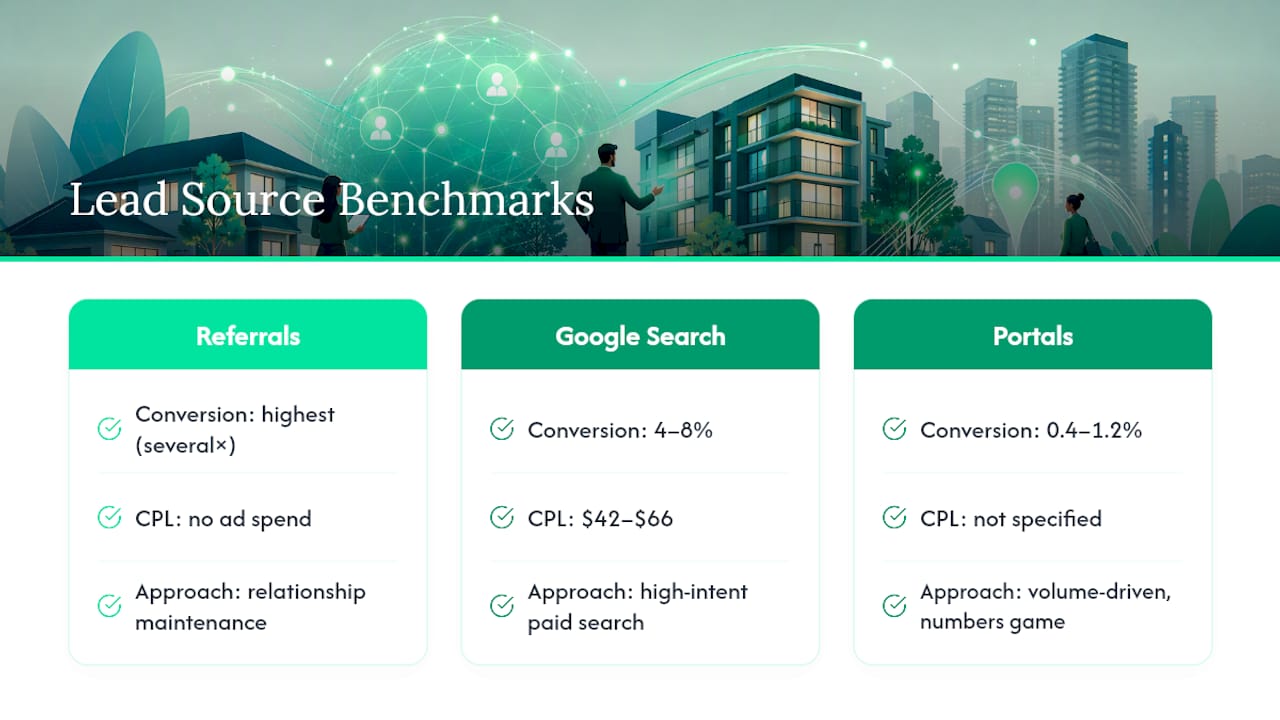
Referrals and sphere of influence convert the highest of any source, often several multiples above cold internet leads, and cost next to nothing to generate beyond the relationship maintenance you're likely already doing. There's no CPL to speak of here because the "cost" is years of reputation, not ad spend.
Portal leads from sites like Zillow or Realtor.com sit at the opposite end. Portal-sourced leads typically convert between 0.4% and 1.2%, which means volume becomes the only viable strategy. Agents who succeed with portals treat them as a numbers game, not a relationship channel, and lean hard on fast automated response to squeeze out every point of conversion they can.
Paid search and social split into two distinct profiles. Google Search Ads run $42 to $66 per lead with a 4% to 8% conversion rate, reflecting the higher intent of someone actively searching.
Expired listings and FSBOs convert unusually well for a cold-outreach source. Expired listings convert at roughly a 44% list rate, among the highest of any prospecting category, because the seller has already decided to sell and simply needs a better agent.
Organic and SEO content starts slow and expensive per lead in year one, then the cost per lead declines steadily as content compounds. Agents who stick with it for 18 to 24 months typically see lower blended CPL and higher lifetime conversion than agents relying purely on paid channels.
The industry's blended average cost per lead sits near $448, with paid channels averaging $480 and organic averaging $416. That $64 gap between paid and organic widens further once you factor in how much longer paid leads take to nurture.
Speed-to-Lead and Follow-Up Persistence: The Operational Benchmarks That Actually Move Numbers
Here's the uncomfortable truth: most of the conversion gap between top and bottom performers has nothing to do with lead quality. It comes down to how fast you pick up the phone.
Contacting a lead within five minutes instead of thirty makes you roughly 21 times more likely to qualify that lead, according to research compiled from MIT and InsideSales data. NAR-backed research also shows that around 78% of buyers end up signing with whichever agent responds first, regardless of that agent's experience or listing inventory. Being first beats being best more often than the industry likes to admit.
The drop-off isn't gradual. Contact and qualification probability falls sharply after the first several minutes and keeps falling through the 30-minute mark, with hour-plus response times performing dramatically worse than same-hour follow-up. Most agents, meanwhile, average response times well beyond that critical window, often because they're mid-showing or juggling five other leads when the notification comes in.
Build your follow-up around this effective lead nurturing explained sequence:
- Automated instant acknowledgment within seconds, even before a human replies, to buy time and confirm the lead was received.
- Live human contact attempt inside the five-minute window whenever humanly possible.
- Six to eight follow-up touches spread across calls, texts, and email over the first two weeks, since most conversions happen well past the first attempt.
- Multi-channel rotation so a lead who ignores calls still gets reached by text or email.
- A defined 90-day nurture tail for leads that don't convert immediately but haven't gone cold either.
Pro Tip: Block 15-minute response windows into your calendar every hour during business hours instead of trying to stay perpetually available. Top-performing agents structure their day around recurring short response blocks and lean on automation to cover the gaps, rather than treating instant response as a heroic, unsustainable habit.
How Teams and Brokerages Should Set and Track Lead Benchmarks
A brokerage tracking one number, usually closed deals, is flying blind on everything that happens before the sale. You need a small set of KPIs measured consistently across every agent and every source.
Track these five metrics monthly, minimum:
- Contact rate: the percentage of leads you actually reach, which exposes response-time problems before they show up in your closing numbers.
- Lead-to-appointment rate: how many contacted leads agree to a showing or consultation.
- Lead-to-close rate: your ultimate conversion benchmark, segmented by source.
- Cost per lead (CPL): tracked by channel, not blended, so you know which spend is actually working.
- Cost per closed deal (CPA): the number that actually determines whether a channel is profitable.
Segment every one of these by experience level. A brand-new agent working portal leads should be benchmarked against other new agents on portal leads, not against your top producer's referral-heavy pipeline. Rather than chasing flat industry averages, compare performance against percentile bands, P25, median, P75, and top-decile, within your own team's historical data. That framing shows you realistic next-step targets instead of an abstract number nobody in your office has ever hit.
Review these numbers weekly at the team level and monthly at the brokerage level. A simple dashboard split by source (rows) and KPI (columns), color-coded against your percentile bands, gives managers a five-second read on where coaching needs to happen.
How AI Lead Scoring Turns These Benchmarks Into Real Gains
Knowing the benchmarks matters less than acting on them in real time, which is exactly where most agents fall short. Agents using CRM systems consistently report conversion lifts of 29% to 41% compared to agents who don't, and the gap comes almost entirely from disciplined, automated follow-up rather than better leads.
Signal Engine's real estate tools were built around exactly that gap. The platform:
- Scores every incoming lead on buy-readiness the moment it enters your pipeline, so agents call the hottest lead first instead of working a list in order received.
- Auto-generates a first-touch text or email within seconds of lead capture, closing the response-time gap that costs most agents their best leads.
- Runs persistent, multi-touch nurture sequences automatically for leads that don't convert on the first attempt.
- Flags missed calls and auto-recovers them with a text follow-up, catching leads that would otherwise vanish silently.
That maps directly onto the operational playbook above: score, prioritize, automate the first touch, then nurture persistently until the lead converts or disqualifies itself.
Benchmarks for Lead Retention and Repeat Client Conversion
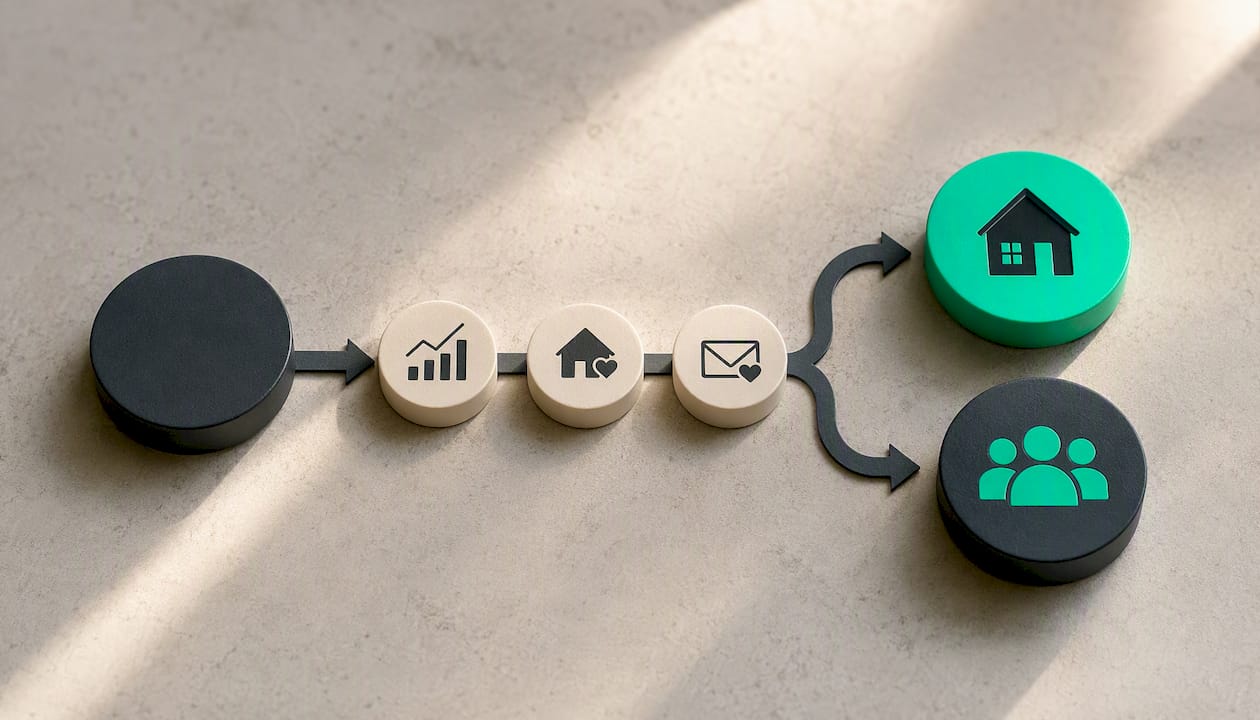
The lead benchmark conversation usually stops at the first closing, which ignores where a huge amount of realistic, low-cost revenue actually lives. Past clients and their referrals convert at rates that dwarf any cold source, because trust is already established and the cost of re-engagement is minimal.
Repeat client conversion, meaning a past buyer or seller coming back to you for their next transaction, typically converts several times higher than a fresh internet lead, though the timeline can stretch years between transactions. Referral conversion from past clients follows a similar pattern: the conversion rate is high, but the volume depends entirely on whether you maintained the relationship in the meantime.
The agents who benchmark well here aren't doing anything exotic. They're staying visible through market updates, home anniversary check-ins, and the occasional handwritten note, then tracking those touches with the same discipline they apply to active leads. Most CRMs let this slide because past clients don't feel urgent. That's precisely the mistake: a five-year-old client relationship that gets one well-timed check-in can produce a referral worth more than a month of paid lead spend.
If you're tracking contact rate and lead-to-close for new leads but nothing for your past client base, you're missing one of the cheapest conversion sources available to you.
Author Perspective: Where to Focus in the Next 180 Days
Three things matter more than the rest combined: speed of first response, actually tracking your numbers by source, and follow-up persistence past the third attempt. In 30 days, instrument your contact rate. In 90, fix your response-time SLA. By 180, you should have a documented cadence running on autopilot for every lead source you touch.
— Bernard
Ready-to-Use Lead Scoring: Signal Engine Growth
Most agents know this and still can't execute it consistently, because doing it manually means being tethered to your phone every waking hour.
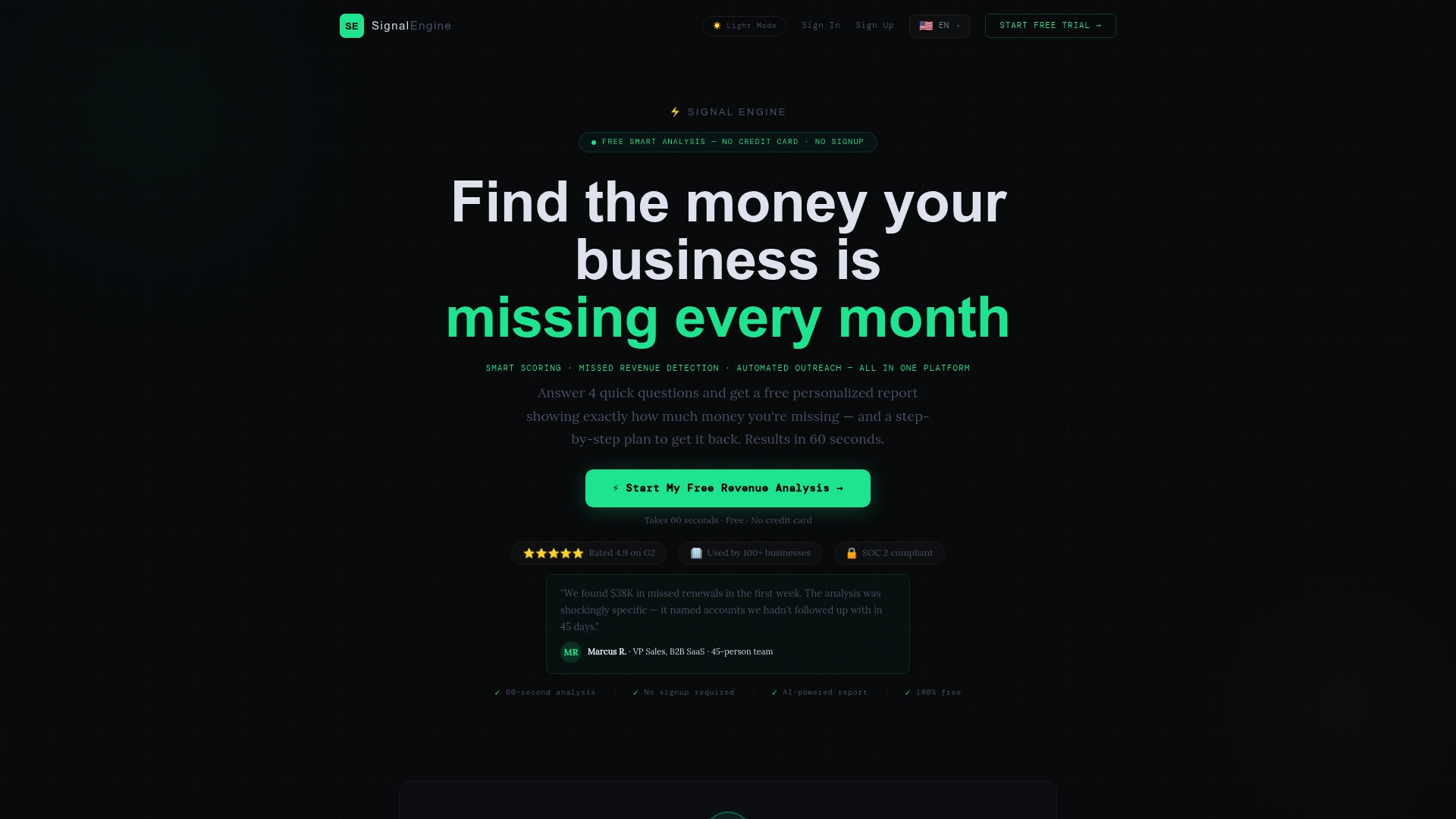
Signal Engine's lead scoring software closes that execution gap instead of just diagnosing it. It scores every lead by buy-readiness the second it lands, auto-fires a first-touch message inside your five-minute window, and runs the six-to-eight touch cadence this article recommends without you lifting a finger. For real estate teams specifically, that means portal leads get the volume treatment they need while referrals get flagged for a personal call, all inside one dashboard instead of three disconnected tools.
The Growth plan runs $149 a month with real-time scoring, cadence automation, and missed-call recovery built in, no per-seat pricing to punish you for adding agents. Check the full plan breakdown and start your free 7-day trial today. Setup takes about five minutes, and no credit card is required to begin.
Sources
- 75+ Real Estate Lead Generation Statistics (2026) | Deal Machine OS
- Why 78% of Real Estate Buyers Sign With the First Agent to Respond — And What to Do About It — HACK/re
- Speed to Lead: Why the First 5 Minutes Matter | Sierra Interactive
- Real Estate Marketing Benchmarks 2026 | Promodo
FAQ
What Is the 3-3-3 Rule in Real Estate?
The 3-3-3 rule is a lead follow-up framework: contact a new lead within 3 minutes, follow up 3 times in the first 3 days, and stay in touch for 3 weeks minimum before deprioritizing them. It's a simplified version of the persistence cadence this article recommends, built to match the urgency of speed-to-lead research.
What Is the Best Lead Generation Method for Realtors?
No single channel wins outright. The strongest approach combines multiple sources and uses lead scoring to prioritize whichever lead is hottest at any given moment.
What Are the 5 P's in Real Estate?
The "5 P's" isn't a standardized industry framework with one agreed definition, and versions of it differ by source. Rather than repeat an unverified acronym, focus on the operational levers this article documents directly: speed, source quality, persistence, tracking, and retention.
How Fast Should I Respond to a New Real Estate Lead?
Aim for five minutes or less. Research shows five-minute response times make you roughly 21 times more likely to qualify a lead than a thirty-minute response, and most buyers sign with whichever agent responds first regardless of experience.
Ready to Stop the Revenue Leak?
Signal Engine gives small and local businesses 31 AI-powered tools to score leads by buying intent, predict churn before it happens, auto-generate email and SMS campaigns, and recover missed calls automatically, all in one dashboard starting at $49/month.
Start your free 7-day trial, no credit card required. Setup takes 5 minutes.