

To text customers in the US, you need their consent first, and for any promotional text that consent has to be written, specific and provable. Replies like STOP must end the messages. Get those three things right and your texts reach customers instead of lawyers. Signal Engine drafts your next customer message and holds it for one-click approval before it reaches anyone, so you can check consent first.
TL;DR
- Promotional texts need prior express written consent. That means a signed agreement, which can be electronic, naming one seller and stating that consent is not a condition of purchase.
- Double opt-in is not a federal legal requirement. It is still the easiest way to build a timestamped consent record, and carriers expect confirmation for recurring programs.
- Opt-outs must work. Any reasonable revocation counts, STOP-type keywords are always valid, and you have up to 10 business days to honor a request.
- Records are your defense. Keep proof of when, how and what each person agreed to, plus your opt-outs.
Table of Contents
- Who this applies to
- Marketing texts vs. informational texts
- What counts as valid opt-in consent
- Is double opt-in required?
- SMS opt-out rules
- Records: the part that wins or loses a dispute
- Special cases for service businesses
- Why consent discipline pays off
- Putting it together: a five-step setup
- Promo: keep texting fast without losing control
- Perspective: consent is a revenue asset
- FAQ
- Sources
- Ready to Stop the Revenue Leak?
Who this applies to
The rules below cover any business texting customers or prospects in the US: HVAC and plumbing crews confirming jobs, dental offices sending reminders, salons rebooking regulars, real estate agents following up on leads, churches reaching members and nonprofits asking for donations. The federal law behind them is the Telephone Consumer Protection Act (TCPA), enforced through Federal Communications Commission (FCC) rules.
The FCC's consumer guidance says autodialed texts to mobile phones need consent. Commercial texts need written consent, while informational texts may rely on oral consent. The rules also apply when a number is not on the National Do Not Call Registry.

The stakes are real. Violations can cost up to $500 per violation or $1,500 per willful violation, and individuals can sue. Because that is per text, a single campaign to a badly sourced list adds up fast.
This is general information, not legal advice. For a specific campaign, a donor program or a health practice, have your attorney review it.
Marketing texts vs. informational texts
The first decision is which kind of text you are sending, because it sets the level of consent.
| Type | Examples | Consent needed |
|---|---|---|
| Informational | Appointment confirmations, service-arrival windows, account or delivery updates | Prior express consent tied to the reason the customer gave you their number |
| Marketing (telemarketing) | Promotions, discounts, upsells, review-for-reward offers, seasonal tune-up pitches | Prior express written consent |
| Mixed | A reminder that also pitches a coupon | Treated as marketing, so written consent |
Telemarketing means promoting or encouraging the purchase of goods or services. Classification is fact-specific, and mixed marketing and informational messages count as telemarketing. A customer who gives you a number for delivery updates has not agreed to promotions. This matters for service businesses: your "reminder" with a 10% coupon tacked on needs the stronger consent.
For how this plays out across industries, see our TCPA compliance rulebook for small business SMS.
What counts as valid opt-in consent
For marketing texts sent with an autodialer or prerecorded voice, the FCC defines prior express written consent as a written agreement bearing the recipient's signature. Electronic and digital signatures qualify when valid under applicable law. A compliant agreement:
- Identifies the phone number being authorized.
- Clearly and conspicuously says the person authorizes marketing messages from your business, including automated ones.
- States that consent is not a condition of purchase. Nobody can be forced to agree to texts to buy a furnace, a haircut or a listing.
- Names one identified seller. The old practice of one checkbox covering dozens of "partners" is exactly what the FCC targeted.
A practical web-form version looks like this:
By checking this box and entering my mobile number, I agree to receive automated marketing text messages from [Your Business Name] at the number provided. Consent is not a condition of any purchase. Message frequency varies. Message and data rates may apply. Reply STOP to cancel.
A few things go wrong again and again:
- Pre-checked boxes. The customer must take the action. Pre-checked boxes, vague language and implied consent are not enough.
- Buried disclosure. Consent hidden in terms of service is not clear and conspicuous.
- Scope creep. Consent has to be logically and topically tied to the interaction that prompted it. Someone who asked for a plumbing quote did not sign up for a partner's lawn-care offers.
- Purchased or inherited lists. A list you did not collect yourself carries no consent of yours. If you buy leads, you need documented proof of consent for your business specifically.
- Wrong or reassigned numbers. People change numbers. Scrub against the FCC's Reassigned Numbers Database.
For a deeper walk through signatures, disclosures and seller identification, this express written consent playbook covers the same standard from the calling side.
One more point on the one-to-one rule: the FCC's effort to require consent tied to a single seller and a single website has been postponed more than once, with the earlier consent requirements staying in place meanwhile. Build your forms around one named business anyway. It is the standard the FCC is heading toward and the cleanest thing to defend.
Is double opt-in required?
No, not by federal law. The TCPA does not mandate double opt-in. The FCC requires written consent for marketing texts but does not dictate the capture mechanism.
So why do so many compliance attorneys recommend it? Two reasons.
Carriers expect confirmation. CTIA's Messaging Principles say senders of recurring programs should send an opt-in confirmation before any further messaging. That confirmation should include:
- the program name
- a customer-care contact
- how to opt out
- a note that messages are recurring, with their frequency
- any fees that may apply
Carriers enforce these guidelines through short-code and toll-free policies, so programs that skip confirmation can be flagged or blocked.
It builds your proof. A two-step flow, where the person submits a form, you text a confirmation and they reply YES, creates an outbound message, an inbound reply and a timestamp. That is much harder to challenge than a form entry alone. It also protects against the classic problem of someone typing a friend's number into your form.
A simple double opt-in sequence:
- Customer enters their number on your form with the consent language beside it.
- You send one text: "[Business] here! Reply YES to get appointment offers and updates, up to 4 msgs/month. Msg & data rates may apply. Reply STOP to cancel."
- Customer replies YES. You log the time, number, form version and reply.
- Only then do marketing messages start.
For a walk through how dealerships document opt-in, opt-out and records, this SMS compliance guide shows the same logic in another service industry.
SMS opt-out rules
Opt-out is where small businesses slip most, because it sits in the daily workflow rather than the signup form. The FCC's 2024 revocation rules, published in the Federal Register, say:
- Customers can revoke consent in any reasonable manner. A reply, an email or a call to your front desk all count.
- These keywords are always reasonable: STOP, QUIT, END, REVOKE, OPT OUT, CANCEL and UNSUBSCRIBE. Other phrasing is judged by the circumstances, so a "please stop texting me" must be treated as an opt-out.
- You have up to 10 business days to honor a request, though you should do it immediately.
- You may send one confirmation text. It must be non-promotional, and if it goes out within five minutes it is presumed to fall within the customer's prior consent.
TCPA.com reports these revocation rules took effect April 11, 2025. The same source reports that in September 2026 the FCC adopted a further order that, once effective, would let senders designate an exclusive opt-out method if clearly disclosed. Until it takes effect, accept any reasonable method.
The FCC also gave callers extra time on one provision: whether a revocation made in reply to one type of message applies to all future messages. That part was first delayed to April 11, 2026 and has been pushed back since, so check the FCC's current order. The safe habit is to treat a STOP as a stop for everything.
Other opt-out essentials:
- Put opt-out language in your messages. The Consumer Action small-business guide lists an automated opt-out mechanism in each text among required practices, and it is standard for carrier programs.
- Keep an internal do-not-contact list and check every send against it, across every tool you use.
- Respect quiet hours. Telemarketing texts to wireless numbers are barred before 8 a.m. or after 9 p.m. in the recipient's local time. If you serve customers across time zones, schedule by their zone, not yours.
For a workflow view of handling unsubscribes inside messaging software, this guide to SMS follow-up and TCPA rules is a useful companion.
Records: the part that wins or loses a dispute
Consent you cannot prove is consent you do not have. The records worth keeping, based on CTIA's documentation guidance and the TCPA practice guides, are:
- date and time of consent
- how it was collected (web form, text keyword, paper form, in-person tablet)
- the exact consent language the person saw, with the form version
- IP address and device details for online forms
- the phone number and the person's identity
- the campaign it relates to
- every opt-out, with date and how it arrived
Consumer Action advises keeping consent and opt-out records for five years. Screenshots of your form at each version are cheap insurance. Lead vendors should hand you the same documentation for any lead they pass to you.
Message content checklist
Every marketing text should:
- Name your business at the start.
- Stay related to what the customer signed up for.
- Include a clear way to opt out.
- Go out within allowed hours.
- Disclose, where relevant, that messages may be AI-generated, which the Consumer Action guide lists as a recommended disclosure.
Special cases for service businesses
Missed-call text-back. A text sent right after a customer calls you is a response to their contact, which is informational. If it turns into a promotion, it moves into marketing territory. Our write-up on missed-call text-back for contractors covers how to keep the first reply useful and on topic.
Appointment reminders. Pure reminders are informational. Add an upsell and you need written marketing consent. See our missed appointment text templates.
Health practices. Dental and medical offices have privacy rules on top of the TCPA. Run patient messaging past your compliance officer or attorney.
Churches and nonprofits. Asking for donations or promoting events by text is generally promotional, so collect written consent from members and donors the same way a business would, and honor STOP replies the same day.
Real estate. Leads from portals arrive without your own consent record. Get consent for your business on first contact. Our real estate follow-up automation guide shows a TCPA-safe sequence.
Why consent discipline pays off
Compliance is not only defense. People who opted in to hear from you open, reply and book. A clean list is a more responsive list: fewer complaints, fewer carrier blocks, fewer wasted sends. Our SMS vs. email playbook shows where text earns its place next to email.
Putting it together: a five-step setup
- Sort your messages into informational and marketing. Anything with an offer is marketing.
- Rewrite your signup forms with the consent language above, an unchecked box, your business name and the no-purchase-required statement.
- Add a confirmation text for recurring programs, and log the reply.
- Wire up opt-outs so a STOP in any form lands on one suppression list that every tool checks.
- Archive everything: form versions, timestamps, replies, opt-outs.
Promo: keep texting fast without losing control
The hardest part of compliant texting is not the law, it is knowing who to text and when. Signal Engine scores every customer on buy-readiness, flags who is about to churn and drafts the next action, then holds it for one-click approval before anything reaches a real customer. That approval step gives you a built-in moment to confirm a contact is someone you have consent to text.
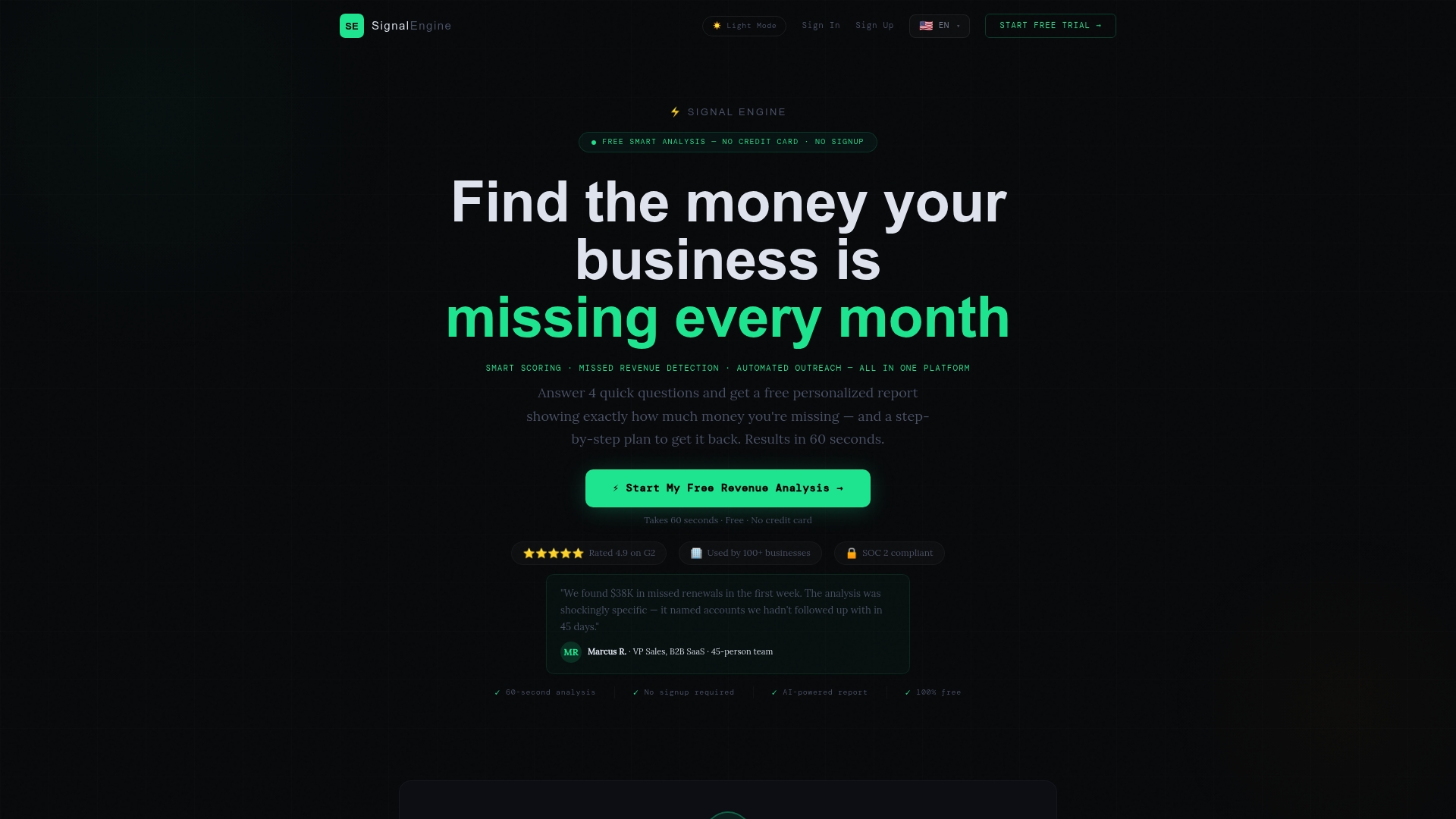
The Free plan is a no-risk way to see it on your own customer list, and Growth is $149 per month, with Scale at $297 per month. Compare options on the Signal Engine pricing page, or watch the live demo first.
Perspective: consent is a revenue asset
Small service businesses tend to treat SMS consent as paperwork. We see it differently: every opted-in number is a customer who raised their hand. That makes the list the most valuable thing your follow-up has.
Our platform is built around that idea. It scores buy-readiness and churn risk so you text the right people at the right moment, and it holds every drafted action for your one-click approval. You stay in charge of what goes out, which is exactly where a small team wants to be when the rules are strict and the penalties are per message.
Our advice: collect consent cleanly, send fewer and better texts to people who asked for them, and let the data tell you who is ready. That beats blasting a big list every time.
Bernard
FAQ
Do I need written consent to send appointment reminders?
Usually not written consent. A reminder tied to the reason the customer gave you their number is informational and generally needs prior express consent. If you add a promotion, the message is treated as marketing and you need prior express written consent.
Can a customer opt in by texting a keyword?
Yes, if the keyword flow shows the full consent language, names your business and states that consent is not a condition of purchase, and you keep a record of it. Many businesses add a confirmation text so the record includes a timestamped reply.
How fast must I honor a STOP?
The FCC allows up to 10 business days, but you should act immediately. You may send one non-promotional confirmation, ideally within five minutes. Treat any reasonable wording, not just the keyword list, as an opt-out.
Does a customer's phone number on an invoice count as consent to market to them?
No. Providing a number for service or delivery updates does not automatically authorize promotional texts. You need separate written consent for marketing.
What are the penalties for texting without consent?
TCPA violations can reach $500 per violation, or $1,500 if willful, and individuals can sue. Courts and carriers both care about your consent records, so keep them.
Sources
- FCC: Stop Unwanted Robocalls and Texts
- Federal Register: 2024 consent rule, 47 C.F.R. 64.1200(f)(9)
- Federal Register: 2024 revocation rules
- FCC order DA-25-312A1 on the revocation waiver
- FCC order DA-25-90A1 on the one-to-one consent postponement
- CTIA Messaging Principles and Best Practices
- Consumer Action: A Small Business's Guide to the TCPA
- National Law Review: Marketing campaign TCPA compliance
- Cove Law: What counts as prior express consent
- TermsFeed: TCPA compliance for SMS marketing
- LeadCompliant: SMS double opt-in
- TCPA.com: TCPA rules for calls and texts
- Express written consent playbook
- SMS compliance for dealerships
- SMS follow-up and TCPA rules
Ready to Stop the Revenue Leak?
Signal Engine gives small and local businesses 31 AI-powered tools to score leads by buying intent, predict churn before it happens, auto-generate email and SMS campaigns, and recover missed calls automatically — all in one dashboard starting at $49/month. Start your free 7-day trial — no credit card required. Setup takes 5 minutes.