

SMS wins when you need action in the next hour: appointment reminders, flash sales, delivery alerts. Email wins when you need depth, records, or rich formatting: newsletters, receipts, detailed offers. SMS click rates consistently beat email's across reported benchmarks, but the real winner is an integrated approach that sequences both and measures revenue per message, something a platform like Signal Engine is built to orchestrate.
TL;DR:
- SMS provides immediate action for time-sensitive messages, such as flash sales, appointment reminders, and high-demand back-in-stock alerts.
- Email is better suited for detailed content, storytelling, and long-form communication like newsletters and product launches.
- While SMS click rates outperform email's, its higher cost and stricter opt-in rules require careful management and segmentation.
- Tracking revenue per message and using incremental testing yield more accurate ROI insights than relying solely on open rates.
- Coordinated multi-channel flows that sequence email and SMS according to message urgency improve engagement and reduce list fatigue.
Table of Contents
- When to Use SMS vs. Email: A Use-Case Matrix for Immediate Decisions
- Pros and Cons: Practical Trade-Offs to Weigh
- Benchmarks and Metrics: What to Trust and How to Compare
- Compliance and Consent: Practical Must-Dos for U.S. Marketers
- Best-Practice Multi-Channel Flows: Welcome, Cart Recovery, and Alerts
- Segmentation and Personalization: Building Channel-Preference Audiences
- Measuring ROI: Revenue-Per-Message Math and Attribution Recommendations
- How Signal Engine Supports Combined SMS + Email Programs for Small Businesses
- Author Perspective: Measurement Over Momentum
- Put This Playbook to Work With Signal Engine
- FAQ
- Sources
- Ready to Stop the Revenue Leak?
When to Use SMS vs. Email: A Use-Case Matrix for Immediate Decisions
Here's the operational rule we'd put on a sticky note above your desk: if it can wait a day, use email; if it can't, use SMS. That single line resolves most channel debates faster than any strategy deck.
Flash sales need urgency and a short window, so SMS wins. Newsletters need room for storytelling and links, so email wins. Delivery and appointment updates are time-sensitive and personal, so SMS wins again. Back-in-stock alerts split the difference: SMS for high-demand items, email for everything else.
| Scenario | Best channel | Why |
|---|---|---|
| Flash sale (2-4 hour window) | SMS | Needs immediate visibility |
| Weekly newsletter | Needs space for content and design | |
| Delivery or shipping update | SMS | Time-sensitive, action-free |
| Appointment reminder | SMS | Reduces no-shows in real time |
| Back-in-stock (high demand) | SMS | Fast-moving inventory |
| Back-in-stock (general) | No urgency, lower cost | |
| Detailed product launch | Needs images, copy, links |
A boutique running a 48-hour sale gets more mileage from two SMS touches than a buried email subject line. A service business sending a quarterly roundup should stick to email, where readers expect longer content.
Pros and Cons: Practical Trade-Offs to Weigh
Each channel earns its place through different strengths, and the trade-offs matter more than the hype.
- SMS immediacy: Messages get seen fast, which is why SMS click rates tend to outperform email, but every send costs money and overuse burns out your list quickly.
- Email economics: Marginal cost per email is close to zero, letting you send richer, longer-form content without worrying about per-message billing.
- Measurement caveats: Email open rates are increasingly unreliable due to privacy protections built into modern mail clients, so clicks and conversions matter more than opens ever did.
- Creative demands: Email supports images, layouts, and long copy; SMS forces you to say it in 160 characters or pay for extra parts.
- Staffing and frequency caps: SMS requires tighter governance, since a single over-sent campaign can trigger mass opt-outs, while email tolerates more frequent, lower-stakes touches.
Choosing a channel means choosing a cost structure and a creative constraint at the same time. Getting that balance right is where most marketers either win trust or burn it.
Benchmarks and Metrics: What to Trust and How to Compare
Open rates used to be the headline metric for email, but they're no longer trustworthy. Email open-rate data is distorted by privacy tools like Apple Mail Privacy Protection, which is why benchmark reports now push marketers toward click-through rate, conversion rate, and revenue per message as the metrics that actually hold up.
SMS has its own blind spot: a delivery receipt confirms the message reached a phone, not that a person read it. Treat delivery confirmation as a floor, not a success metric, for either channel.
The metrics worth tracking on both channels:
- Click-through rate: Measures actual engagement, not just inbox placement.
- Conversion rate: Ties the message directly to revenue, which is the number that matters to your budget.
- Revenue per message: Normalizes for cost differences between a nearly free email send and a billed SMS send.
- Unsubscribe or opt-out rate: Signals list fatigue before it becomes a deliverability problem.
Running a small holdout test, where you withhold a campaign from a modest portion of a segment, gives you a cleaner read on incremental lift than comparing campaign to campaign. That's the only way to know whether SMS added revenue or simply pulled forward purchases that email would have captured anyway.
Compliance and Consent: Practical Must-Dos for U.S. Marketers
SMS and email carry different legal obligations, and getting them wrong costs more than a bad campaign ever would. Under the FCC's 2024 rule changes, prior express written consent for SMS marketing must be given to one seller at a time, so shared or bundled opt-in forms covering multiple businesses no longer satisfy the standard. The same order confirms that opt-outs sent by reply text, such as STOP or QUIT, count as reasonable revocation methods, and you must honor them within ten business days.
Email carries its own baseline. Under the CAN-SPAM Act, every commercial email needs a clear, conspicuous opt-out mechanism, and you cannot charge a fee or demand extra information to process that request.
- Keep SMS opt-in completely separate from email opt-in, never bundled into one checkbox.
- Support STOP, QUIT, CANCEL, and similar keywords, and document every opt-out with a timestamp.
- Honor SMS revocations within ten business days and email opt-outs promptly, per the respective rules.
Pro Tip: Build your SMS opt-in flow with a documented timestamp and seller-specific disclosure, since vague or bundled consent is the fastest way to end up outside the FCC's rules.
Best-Practice Multi-Channel Flows: Welcome, Cart Recovery, and Alerts
The strongest programs don't pick a channel, they sequence both with a clear hierarchy. Email carries the detail, SMS carries the nudge.
- Welcome flow: Send a detailed welcome email immediately after signup, then follow with a short SMS confirmation once the phone number is verified, keeping the text under two sentences.
- Cart recovery: Lead with an email reminder at the one-hour mark, follow with a second email at 24 hours, and only add an SMS nudge if the email remains unopened and the cart is still abandoned after that window.
- Transactional updates: Use SMS for anything timing-critical, like a delivery window or appointment change, and reserve email for receipts and confirmations that customers may need to search for later.
- Frequency protection: Cap SMS sends per contact per week and test cadence changes on a small segment before rolling them out broadly, since SMS lists erode faster than email lists when overused.
Coordinating these flows well is less about creative polish and more about sequencing logic, something automated outreach sequences are built to handle without manual triggers.
Pro Tip: Set a hard rule that no contact receives more than two SMS messages in a single week outside of transactional alerts, since that cap protects long-term deliverability more than any single clever campaign.
Segmentation and Personalization: Building Channel-Preference Audiences
Not every customer wants the same channel, and treating them identically wastes both budget and goodwill. Behavior tells you more than a sign-up form ever will.
- Define preference by behavior: A contact who clicks SMS links repeatedly but ignores email opens is a strong candidate for an SMS-first segment, and the reverse holds just as clearly.
- Personalize by value and stage: High-value repeat customers can handle more frequent SMS touches, while new leads are better served by a slower, email-first nurture sequence.
- Clean your data first: Validate phone numbers before enrolling contacts in SMS flows, deduplicate across channels, and merge cross-channel identities so the same person doesn't receive conflicting messages from two systems.
Good segmentation isn't a one-time setup. Preferences shift as customers move through their lifecycle, so revisit these segments quarterly rather than treating them as fixed.
Measuring ROI: Revenue-Per-Message Math and Attribution Recommendations
The formula is simple: revenue per message equals total campaign revenue divided by messages sent. Say an email campaign sent to 10,000 contacts generates $3,000 in attributed revenue, that's $0.30 per message at a cost near zero. An SMS campaign sent to the same list generates $1,500 but costs $0.02 per message in carrier fees, netting a different ROI picture once you account for spend.

SMS costs can shift significantly depending on encoding: a standard GSM-7 message allows more characters per segment than a Unicode message, so a single emoji or special character can push a text into a second billed segment and raise per-send cost. That's background any marketer comparing channel economics should factor in before declaring a winner.
For a cleaner read on true lift, run a holdout test rather than trusting raw revenue comparisons, since list quality and timing distort simple side-by-side numbers.
How Signal Engine Supports Combined SMS + Email Programs for Small Businesses
Running both channels well takes more coordination than most small teams have hours for. We use an AI revenue intelligence platform that scores every customer on buy-readiness, flags churn risk before it's too late, and drafts the next action for one-click approval before anything reaches a customer. A typical micro-workflow looks like this: a customer's buy-readiness score crosses a threshold, which triggers a detailed email offer, followed by a short SMS nudge if the email goes unopened. The platform ships with configurations for multiple industries, and an onboarding AI builds a custom mode for businesses outside standard categories.

Author Perspective: Measurement Over Momentum
The biggest mistake we see is treating SMS like a louder version of email. It isn't. SMS earns trust through restraint, and the channel that wins isn't the one with the highest click rate, it's the one with the highest revenue per message after you've tested incrementally rather than guessed.
— Bernard
Put This Playbook to Work With Signal Engine
Everything in this guide—scoring who's ready to buy, triggering the right channel, measuring revenue per message—is supported by AI revenue intelligence running in the background. We score leads by buying intent, auto-generate the email and SMS campaigns that follow, and hold every draft for one-click approval before it reaches a real customer.
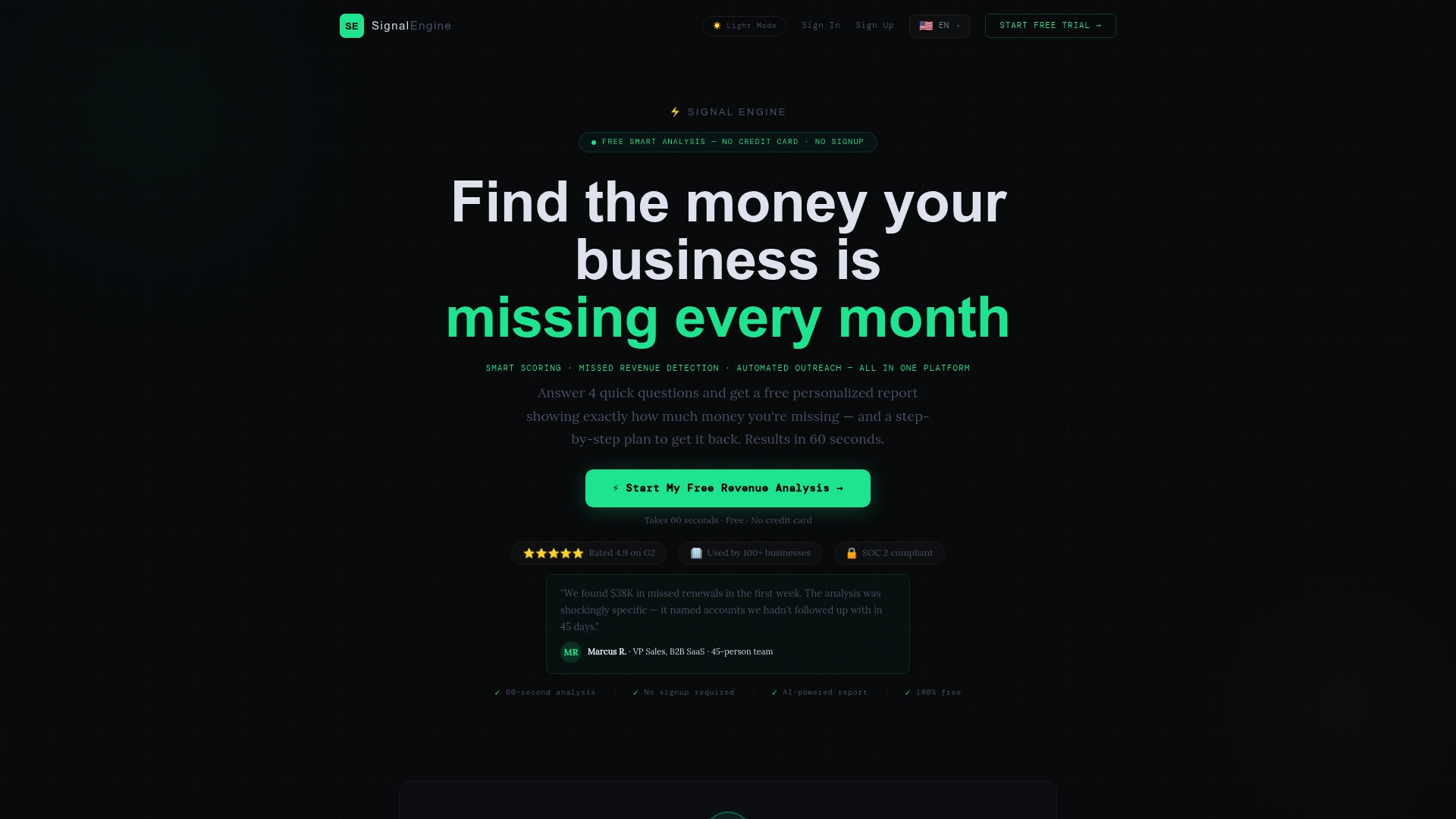
| What you need | What we provide |
|---|---|
| Buy-readiness scoring | AI lead scoring across multiple industries |
| Channel orchestration | Auto-generated email and SMS campaigns |
| Revenue measurement | Revenue intelligence dashboard |
Plans start with Signal Engine Free, and Growth runs $149 per month if you need deeper automation. See the full feature set built for combined channel programs.
FAQ
Is SMS better than email?
Neither channel is universally better. SMS tends to produce higher click rates for urgent, time-sensitive messages, while email remains the more cost-effective choice for detailed content and broad reach, so the best results come from using both in sequence.
Does anyone use SMS anymore?
Yes, SMS remains a widely used channel for appointment reminders, delivery updates, and time-sensitive alerts, and businesses continue to adopt it specifically because it reaches people faster than email for urgent messages. The FCC's ongoing rule updates around consent and text blocking reflect how much commercial SMS volume still flows through the channel.
What is the main disadvantage of SMS messaging?
The biggest drawback is cost and character limits: SMS is billed per message or per segment, and Unicode characters can push a message into a more expensive second segment. SMS also carries stricter consent requirements than email, including seller-specific prior express written consent, which adds operational overhead.
Sources
- Federal Register: Telephone Consumer Protection Act rule changes (Second Report and Order)
- FCC Second Report and Order (summary document)
- CAN-SPAM Act: A Compliance Guide for Business (FTC)
- Statista — Marketing email open rates by sender type
Ready to Stop the Revenue Leak?
Signal Engine gives small and local businesses 31 AI-powered tools to score leads by buying intent, predict churn before it happens, auto-generate email and SMS campaigns, and recover missed calls automatically, all in one dashboard starting at $49/month.
Start your free 7-day trial, no credit card required. Setup takes 5 minutes.