

Account-based marketing (ABM) is a B2B strategy that focuses your sales and marketing resources on a defined set of high-value accounts, treating each one as a market of one. Per the ABM framework, it flips the traditional funnel: instead of casting wide and filtering down, you start with the accounts you want and build everything around them. If your average deal size is high, your buying committees are complex, or you're selling into strategic enterprise accounts, ABM will almost always outperform broad demand generation. If you're selling a $49/month self-serve product to thousands of SMBs, it probably won't.
The three scale models give you a practical starting point:
- One-to-one (Strategic ABM): Fully bespoke programs for your top small number of accounts. Maximum personalization, maximum resource investment.
- One-to-few (ABM Lite): Semi-custom plays for clusters of a moderate number of accounts that share similar profiles, pain points, and buying behavior.
- One-to-many (Programmatic ABM): Scaled personalization using intent data and automation across a larger set of accounts.
Pro Tip: Before you touch a single piece of content or ad creative, spend real time on account selection. The accounts you choose determine your ceiling. Weak selection is the single most common reason ABM programs underperform, and no amount of personalization fixes a bad target list.
Key Takeaways
ABM consistently outperforms broad demand generation for B2B teams when account selection is disciplined, sales and marketing operate from shared account-level KPIs, and measurement closes the loop back into playbook refinement.
| Point | Details |
|---|---|
| Start with account selection | Your target list determines your ceiling; focus on targeting the right accounts before building any content or plays. |
| Match the model to your resources | One-to-one for top accounts, programmatic for scale; most teams run both tiers simultaneously. |
| Shift to account-level metrics | Drop MQL reporting; track account engagement score, influenced pipeline, and win rate instead. |
| Pilot before scaling | Run 10–20 accounts for 60–90 days, debrief with sales, then expand with validated playbooks. |
| Signalengine for SMB ABM | Signalengine's intent scoring and outreach automation let small teams run account-focused plays starting at $49/month. |
Table of Contents
- What is account-based marketing and why does it beat demand gen for B2B?
- Which ABM model fits your team and account mix?
- How does an ABM program actually work?
- What tactics and channels power ABM campaigns?
- How to implement ABM step by step
- How do you measure ABM success and attribute revenue?
- What tools does an ABM tech stack need?
- What are the most common ABM pitfalls?
- What does the research say about ABM effectiveness?
- Why ABM works differently for SMBs than enterprise teams
- Signalengine gives you the revenue intelligence to run ABM without the enterprise overhead
- Sources
- FAQ
- Ready to Stop the Revenue Leak?
What is account-based marketing and why does it beat demand gen for B2B?
The American Marketing Association frames ABM's core advantage clearly: personalized engagement and tight sales-marketing alignment make it the right fit when buying committees are large, deal cycles are long, and average contract values justify the investment. Broad demand generation optimizes for volume. ABM optimizes for fit and conversion within a specific account set.
The business case is straightforward. When you know exactly which accounts you're pursuing, every dollar of marketing spend goes toward moving those specific deals forward. You're not generating leads that sales ignores. You're not nurturing contacts who will never buy. You're coordinating every touchpoint around accounts that already match your ideal customer profile.
That coordination is what produces the outcomes revenue leaders care about: higher close rates, larger deal sizes, and shorter sales cycles. ABM also tends to improve customer fit, which matters for retention. Accounts that were properly researched and targeted before the sale tend to stay longer and expand faster after it.
The ROI case for ABM over traditional demand generation
📊 Benchmark: Vendor and practitioner studies commonly report 2–4x higher close rates and 30–50% shorter sales cycles for mature ABM programs, though these figures are conditional on program fit, account selection quality, and execution discipline. Treat them as directional ranges, not guarantees.
The Forrester New Wave for ABM Platforms reinforces that the strongest performance gains come from teams that pair account-level reporting with disciplined measurement, not from any single tool or channel. The platform is an enabler. The operating model is the differentiator.
Which ABM model fits your team and account mix?
Choosing the right model is a resource and ROI tradeoff, not a prestige decision. Here's how each one plays out in practice:
- One-to-one / Strategic ABM: You assign a dedicated pod (AE, marketer, SDR, sometimes a CSM) to each account. Custom research, bespoke content, executive-level relationship building. Typical account count: a limited number. ROI per account is highest, but cost per account is also highest and scaling is slow.
- One-to-few / ABM Lite: You cluster accounts by industry, company size, or pain point and build semi-custom plays that work across the cluster with light personalization at the account level. Typical account count: a modest cluster. A good middle ground for mid-market teams with limited headcount.
- One-to-many / Programmatic ABM: You use intent data, automation, and dynamic content to personalize at scale. Typical account count: 50–500+. Conversion lift per account is lower than one-to-one, but the volume makes the math work. Requires more sophisticated tooling and data infrastructure.
Most mature ABM programs run all three tiers simultaneously: a handful of strategic accounts at the top, a broader set in ABM Lite, and a programmatic layer that feeds the pipeline with net-new targets.
How does an ABM program actually work?
Amplitude's ABM breakdown describes the operational shift clearly: ABM moves your team from lead-level thinking to account-level thinking across every function. That shift touches metrics, incentives, content, and how sales and marketing talk to each other.
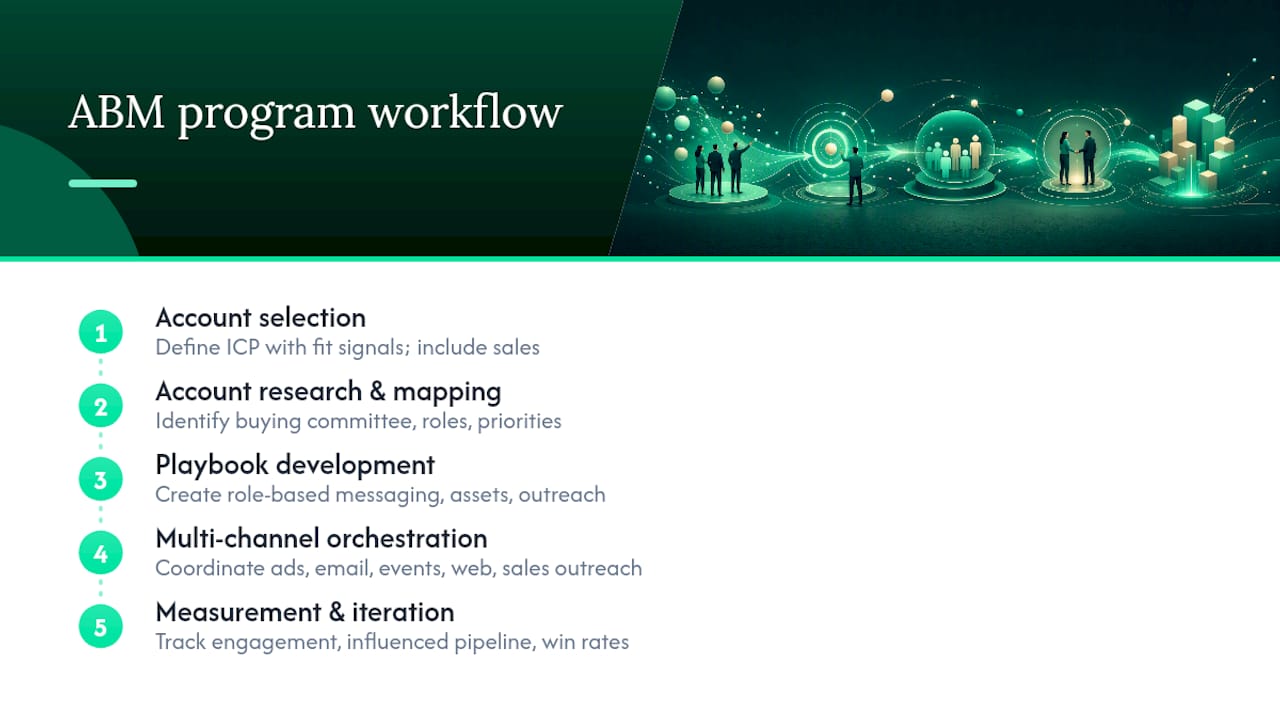
The core components, in order:
Account selection is where you define your ideal customer profile (ICP) using firmographic, technographic, and behavioral fit signals, then layer in intent data to prioritize accounts that are actively in-market. This is the highest-leverage step in the entire program.
Account research and stakeholder mapping means identifying every member of the buying committee, their role in the decision, their individual priorities, and the internal dynamics that will shape the deal. For strategic accounts, this can take days. For programmatic tiers, you rely more on data enrichment tools.
Playbook development translates that research into role-based messaging, content assets, and coordinated outreach sequences. A CFO needs a different message than a VP of Engineering, even at the same account.
Multi-channel orchestration is the execution layer: running personalized ads, email sequences, sales outreach, events, and web personalization in a coordinated sequence rather than as isolated campaigns.
Measurement and iteration closes the loop. You track account engagement, influenced pipeline, and win rates at the account level, then feed those signals back into playbook refinement and account selection.
Pro Tip: Pull sales into account selection before you build a single playbook. Sales reps know which accounts have real budget authority and which are tire-kickers. That input cuts your research time and dramatically improves your target list quality.
What tactics and channels power ABM campaigns?
ABM plays work because they combine channels in a coordinated sequence rather than running them in parallel and hoping something lands. Here's what a multi-channel play looks like for a single target account:
- Intent-triggered outreach: A target account starts researching your category. An intent signal fires. Sales gets an alert and sends a personalized email within 24 hours referencing the account's specific context.
- Targeted digital ads: The account's IP range or matched contacts start seeing display and LinkedIn ads with messaging tied to their industry pain point, not a generic brand message.
- Web personalization: When someone from that account visits your site, the homepage headline, case study, and CTA dynamically reflect their vertical and use case.
- Direct mail or gifting: For strategic accounts, a physical touchpoint (a relevant book, a branded gift, a handwritten note) cuts through digital noise at a critical deal stage.
- Executive-to-executive engagement: A LinkedIn message or warm introduction from your CEO or VP to their counterpart at the target account, timed to a deal milestone.
- Events and webinars: Invite specific stakeholders from target accounts to exclusive roundtables or VIP dinners where the conversation is relevant to their exact challenges.
Gartner's intent data guidance highlights that the type of intent signal matters: first-party behavioral signals (what contacts do on your site) are the most reliable for timing outreach, while third-party publisher intent and technographic signals help with earlier-stage prioritization. Match your intent sources to where your buying committee actually spends time.
For practical play templates you can adapt, Atlassian's ABM playbook shows how coordinated intent triggers, personalized content, and sales sequences combine into repeatable campaign recipes for high-value deals.
How to implement ABM step by step
A pilot-first approach reduces risk and gives you real data before you commit full resources. Here's the sequence:
- Define your goals and ICP. Set specific pipeline and revenue targets. Document your ICP using firmographic, technographic, and behavioral criteria. Use your TAM analysis to validate that your target account universe is large enough to sustain the program.
- Assemble a cross-functional team. Minimum viable team: one marketer, one AE or sales lead, and one SDR. Add a RevOps or data owner if you have one. Assign a playbook owner who is accountable for execution.
- Select 10–20 pilot accounts. Use ICP fit scores, intent signals, and sales input to build your initial list. Smaller pilots produce cleaner data. Avoid the temptation to start with 100 accounts.
- Research and map stakeholders. For each pilot account, identify 3–7 buying committee members, their roles, and their priorities. Use LinkedIn, 10-K filings, press releases, and data enrichment tools.
- Build playbooks and assets. Create role-based email sequences, ad creative, and landing pages. Each asset should reference the account's specific context, not just their industry.
- Launch with measurable KPIs. Track account engagement score, meetings booked, influenced pipeline, and deal velocity from day one. Set a 60–90 day review checkpoint.
- Gather feedback and iterate. After the pilot, debrief with sales. Which accounts engaged? Which plays worked? What messaging resonated? Refine before scaling.
- Scale with automation and programmatic personalization. Once your playbooks are validated, use automated outreach tools and intent-driven triggers to expand to your one-to-few and one-to-many tiers.
Pre-launch checklist:
- CRM accounts tagged with ICP tier and ABM status
- Data enrichment completed for all pilot accounts
- Intent data source connected and alerts configured
- Playbook owner assigned and accountable
- Baseline metrics captured before launch
How do you measure ABM success and attribute revenue?
The biggest measurement mistake in ABM is carrying over lead-level KPIs from demand generation. MQLs are irrelevant at the account level. What matters is whether target accounts are engaging, advancing, and closing.

Gartner's ABM measurement framework recommends tracking account engagement and influenced pipeline as the primary indicators of program health. Here are the core metrics and how to use them:
| Metric | What it measures | How to calculate it | Reporting cadence |
|---|---|---|---|
| Account engagement score | Depth and breadth of interactions across the buying committee | Sum of weighted touchpoints (email opens, site visits, ad clicks, meetings) per account | Weekly |
| Influenced pipeline | Pipeline value where ABM activity touched the deal | Total pipeline value of accounts with recorded ABM touchpoints | Monthly |
| Pipeline velocity | Speed of deal progression within target accounts | (# of deals × win rate × avg deal size) ÷ sales cycle length | Monthly |
| Average deal size | Revenue per closed deal in ABM accounts vs. non-ABM | Total closed revenue ÷ number of closed deals | Quarterly |
| Win rate | Percentage of ABM accounts that close | Closed-won deals ÷ total ABM opportunities | Quarterly |
| Program ROI | Return on ABM investment | (Revenue influenced by ABM − program cost) ÷ program cost | Quarterly |
For attribution, multi-touch models work better than first-touch or last-touch for ABM because buying committees interact across many channels over long cycles. The goal is to show influence, not claim sole credit.
Pro Tip: Build a closed-loop feedback loop with sales. After every won or lost deal, ask the AE: which plays moved the deal forward? Which content actually got shared internally? That qualitative data is worth more than any dashboard for improving your next playbook.
What tools does an ABM tech stack need?
Your stack should match your ABM tier. A one-to-one program can run on a CRM, LinkedIn Sales Navigator, and a good data enrichment tool. A programmatic program needs more infrastructure.
Core technology categories:
- CRM (e.g., Salesforce, HubSpot): The system of record for account data, contact mapping, and deal tracking. Account-level reporting is non-negotiable.
- Account intelligence and intent data: Tools that surface which accounts are in-market and what they're researching. Gartner distinguishes first-party, third-party, and technographic intent signals, each with different use cases.
- Marketing automation: Handles email sequences, nurture tracks, and trigger-based outreach at scale.
- ABM platforms: Dedicated platforms that layer account targeting, ad orchestration, and engagement scoring on top of your CRM and MAP.
- Ad platforms with account targeting: LinkedIn Campaign Manager and display networks with IP-based targeting are the most common for B2B.
- Web personalization tools: Dynamically adjust site content based on the visiting account's profile.
- Data enrichment: Keeps contact and firmographic data clean and current across your account list.
- Analytics and revenue intelligence: Connects ABM activity to pipeline and revenue outcomes at the account level. AI-powered client analysis tools can accelerate account scoring and prioritization significantly.
Tool selection checklist:
- Does it report at the account level, not just the contact or lead level?
- Does it integrate with your CRM without a custom build?
- Can it scale from your pilot tier to your programmatic tier without a platform swap?
- What is the implementation timeline, and do you have the internal resources to run it?
Forrester's platform evaluation focuses on account-level reporting, CRM integration depth, and programmatic personalization capabilities as the primary differentiators between platforms. Those three criteria should anchor your vendor evaluation.
What are the most common ABM pitfalls?
Most ABM programs that fail do so for the same reasons. Knowing them in advance is a significant advantage.
Treating ABM as a campaign, not an operating model. ABM requires sustained coordination between sales and marketing across months-long deal cycles. Teams that run a "90-day ABM campaign" and then revert to demand gen never see the compounding returns. Per TechTarget's practitioner analysis, this is the most common failure mode in ABM implementations.
Poor account selection. Targeting accounts that don't fit your ICP, or selecting based on aspiration rather than data, wastes every downstream resource. If your win rate on ABM accounts isn't materially higher than your baseline, revisit the list before you touch the playbooks.
Weak sales-marketing alignment. ABM collapses without a shared definition of target accounts, shared KPIs, and a regular operating rhythm between the two teams. If sales and marketing are still arguing about MQL definitions, you're not ready to run ABM.
Measuring with lead-level metrics. Reporting MQLs from an ABM program is like measuring a basketball team's performance by counting individual passes. The account is the unit of measurement.
Surface-level personalization. Swapping in a company name and logo is not ABM. Buying committees can tell the difference between genuine account intelligence and mail-merge personalization. If your "personalization" doesn't reference something specific to that account's business situation, it's not working.
Pro Tip: If your data is inconsistent, your CRM is messy, or your sales team isn't bought in, pause before scaling. Scaling a broken ABM program just produces bigger, more expensive failures. Fix the foundation first.
What does the research say about ABM effectiveness?
The evidence base for ABM is real, but it comes with important caveats about program maturity and execution quality.
📊 Benchmark: Vendor and practitioner studies, including data from abmatic.ai's ABM benchmarks, report that mature ABM programs can achieve 2–4x higher close rates and 30–50% shorter sales cycles compared with traditional demand generation. These ranges reflect programs with disciplined account selection, closed-loop measurement, and sustained sales-marketing alignment, not first-year pilots.
The Forrester New Wave evaluation of ABM platforms consistently ties the strongest outcomes to teams that invest in account-level reporting and CRM integration, not to any single channel or tactic. The platform enables scale; the operating model drives results.
Amplitude's analysis reinforces that the strongest evidence links improved outcomes to disciplined account selection and closed-loop measurement. Teams that skip those foundations and jump straight to programmatic personalization consistently underperform teams that build the fundamentals first.
The honest summary: ABM works when the accounts are right, the teams are aligned, and the measurement is honest. It doesn't work as a shortcut to pipeline when demand gen is underperforming.
Why ABM works differently for SMBs than enterprise teams
Most ABM playbooks are written for enterprise marketing teams with six-figure tool budgets and dedicated ABM managers. That's not most B2B companies.
For SMBs and mid-market revenue teams, the math on one-to-one ABM is often brutal. You can't assign a dedicated pod to 15 accounts when your entire revenue team is five people. What actually works at that scale is a hybrid: a small strategic tier for your top 5–10 accounts, combined with a programmatic layer that uses intent scoring and automation to handle the rest.

The key insight is that automation doesn't replace the personalization that makes ABM work. It replaces the manual coordination that makes ABM expensive. When your CRM automatically tags an account as in-market based on intent signals, and your outreach platform fires the right sequence without a human triggering it, you get the timing and relevance of a bespoke program at a fraction of the cost.
Account selection and closed-loop measurement matter even more at the SMB level because you have fewer resources to absorb mistakes. Picking the wrong 10 accounts for a strategic ABM program at an enterprise company is a setback. At an SMB, it can consume your entire marketing budget for a quarter.
The ABM checklist for B2B teams is worth bookmarking if you're building this from scratch. It covers the tool categories, platform decisions, and step-by-step tasks that resource-constrained teams actually need, without the enterprise overhead.
Signalengine gives you the revenue intelligence to run ABM without the enterprise overhead
Running ABM at the SMB level means you need intent scoring, account engagement tracking, and outreach automation in one place, not spread across five tools with a six-figure integration budget. Signalengine's revenue intelligence platform gives you exactly that: automated lead scoring by buying intent, churn prediction to protect your existing accounts, and email and SMS campaign automation that fires based on account behavior, all starting at $49/month.
You can see a live walkthrough of how it works for account-focused revenue motions at the Signalengine demo page. No sales call required to get started.
Sources
- What Is Account-Based Marketing? | American Marketing Association
- What Is Account-Based Marketing (ABM)? | Amplitude
- The Forrester New Wave™: Account-Based Marketing Platforms, Q1 2022
- Types of intent data | Gartner
FAQ
What is account-based marketing in simple terms?
ABM is a B2B strategy where sales and marketing focus their resources on a specific list of high-value target accounts rather than generating broad leads. Each account is treated as its own market with personalized messaging and coordinated outreach.
How is ABM different from traditional demand generation?
Demand generation casts wide to attract as many leads as possible, then filters them down. ABM starts with the accounts you want and builds every campaign around moving those specific deals forward, which produces higher conversion rates but requires more upfront research and coordination.
What metrics should you track for ABM?
Track account engagement score, influenced pipeline, pipeline velocity, average deal size, and win rate within your target account set. Avoid reporting MQLs, which are a lead-level metric that doesn't reflect account-level progress.
How many accounts should you start with in an ABM pilot?
Start with 10–20 accounts for your pilot. That sample is large enough to produce meaningful data and small enough to execute with quality. Run the pilot for 60–90 days before scaling.
Can small businesses run ABM without a large team or budget?
Yes. SMBs can run a hybrid model: a small strategic tier for top accounts combined with programmatic ABM using intent scoring and automation tools. Platforms like Signalengine make this accessible starting at $49/month, without requiring a dedicated ABM manager or enterprise tool stack.
Ready to Stop the Revenue Leak?
Signal Engine gives small and local businesses 31 AI-powered tools to score leads by buying intent, predict churn before it happens, auto-generate email and SMS campaigns, and recover missed calls automatically — all in one dashboard starting at $49/month.
Start your free 7-day trial — no credit card required. Setup takes 5 minutes.