

TL;DR:
- Agency revenue reporting ensures revenue is recognized based on service delivery, not cash received, following ASC 606. Accurate reporting excludes pass-through costs from revenue, emphasizes clear workflow ownership, and uses a core set of six financial reports for complete insights. Proper implementation speeds up month-end closing, enables effective client and operational decisions, and prevents revenue leaks.
Agency revenue reporting is the systematic process of recognizing, recording, and analyzing revenue based on service delivery rather than cash received. Understanding how agency reporting on revenue works is non-negotiable for any business leader who wants accurate margins, clean financials, and decisions grounded in real numbers. The standard governing this process is ASC 606, the revenue recognition framework published by the Financial Accounting Standards Board (FASB). Alongside that standard, six core financial reports form the backbone of any credible agency reporting pack: the Profit & Loss statement, Accounts Receivable Aging, Utilization Report, Client Profitability Summary, Cash Flow Statement, and Budget Variance Report.
What are the key accounting principles behind agency revenue reporting?
Agency revenue reporting runs on accrual accounting, not cash basis. Accrual accounting means you record revenue when services are performed, regardless of when the client pays. Cash basis accounting, by contrast, records revenue only when money hits your account. For agencies with retainers, project milestones, and multi-month campaigns, cash basis produces a distorted picture of actual performance.

ASC 606 is the controlling standard for revenue recognition in the United States. It requires agencies to recognize revenue as services are delivered, not when an invoice goes out or a payment clears. That distinction matters enormously for retainer clients. If a client pays three months upfront in January, you cannot book all of it as January revenue. You recognize one month at a time as you deliver the work.
Gross vs. net reporting for pass-through costs
Pass-through costs are expenses an agency pays on a client's behalf, such as media buys, printing, or third-party vendor fees. Reporting these as gross revenue inflates your top line and masks true margins. The correct approach is net reporting: record only the agency fee or markup as revenue, and run the pass-through cost through a clearing account.
Adjusted Gross Income (AGI) is the metric that captures this correctly. AGI equals total revenue minus pass-through expenses, leaving only the income available to cover overhead and generate profit. Most agency leaders who feel margin pressure are actually suffering from a reporting problem, not a pricing problem. Their numbers include costs that were never theirs to keep.
Key pitfalls to avoid in agency revenue recognition:
- Booking retainer payments as immediate revenue instead of deferring them across the service period
- Misclassifying pass-throughs as agency revenue, inflating top-line figures
- Ignoring work-in-progress (WIP) balances, which distort monthly margin reporting
- Mixing general accounting with cost accounting, causing operating cash to absorb client expenses
Pro Tip: Set up dedicated clearing accounts for all pass-through costs before your next billing cycle. This single structural change prevents your operating cash from financing client-side expenses and gives you a clean AGI figure every month.
Which financial reports make up a complete agency reporting pack?
Six essential reports form the core of a complete agency reporting pack. Implementing them in phases over three months gives you full financial visibility without overwhelming your team. Here is what each report does and why it belongs in your stack:
- Profit & Loss Statement — Shows total revenue, cost of goods sold, gross profit, operating expenses, and net income. This is your primary health check. Review it monthly.
- Accounts Receivable Aging Report — Lists outstanding invoices by age (0–30 days, 31–60 days, 61–90 days, 90+ days). It flags collection risk before it becomes a cash crisis.
- Utilization Report — Measures billable hours as a percentage of total available hours. This is the agency-specific metric that connects labor capacity directly to revenue generation.
- Client Profitability Summary — Breaks down revenue, direct costs, and margin by client. This report tells you which clients are actually worth keeping.
- Cash Flow Statement — Tracks cash in and cash out over a period. Profitable agencies can still fail from poor cash timing. This report prevents that.
- Budget Variance Report — Compares actual results against planned figures. Variances signal where your estimates are wrong and where execution is slipping.
Recommended reporting cadence
| Report | Frequency | Primary Use |
|---|---|---|
| Cash Flow Statement | Weekly | Liquidity monitoring |
| Accounts Receivable Aging | Weekly | Collection risk management |
| Profit & Loss Statement | Monthly | Overall financial health |
| Utilization Report | Monthly | Labor efficiency tracking |
| Client Profitability Summary | Quarterly | Pricing and retention decisions |
| Budget Variance Report | Monthly | Forecast accuracy review |
The cadence above matches report frequency to metric volatility. Weekly and monthly reporting cycles improve operational control because you catch problems while they are still correctable. Quarterly reviews of client profitability are sufficient because client margin trends move slowly.
Pro Tip: Build your reporting pack in phases. Start with the P&L and cash flow statement in month one. Add AR aging and utilization in month two. Complete the pack with client profitability and budget variance in month three. This phased approach prevents data paralysis.
How do agencies operationalize revenue reporting workflows?
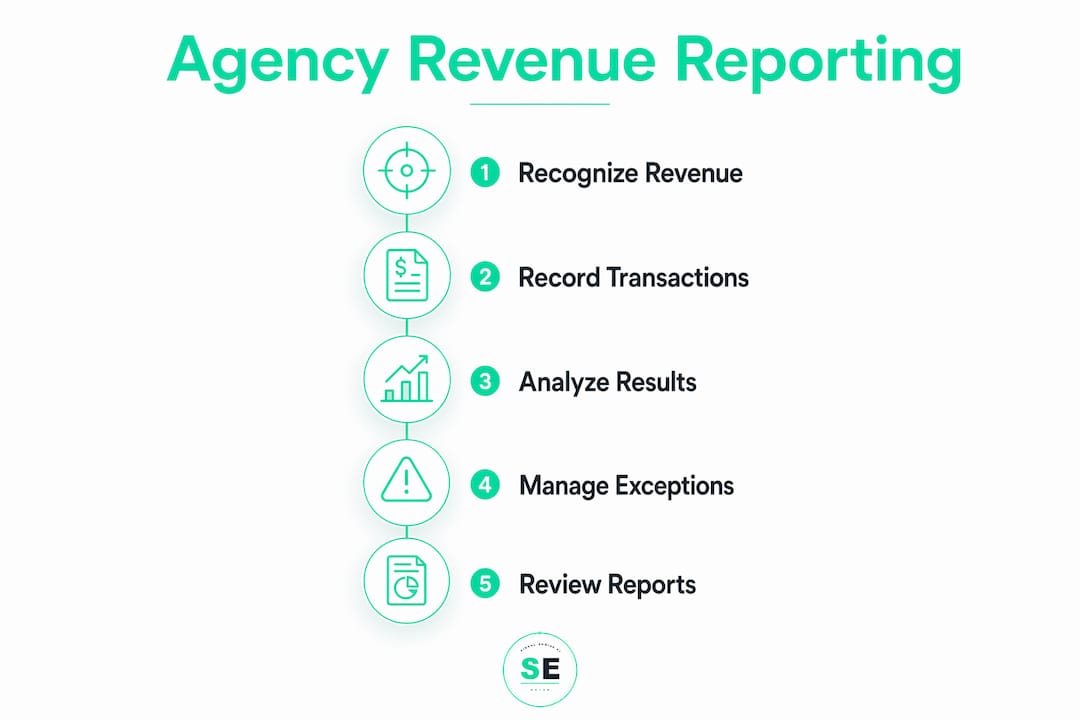
Accurate revenue reporting does not happen automatically. It requires defined workflows, clear ownership, and a disciplined monthly close process. Standardized workflows enable a 5-day monthly close with project reviews and assigned ledger owners validating every revenue and expense line before the books close.
The month-end close process should follow a fixed sequence:
- Day 1–2: Project managers confirm all deliverables completed and hours logged for the period
- Day 2–3: Finance reconciles billing data against delivery records to validate revenue recognition
- Day 3–4: Pass-through costs are cleared from client accounts and moved to the correct expense lines
- Day 4–5: Leadership reviews the draft P&L, flags variances above threshold, and approves the close
Exception management is where most agency reporting breaks down. Exception mismatches should be acknowledged within 4 hours and resolved within 48 hours to maintain data accuracy. That is a tight window, and it requires a dedicated exception queue rather than an ad hoc email chain. When discrepancies sit unresolved for days, they compound and corrupt the monthly close.
Technology plays a direct role in keeping this process reliable. Integrating your project management, billing, and accounting systems eliminates the manual data transfers that introduce errors. Automated exception management and ledger ownership are the two structural changes that most reliably prevent fragile reporting at scale. Assigning a named owner to each revenue ledger creates accountability. Automating exception detection means problems surface in hours, not at month-end.
Pro Tip: Assign a named ledger owner to every client account, not just a team. When a discrepancy appears, the owner is responsible for resolution within 48 hours. This single accountability rule reduces close time and improves data integrity more than any software upgrade.
What metrics do agency managers use to optimize revenue?
Understanding agency revenue tracking goes beyond producing reports. The real value comes from interpreting what those reports tell you about pricing, client mix, and labor efficiency.
Client profitability is the most underused metric in agency management. 20% of clients generate up to 80% of profit, while some clients actively lose money. That is the Pareto principle applied directly to your client roster. Most agency leaders know this intellectually but never act on it because they lack a clean client profitability report. Once you have one, the conversation about repricing or exiting unprofitable clients becomes a data conversation, not a feelings conversation. For a deeper look at identifying profitable clients, revenue attribution analysis gives you the full picture.
Utilization rate is the agency-specific efficiency metric that connects your labor cost to your revenue capacity. A utilization rate below 65% means you are paying for hours that generate no revenue. Above 85%, your team is at risk of burnout and quality decline. The target range for most agencies sits between 70% and 80% billable utilization.
AGI informs your pricing strategy in a way gross revenue never can. When you know your true earned income after pass-throughs, you can set rates that actually cover overhead and deliver margin. Revenue recognition failures around retainers and WIP cause margin distortions that make profitable accounts look unprofitable and vice versa. Fixing recognition timing fixes your pricing signals.
"The agencies that grow consistently are not the ones with the most clients. They are the ones that know exactly which clients are worth growing."
AR aging and cash flow monitoring close the loop. An agency can show strong P&L results while running dangerously low on cash if collections lag. Reviewing AR aging weekly and using AI tools for AR management catches slow-paying clients before they create a liquidity problem.
Why most agencies get revenue reporting wrong
I have worked with enough agency operators to recognize a pattern. The reporting exists. The spreadsheets are there. The accounting software is running. But the numbers are wrong, and nobody knows it until a quarter closes badly.
The root cause is almost always pass-through misclassification combined with inconsistent revenue recognition timing. An agency books a $200,000 media buy as revenue, shows a strong top line, and then wonders why the bank account does not match the P&L. The answer is that separating general accounting from cost accounting is not optional. It is the structural foundation that everything else depends on.
The second failure I see consistently is the absence of ledger ownership. When everyone is responsible for data accuracy, no one is. Assigning named owners to specific revenue ledgers and holding them to a 48-hour exception resolution standard changes the culture around financial data. It stops being a finance department problem and becomes an operational discipline.
My honest recommendation: before you invest in better reporting software, fix your recognition schedule and your pass-through accounting. Clean inputs produce clean reports. Sophisticated tools running on dirty data just produce faster wrong answers.
— Bernard
How Signalengine helps agencies detect revenue leaks fast
Your reporting pack tells you what happened. Signalengine tells you what is about to happen.

Signalengine is the revenue intelligence platform built for businesses that do not have time to dig through data manually. It scores customer behavior automatically, flags clients showing churn signals before they leave, finds openings in your competitive market, and surfaces the next best action without you asking. For agency operators who have built solid reporting foundations and want to turn those insights into proactive revenue moves, Signalengine closes the gap between knowing your numbers and acting on them. Setup takes five minutes. Pricing starts at $49 per month.
Key takeaways
Agency revenue reporting works correctly only when revenue recognition aligns with service delivery, pass-through costs are excluded from earned income, and each report in the pack has a named owner and a fixed review cadence.
| Point | Details |
|---|---|
| ASC 606 governs recognition | Record revenue when services are delivered, not when invoiced or paid. |
| AGI reveals true margins | Subtract pass-through costs from gross revenue to see actual earned income. |
| Six reports form the core pack | P&L, AR aging, utilization, client profitability, cash flow, and budget variance cover all critical dimensions. |
| Pareto drives client decisions | 20% of clients generate up to 80% of profit; use client profitability reports to act on this. |
| Exception speed protects integrity | Acknowledge discrepancies within 4 hours and resolve within 48 hours to keep data clean. |
FAQ
What is agency revenue reporting?
Agency revenue reporting is the process of recognizing, recording, and analyzing revenue based on when services are delivered, following standards like ASC 606. It separates agency-earned income from pass-through client costs to produce accurate financial statements.
What is adjusted gross income for an agency?
Adjusted gross income (AGI) equals total revenue minus pass-through expenses such as media buys and vendor fees. It reflects the income actually available to cover agency overhead and generate profit.
How often should agencies review their financial reports?
Cash flow and AR aging reports should be reviewed weekly. Profit & Loss and utilization reports should be reviewed monthly. Client profitability summaries are best reviewed quarterly to identify pricing and retention decisions.
Why does pass-through cost misclassification matter?
Reporting pass-through costs as agency revenue inflates top-line figures and hides poor margins. This creates false confidence in financial performance and leads to mispriced services and underestimated overhead.
What is a realistic monthly close timeline for an agency?
A well-structured agency can complete its monthly close in five days using standardized workflows, project delivery reviews, and assigned ledger owners. Exception mismatches should be resolved within 48 hours to keep the close on schedule.
Ready to Stop the Revenue Leak?
Signal Engine gives small and local businesses 31 AI-powered tools to score leads by buying intent, predict churn before it happens, auto-generate email and SMS campaigns, and recover missed calls automatically — all in one dashboard starting at $49/month.
Start your free 7-day trial — no credit card required. Setup takes 5 minutes.