

The single most effective thing you can do for salon client retention is convert one-off visits into recurring booked relationships and stop appointment drift before it starts. The four fastest levers are pre-booking at checkout, automated reminders, personalized follow-up, and simple loyalty incentives. Below, you get the prioritized tactics, the scripts, and the KPIs to track so you know it's working.
TL;DR:
- Improving pre-booking and automated reminders can significantly reduce appointment drift and increase client retention rates.
- Personalizing client records and building trust through relational benefits boosts clients' likelihood of returning and enhances overall loyalty.
- Launching simple, easy-to-manage loyalty and referral programs can boost repeat visits and new client acquisition, but only if tracked and optimized regularly.
- Automating booking, reminders, and follow-up communications helps small salons recover missed appointments and manage client relationships without extra staff.
- Focusing first on fixing checkout scripts to secure future bookings is the most efficient step toward reversing retention decline.
Table of Contents
- Prioritized retention strategies every salon owner should try
- Pre-booking and appointment frequency: scripts that close the gap
- Personalization and relationship management that actually sticks
- Designing loyalty and referral programs that work for small salons
- Technology and automation that raise retention without adding headcount
- Measure what matters: the compact KPI dashboard
- 30 to 90 day retention playbook: who does what, by when
- Why Bernard wrote this guide and where Signal Engine fits
- What most salons get wrong about retention
- Turn these tactics into automatic revenue recovery
- Ready to Stop the Revenue Leak?
- FAQ
- Sources
Prioritized retention strategies every salon owner should try
Retention tactics are not equal. Some move the needle fast and cost almost nothing, others take longer to pay off. Start with the ones that touch every client visit.
- Pre-booking and appointment anchoring: locks in the next visit before the client leaves your chair. Do this: train front desk and stylists to ask "same time in six weeks?" at checkout, every time.
- Automated reminders and missed-call recovery: cuts no-shows and recovers calls you'd otherwise lose. Do this: turn on SMS confirmations and a text-back for missed calls this week.
- Personalized client records and stylist fit: builds the relationship that keeps people coming back to the same chair. Do this: add a "home routine" field to every client profile.
- Loyalty and referral incentives: rewards the behavior you want more of, repeat visits and referrals. Do this: pick one simple program and launch it this month.
- Retail follow-up and product education: extends the relationship between visits and protects retail revenue. Do this: text a reorder reminder at the 80% mark of product usage.
- Service consistency and add-on suggestions: gives clients a reason to trust the outcome every time. Do this: standardize your consultation questions across the team.
Pro Tip: Pick two tactics from this list, not all six, and get them running well before adding a third.
Pre-booking and appointment frequency: scripts that close the gap
Appointment drift happens when a six-week client quietly becomes an eight or nine-week client. The gap widens, retail sales drop because clients buy elsewhere, and eventually the client doesn't come back at all, a pattern Salon Today has documented as a driver of lost retail revenue and weaker lifetime value.
- At checkout, say: "Let's get you on the books for six weeks out, before you lose this slot." Book it, then confirm by text.
- Send an automated confirmation the day it's booked, a reminder three days before, and a rebook prompt three days after the visit.
- For missed appointments, follow up within the hour with a text offering two alternative slots.
Pull last month's booking data and check what percentage of clients left with a future appointment on the books. That single number, your pre-book rate, tells you more than almost any other metric.
Pro Tip: If your pre-book rate is low, fix the checkout script before you touch anything else.
Personalization and relationship management that actually sticks
Clients don't return because of a good haircut alone. Research on personal service businesses found that relational benefits, personalized contact, trust, and a sense of commitment, significantly increase a client's intention to come back, and habit strengthens that effect over time. That means the notes your stylist keeps matter as much as the service itself.
Capture these fields for every client:
- Home hair care routine and current products used.
- Style goals and any history of color or treatment issues.
- Allergies or scalp sensitivities flagged clearly.
- Preferred stylist and any notes on communication style.
Build a short handoff process so a substitute stylist can read a profile in thirty seconds and deliver the same experience. Once a month, spot-check ten client records: if half are empty, that's your data-quality problem to fix first.
Designing loyalty and referral programs that work for small salons
A loyalty program only earns its keep when it's simple enough for your team to run without extra admin. Zendesk's guidance on loyalty program design is blunt about this: reward the behavior you want, repeat visits or referrals, and keep the mechanics easy to explain in one sentence.
- Punch-card by visit count: rewards loyalty regardless of spend, simple to explain at checkout.
- Spend-and-earn tiers: rewards your higher-spending clients and nudges add-on purchases.
- Holiday red-envelope promotion: a seasonal push that drives rebooking in a slow month.
- Referral voucher workflow: gives both the referrer and the new client a credit toward their next visit.
Track three numbers: how many clients enrolled, how many redeemed a reward, and whether redemption visits brought in more revenue than a typical visit. If none of those numbers move after ninety days, the program needs a redesign, not more promotion.
Technology and automation that raise retention without adding headcount
Small teams don't have hours to spend chasing bookings by hand, which is exactly why the right automation pays for itself. Salon Today's reporting on salon technology found that targeted automation like SMS confirmations and missed-call text-backs often delivers outsized returns for small shops because it reduces no-shows with almost no staff time.
- 24/7 online booking: captures appointments outside business hours, when many clients actually decide to book.
- SMS reminders: cut no-shows and prompt rebooking automatically.
- Missed-call text-back: turns a call you couldn't answer into a booked visit instead of a lost one.
- Simple CRM: keeps client notes and preferences in one place your whole team can access.
- Online reorder links: catches retail sales between visits instead of losing them to a drugstore aisle.
Roll out booking and reminders first since they touch every client. Add the CRM and reorder links once the basics run smoothly. For reminder timing and message examples, Astreaux's guide to SMS appointment reminders and RealClient's post on reminder cadence are worth a read before you write your own scripts. Our guide on automated outreach sequences covers the reactivation side of the same system.
Measure what matters: the compact KPI dashboard
You can't fix what you don't track. Four numbers tell you almost everything: client retention rate, average days between visits, pre-book rate, and client lifetime value.
Retention rate is the percentage of clients from a given period who return within your typical rebooking window. Average days between visits flags drift early, before a client disappears entirely.
Industry-wide same-store growth flattened to about 2% in mid-2026 while new-guest acquisition fell roughly 10%, which means retention has become the main growth lever for most salons, not new-client marketing.
- Check pre-book rate and no-show rate weekly, they shift fast and are easy to correct.
- Review retention rate and average days between visits monthly, by stylist and by cohort.
- Revisit client lifetime value and loyalty redemption quarterly to catch slower trends.
30 to 90 day retention playbook: who does what, by when
This sequence gets your whole team moving without overwhelming anyone in week one.
- Days 1 to 30: front desk pushes pre-booking at every checkout, reminders go live, staff get a fifteen-minute script training, one retail bundle launches. Owner or manager leads this.
- Days 31 to 60: launch the loyalty program, put online reorder links live, start a reactivation text campaign to clients past their usual rebook window. Manager or marketing lead owns this.
- Days 61 to 90: review all four KPIs, test one new segment (like lapsed VIP clients), and experiment with one new incentive based on what the data shows. Owner reviews results.
Pro Tip: Assign one owner per task from day one, a plan nobody owns rarely survives past week two.
Why Bernard wrote this guide and where Signal Engine fits
Bernard covers small business revenue operations, with a focus on how service businesses turn repeat visits into predictable revenue. The tactics above map directly to automation most salons already need: churn prediction flags clients drifting past their usual rebook window, automated campaigns handle reactivation texts, and missed-call recovery saves visits that would otherwise vanish. Signal Engine is one practical way to run these steps, not the only one.

What most salons get wrong about retention
Most salons chase new clients when the real growth problem sits inside their own client list. Acquisition costs keep climbing while flat same-store growth makes new clients harder to profit from, yet owners still spend more energy on ads than on the client who hasn't rebooked in nine weeks.

The conventional advice, "build a loyalty program," isn't wrong, but it's often the third move, not the first. A loyalty program rewards people who already come back. It does nothing for the client quietly drifting from six weeks to nine. Fix pre-booking and reminders first: they stop the leak. Then add personalization and loyalty to deepen a relationship that's already stable.
If you only have time for one change this quarter, make it the checkout script. Every client who leaves with a booked next visit is a retention problem you don't have to solve later.
— Bernard
Turn these tactics into automatic revenue recovery
Running pre-booking scripts, reminder cadences, and reactivation campaigns by hand works, until your client list grows past what one person can track by memory. The platform can watch for clients drifting past their usual rebook window, draft reactivation texts automatically, and recover missed calls before they become missed visits. The platform includes churn prediction and campaign automation, with no per-seat pricing. The Free plan is a reasonable way to see what fits your salon before committing to anything. Explore the plans and pricing or see it running on a live demo.
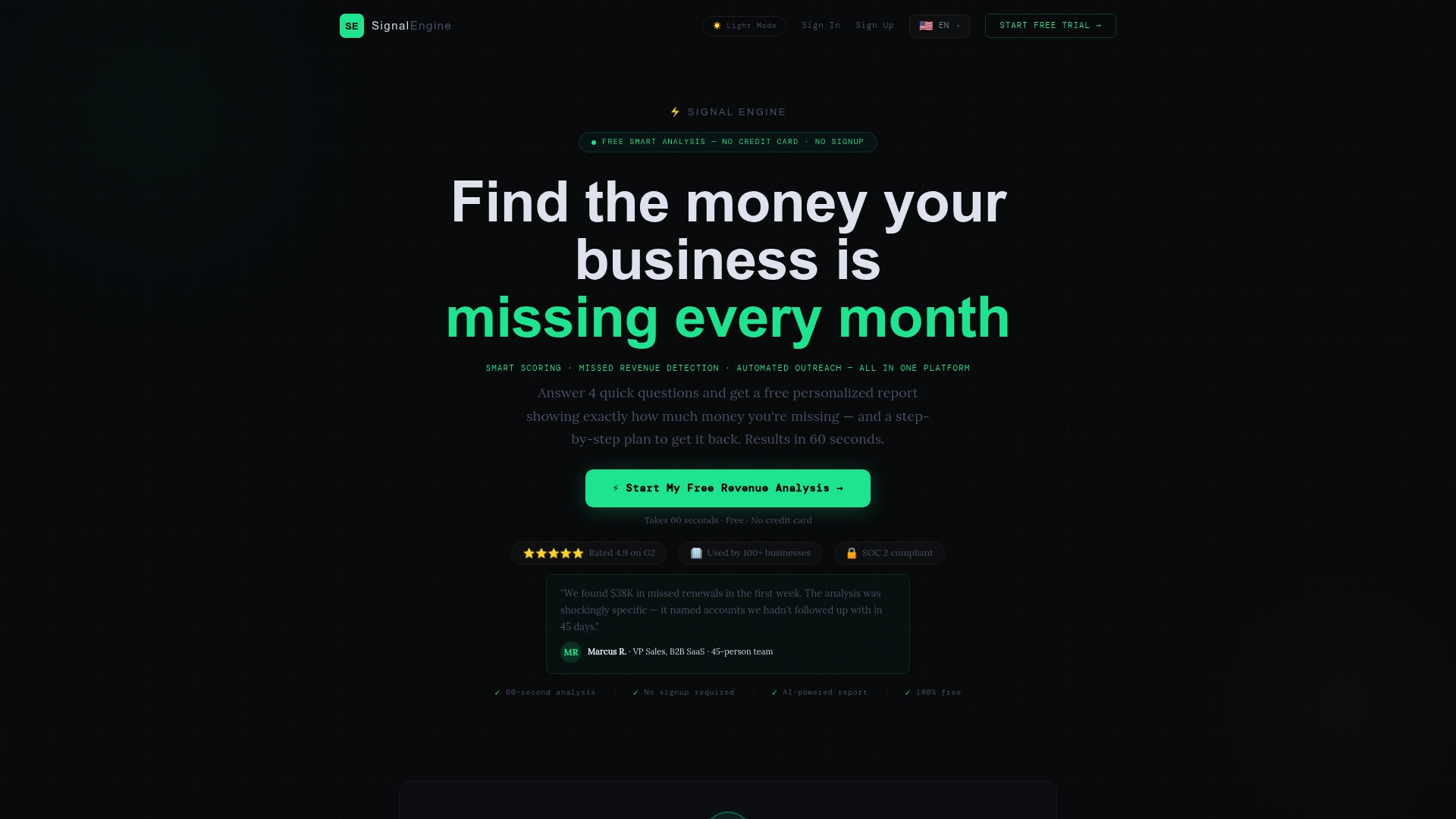
Ready to Stop the Revenue Leak?
Signal Engine gives small and local businesses 31 AI-powered tools to score leads by buying intent, predict churn before it happens, auto-generate email and SMS campaigns, and recover missed calls automatically, all in one dashboard starting at $49/month.
Start your free 7-day trial, no credit card required. Setup takes 5 minutes.
FAQ
How to increase clients in a salon?
The fastest path is retaining the clients you already have, since industry-wide new-guest acquisition fell roughly 10% in 2026 while retention stayed the stronger growth lever. Pair strong pre-booking habits with a simple referral incentive to bring in new clients through people who already trust you.
How much tip for $200 hair?
Tipping amounts vary by region and personal budget, so there's no single standard figure to cite here. A common approach is tipping a percentage of the service total, adjusted for exceptional service or a longer appointment.
How to ensure client retention?
No single tactic guarantees retention, but combining pre-booking, automated reminders, and personalized client records addresses the main reasons clients drift away. Relational benefits like personalized contact and trust have been shown to meaningfully increase a client's intention to return.
Why do clients leave their hair stylist?
Clients often drift away gradually rather than leaving abruptly, with visit gaps stretching from a typical six weeks to eight or nine weeks before they stop coming entirely, a pattern Salon Today has tracked alongside lost retail sales. Inconsistent service, a lack of personal connection, and poor follow-up between visits are common underlying causes.
Sources
- What's really happening with salon retail and how to reclaim your revenue — Salon Today
- The influence of relational benefits on behavioral intention and the moderating role of habit — MDPI
- Loyalty programs: How they work, examples, and tips — Zendesk