

Scope creep in consulting is the unauthorized, uncompensated expansion of work beyond what an engagement's Statement of Work actually specifies. That's distinct from a scope change, which is documented, priced, and approved before anyone touches it. The Project Management Institute has tracked scope failures as a leading driver of cost and schedule overruns for years, and steering-committee governance gaps are usually where the drift starts.
If you suspect it's happening right now, do this before you do anything else:
- Stop work on the new ask. Don't quietly absorb it into this week's deliverable.
- Log the request in writing, even if it's a two-line email to yourself, with the date and who asked.
- Run a 10-minute impact estimate on hours and calendar days.
- Send a holding message to the client that names the request and asks for formal approval before you proceed.
Key Takeaways
Scope creep in consulting is unauthorized, uncompensated work expansion, and it's stopped through a tight SOW, a fast change-control process, and weekly budget-versus-milestone checks.
| Point | Details |
|---|---|
| Definition first | Scope creep is unapproved, uncompensated work growth; a scope change is documented, priced, and approved. |
| Know the real cost | A significant share of consulting projects see scope creep, with affected projects experiencing notable cost overruns. |
| Watch two numbers weekly | Track budget burn against milestone completion and undocumented requests logged per period. |
| Fix the SOW before signature | Measurable deliverables and explicit exclusions prevent more creep than any mid-project conversation. |
| Use a holding note | A same-day written note on out-of-scope requests preserves chargeability and creates a paper trail. |
| Monitor engagement signals automatically | Signal Engine flags budget burn and invoice pattern shifts so drift surfaces before it reaches a dispute. |
Table of Contents
- What Does Scope Creep Look Like in Consulting?
- What Causes Scope Creep in Consulting Engagements?
- What Are Some Real Examples of Scope Creep in Consulting?
- What Does Scope Creep Actually Cost a Consulting Firm?
- How Do You Detect Scope Creep Before It Becomes a Dispute?
- How Do You Manage and Prevent Scope Creep in Consulting?
- What SOW Language Actually Prevents Scope Creep?
- Scope Change or Scope Creep: How Do You Tell the Difference?
- Turn Scope Monitoring Into Revenue Protection
- Ready to Stop the Revenue Leak?
- Sources
- FAQ
What Does Scope Creep Look Like in Consulting?
Consulting scope creep hides better than it does in software or construction. A missed feature or an unpoured foundation is obvious. A slightly deeper competitive analysis or a workshop that runs an extra hour isn't. Deliverables like strategy decks, recommendations, and facilitated sessions are judged on quality and perceived usefulness, not a checklist, so a client can ask for "just a bit more" without either side registering it as a scope change.
The common forms are predictable once you know to watch for them: an extra round of stakeholder interviews because "we want to make sure we heard from operations too," a deliverable that grows from a five-slide recommendation to a twenty-page appendix, or the "one quick ask" during a working session that turns into three days of new analysis. None of these feel like a big deal in the moment. That's exactly why they add up.
What Causes Scope Creep in Consulting Engagements?
Most scope creep traces back to a handful of fixable failures, and PMI's own research points to the same root causes across industries.
- Vague SOW or RFP language. Deliverables described as "provide strategic recommendations" instead of naming format, length, and acceptance criteria.
- Rushed discovery. Skipping stakeholder mapping up front guarantees someone important surfaces mid-project with new requirements.
- Stakeholder turnover. A new sponsor rewrites priorities without renegotiating the contract.
- Invoice or billing misalignment. Fixed-fee pricing with no milestone billing removes any natural checkpoint to flag added work.
- Steering-committee drift. Committees that start out defining terms slide into simply rubber-stamping delivery, and ConsultingQuest's governance research shows this is usually where creep gets normalized before it ever shows up as a budget line.
- Time-and-materials incentives. T&M can quietly reward scope growth instead of flagging it, if nobody's watching hours against the original estimate.
Vague SOW language and rushed discovery are cheapest to fix during the sales process, before signature. Governance drift and billing misalignment are delivery-phase problems and need a standing review habit, not a one-time contract fix.
What Are Some Real Examples of Scope Creep in Consulting?
A market-entry engagement scoped for three data visualizations ends with eleven, because each client review added "one more chart, it'll be quick." Nobody priced the extra six. The lesson: a change request at chart number four would have stopped seven hours of unpaid work.
A pricing strategy project scoped for two weeks of analysis absorbs a running stream of ad hoc data pulls from a client analyst who emails "can you also check this" every few days. Three weeks later, the consultant has done a second project's worth of analysis for the price of one.
A one-hour "quick sync" with the CFO turns into a 90-minute working session that surfaces two new workstreams. The consultant leaves having verbally agreed to deliverables that were never in the SOW, with no record beyond a meeting note.
Each case shares the same missing step: a pause to ask "is this in scope," followed by a documented decision either way.
What Does Scope Creep Actually Cost a Consulting Firm?
Consulting-specific analysis puts real numbers on what feels, in the moment, like a small favor. Industry benchmarking finds that roughly 52% of consulting projects experience scope creep, and affected projects run an average cost overrun of about 27%.
That overrun shows up in a few predictable places:
- Margin erosion, since unpaid hours come straight out of the engagement's profitability, not just its billed revenue.
- Schedule slip, as the same team absorbs new work without a matching extension to the delivery date.
- Team burnout, when consultants quietly work extra hours to protect the client relationship instead of raising the issue.
- Relationship damage, ironically, because clients who get used to free extras start expecting them, and pushback later feels like a broken promise rather than a fair boundary.
Watch two numbers weekly: budget burn against milestone completion, and the ratio between hours logged and hours billed. A gap between those two lines is the earliest reliable signal that creep, not underestimation, is the problem.
How Do You Detect Scope Creep Before It Becomes a Dispute?
Scope creep is hardest to fight once it's invisible, and documentation gaps are usually why it stays invisible until an invoice dispute forces the conversation. Three signals catch it early: budget burn running ahead of milestone completion, deliverables slipping without any documented change request behind the delay, and invoice patterns that shift, like a fixed-fee engagement suddenly generating far more billable hours than the original estimate assumed.
Three metrics make those signals concrete instead of gut-feel. Track the percentage of budget consumed against the percentage of deliverables actually complete. Track the average size of tasks compared to what was originally estimated, since tasks that keep growing are a leading indicator. Track the raw count of undocumented requests logged in a given period, even the ones you said yes to.
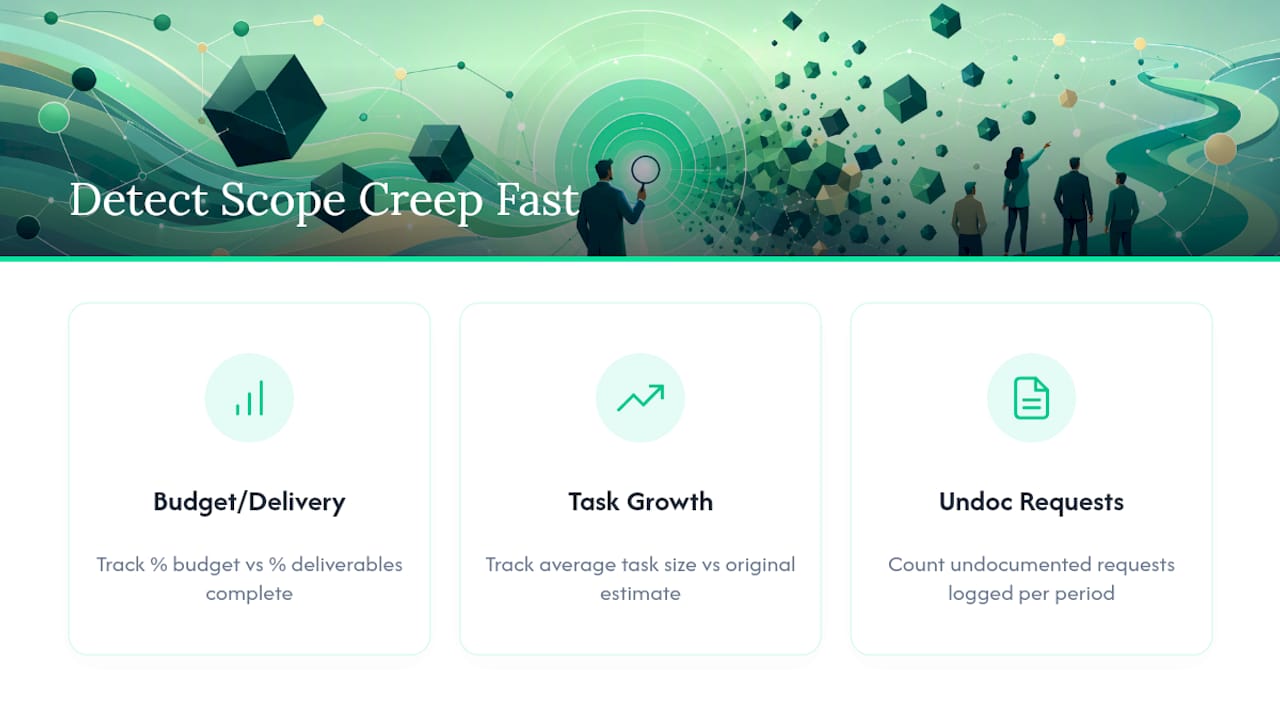
Pair those metrics with a simple rhythm: a short weekly internal team check, a weekly client status update that explicitly names scope status, and a monthly budget review against the milestone plan. A tool that surfaces engagement and revenue signals automatically removes the guesswork from spotting the burn-versus-completion gap before a client call forces the issue.
How Do You Manage and Prevent Scope Creep in Consulting?
Prevention starts before the contract is signed and continues through every status meeting after. Asana's scope management guidance is built around the same core idea: active management and a formal change-control process beat hoping the client stays reasonable.
Build the SOW to survive scrutiny. Every SOW should specify the deliverables by name and format, the measurable acceptance criteria for each one, an explicit exclusions list, named roles and approval authority on both sides, and milestone definitions with clear conditions for sign-off. Vague deliverables are the single easiest cause to eliminate, and it costs nothing to fix at the drafting stage.
Run change requests through a lightweight, repeatable process.
- Triage the request the day it arrives: is it a genuine addition or a clarification of existing scope?
- Estimate impact quickly, hours and calendar time, even roughly.
- Document the request and estimate in writing and route it for client approval.
- Convert approved requests into a formal change order and log it against the invoice.
Choose the pricing model that matches your risk. Fixed-fee protects predictable, well-scoped work but punishes you hardest when scope drifts. Time and materials removes that risk but needs disciplined hour tracking to avoid looking like you're padding. Phased or milestone-based pricing splits the difference: each phase gets its own fixed price and its own re-scoping checkpoint, which gives both sides a natural, low-drama moment to renegotiate.
Use governance to force the conversation, not avoid it. A steering committee should open every meeting with a two-minute scope-status item, not bury it in "any other business." Standing agendas that force a budget-versus-deliverables check keep drift from compounding silently for a month.
Pro Tip: When a client asks for something outside scope mid-meeting, send a same-day "holding note" that restates the request, flags it as a potential change, and confirms you're pausing work on it pending approval. It keeps your hours chargeable, puts the ball in the client's court, and gives you a timestamped paper trail if the invoice conversation gets tense later.

What SOW Language Actually Prevents Scope Creep?
Specific, measurable language does more preventive work than any amount of goodwill. A deliverable clause should read something like: "Deliver a market-entry strategy report of 15 to 20 pages, including three prioritized market recommendations, delivered as a PDF and reviewed in one 90-minute working session." That's testable. "Provide market entry recommendations" is not.
Exclusions clauses need the same specificity. Try: "This engagement does not include implementation support, staff training, or ongoing monitoring after the final report delivery," or "Additional stakeholder interviews beyond the five scoped in Section 2 will be billed at the standard hourly rate under a signed change order."
A change-request form doesn't need to be elaborate. Capture six fields in a single email or one-page form: requester name, date, description of the request, estimated hours and cost, impact on the delivery timeline, and a signature or written approval line. Attach the SOW's deliverable clauses as an appendix so the client sees the baseline you're measuring against, and send the change-request template the moment a request lands, not after you've already started the work.
Scope Change or Scope Creep: How Do You Tell the Difference?
A scope change is documented, priced, and approved before work starts. Scope creep is none of those things, work expands and nobody signed off on it. The terminology gets muddled with "feature creep" too, but the practical test for a consultant is simpler: ask whether the addition is documented, whether it's compensated, and whether it's approved.
If the answer to all three is yes, price it, schedule it, and issue a change order. If any answer is no, pause work on that item, run the impact estimate, and either request formal approval or decline. When you raise this with a client, frame it around protecting the engagement's quality and timeline, not around money. "I want to make sure we scope this properly so it doesn't push back your final deliverable" lands better than a line about billing.
A consultant's take on holding the line
Governance beats heroics every time. The consultants who avoid scope creep aren't the ones who work the hardest to absorb extra requests. They're the ones who built a SOW tight enough, and a weekly habit disciplined enough, that drift gets caught in week one instead of week ten. A ten-minute Friday review of "what did we do this week that wasn't in the SOW" catches more creep than any contract clause ever will.

Turn Scope Monitoring Into Revenue Protection
Catching scope creep early is really a monitoring problem, and that's the same problem Signalengine was built to solve for revenue teams. Signal Engine tracks the same kind of drift signals this article walks through: budget burn against milestones, shifting invoice patterns, repeated undocumented requests, and scores them automatically so you're not relying on memory or a gut feeling during a status call.
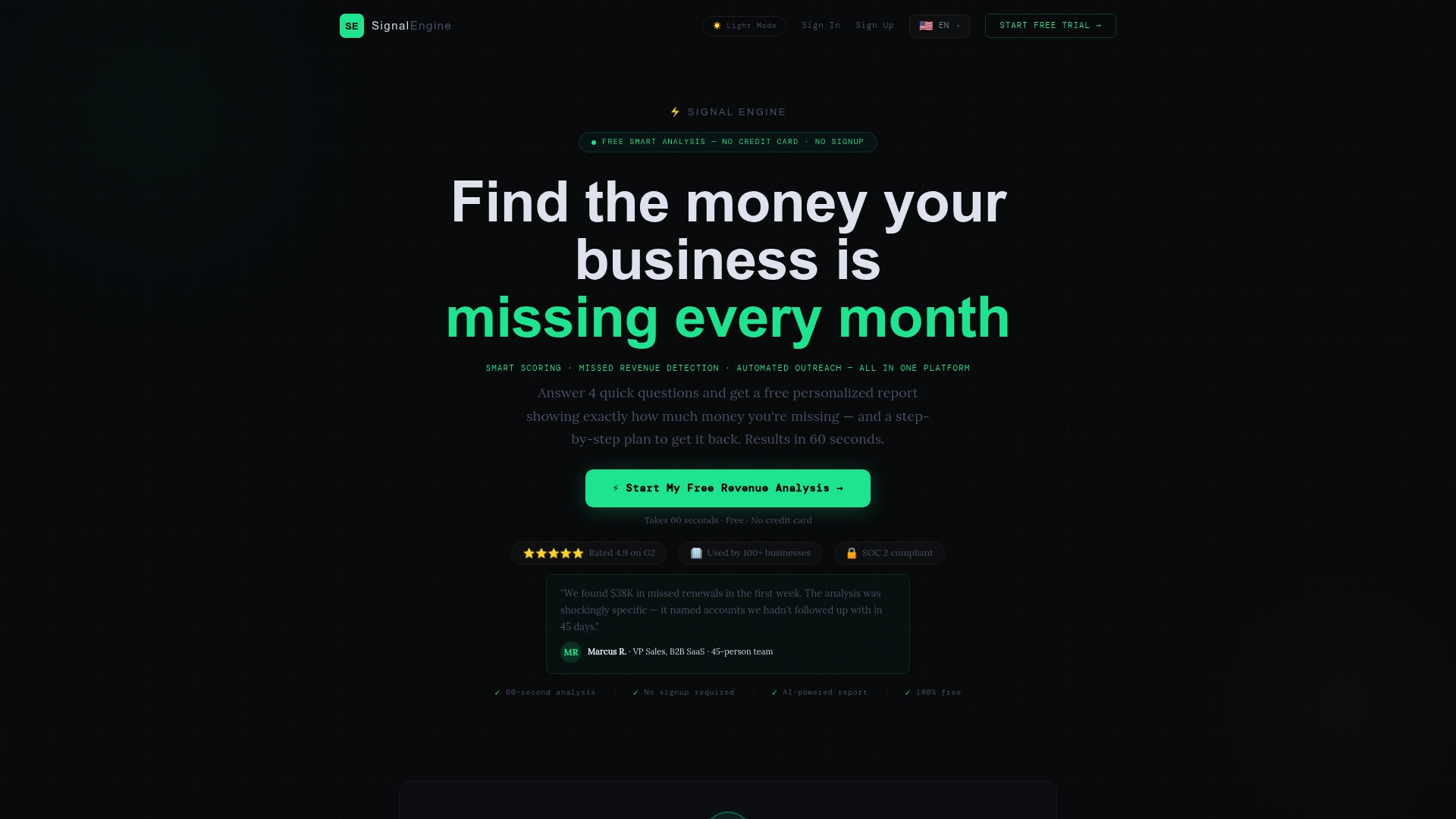
For a consulting firm juggling multiple engagements, that means less time reconstructing what happened three weeks ago and more time acting on it while there's still billing leverage. The platform's revenue intelligence tools for small businesses surface exactly the kind of pattern shift that separates a healthy scope change from creep that's already cost you a week of unbilled hours.
Ready to Stop the Revenue Leak?
Signal Engine gives small and local businesses 31 AI-powered tools to score leads by buying intent, predict churn before it happens, auto-generate email and SMS campaigns, and recover missed calls automatically — all in one dashboard starting at $49/month.
Start your free 7-day trial — no credit card required. Setup takes 5 minutes.
Sources
- What is scope creep (Asana)
- Consulting scope creep (Scopecreeper)
- Change orders, scope creep and governance issues (ConsultingQuest)
- Consulting Scope Creep Is a Documentation Problem (Fieldway)
FAQ
What Is Scope Creep in Simple Words?
Scope creep is when a project quietly grows beyond what was originally agreed, without anyone formally approving the extra work or paying for it.
What Is a Famous Example of Scope Creep?
Large public infrastructure and software rollouts are the most commonly cited examples, where added requirements piled up without matching budget or schedule changes; in consulting, the same pattern shows up on a smaller scale through added analysis and expanding deliverables that never get a change order.
Is $100 an Hour Good for Consulting?
It depends heavily on specialty, market, and experience level, and no single rate applies across consulting; what matters more than the rate itself is whether your SOW and change-control process protect that rate from being eroded by unbilled scope creep.
What Is the Rule of Three in Consulting?
Definitions vary by firm and specialty, so there's no single agreed-upon version; consultants asking about this are usually better served by focusing on documented scope management rather than an informal rule.
How Do You Communicate Scope Creep to a Client Without Damaging Trust?
Frame the conversation around protecting the engagement's quality and timeline rather than money, and bring a documented change request so the client sees a specific ask, not a vague complaint.