

Failed payments are a leading cause of subscription churn because they turn willing customers into inactive accounts unless someone recovers the charge fast. This isn't a customer-service problem or a marketing problem. It's a billing plumbing problem that gets blamed on "retention."
Industry benchmarks put involuntary churn at 20% to 40% of total subscription churn, and roughly 15% of recurring card charges fail on any given attempt. Recurly's data, cited in a Recurly analysis, tied 42% of subscription cancellations to failed payments, costing DTC subscription brands an estimated $47 billion. Every one of those customers wanted to stay. Their card just didn't cooperate.
Here's what happens next if nobody intervenes:
- Revenue disappears the moment the charge fails, not weeks later when someone notices.
- Support tickets spike from confused customers who thought they were still paying.
- Trust erodes fast. Customers assume you messed up, even when their bank did.
- Signalengine flags these accounts automatically, scoring who's at risk before the next billing cycle hits.
The fix is not complicated. Prioritize a card updater, layer in smart retry timing, and run a short, clear dunning sequence. Get those three right and most of this problem goes away.
Key Takeaways
Involuntary churn from failed payments is preventable in most cases, but only if retry logic, card updaters, and dunning are treated as one coordinated system rather than three separate afterthoughts.
| Point | Details |
|---|---|
| Involuntary churn is distinct | It typically makes up 20% to 40% of total subscription churn and needs its own tracking, separate from voluntary cancellations. |
| Recovery compounds fast | Combining account updaters, smart retries, and dunning can recover 60% to 80% of otherwise-lost revenue from failed charges. |
| Visible errors cost more than the transaction | Roughly 62% of users who hit a payment error never return, so speed and clarity in outreach matter. |
| Sequence fixes by effort | Start with account updaters and backup payment capture, then smart retries, then failover infrastructure. |
| Signalengine flags risk early | Signalengine scores subscriber churn risk automatically, helping teams prioritize which failed payments need urgent human follow-up. |
Table of Contents
- What Failed Payments and Involuntary Churn Actually Mean
- How a Failed Payment Actually Becomes Churn
- Common Reasons Payments Fail
- How to Measure Failed Payments and Involuntary Churn
- How to Recover Failed Payments and Reduce Involuntary Churn
- Building Payment Resiliency So Technical Failures Stay Invisible
- 10-Step Checklist to Cut Involuntary Churn This Quarter
- The ROI Case for Fixing Failed Payments
- What Operators Consistently Get Wrong About Involuntary Churn
- Ready to Stop the Revenue Leak?
- Sources
- FAQ
What Failed Payments and Involuntary Churn Actually Mean
A failed payment is any charge attempt that a card network or bank rejects, whether it's an authorization decline, a gateway timeout, or a processor error. Involuntary churn is what happens next: the subscriber loses access not because they chose to cancel, but because the payment never went through.
That distinction matters more than most billing teams treat it. Voluntary churn means someone decided your product wasn't worth it. Involuntary churn means your product was worth it, and a card network got in the way.
A few everyday examples make the pattern obvious:
- A customer's card expires right before their renewal date and nobody catches it.
- A subscriber has the money but hits a temporary cash crunch on the day before payday, so the charge bounces.
- Your payment processor has a brief outage during a checkout window and the retry never fires.
Card expiration alone drives a huge share of these failures, and the split between "soft declines" (temporary, often recoverable) and "hard declines" (permanent, requiring customer action) determines how you should respond. Treating every decline the same way, retrying blindly and hoping, is how businesses leave $47 billion on the table industry-wide. Tools like Signalengine exist specifically to separate the recoverable failures from the ones that need a human touch.
How a Failed Payment Actually Becomes Churn
The path from a single declined charge to a canceled subscription runs through several steps, and each one is a chance to intervene or lose the customer for good.
A charge fails at the gateway. Your billing system either retries on a fixed schedule or does nothing. Dunning emails go out, or they don't. The customer's access gets suspended after a grace period. If nobody has fixed the payment method by then, the subscription cancels. Now you're paying to re-acquire a customer you never actually lost interest from.
Issuer decline codes tell you which branch of that flow you're on. A "do not honor" code often signals a hard decline requiring the customer to act. An "insufficient funds" code is frequently temporary and resolves on retry, especially if you time that retry around a payday. Fire retries too aggressively, though, and some issuers read the pattern as fraud, which can make things worse instead of better.
The behavioral fallout is brutal: roughly 62% of users who encounter a payment error never come back to the site to try again on their own.
That statistic alone should reframe how urgently your team treats a failed charge. Visible errors don't just cost the immediate transaction. They cost the relationship. Customers who hit a decline screen often feel embarrassed or annoyed, and many quietly switch to a competitor rather than track down a new card number and re-enter it.
The interception points are consistent across every subscription business:
- Monitor authorization rates in real time so a failure spike doesn't sit unnoticed for days.
- Time retries around likely paydays and issuer patterns instead of firing on a fixed 24-hour clock.
- Run card updater services in the background so expired cards get refreshed before renewal, not after.
- Route high-value accounts to a human touchpoint the moment a hard decline hits.
Common Reasons Payments Fail
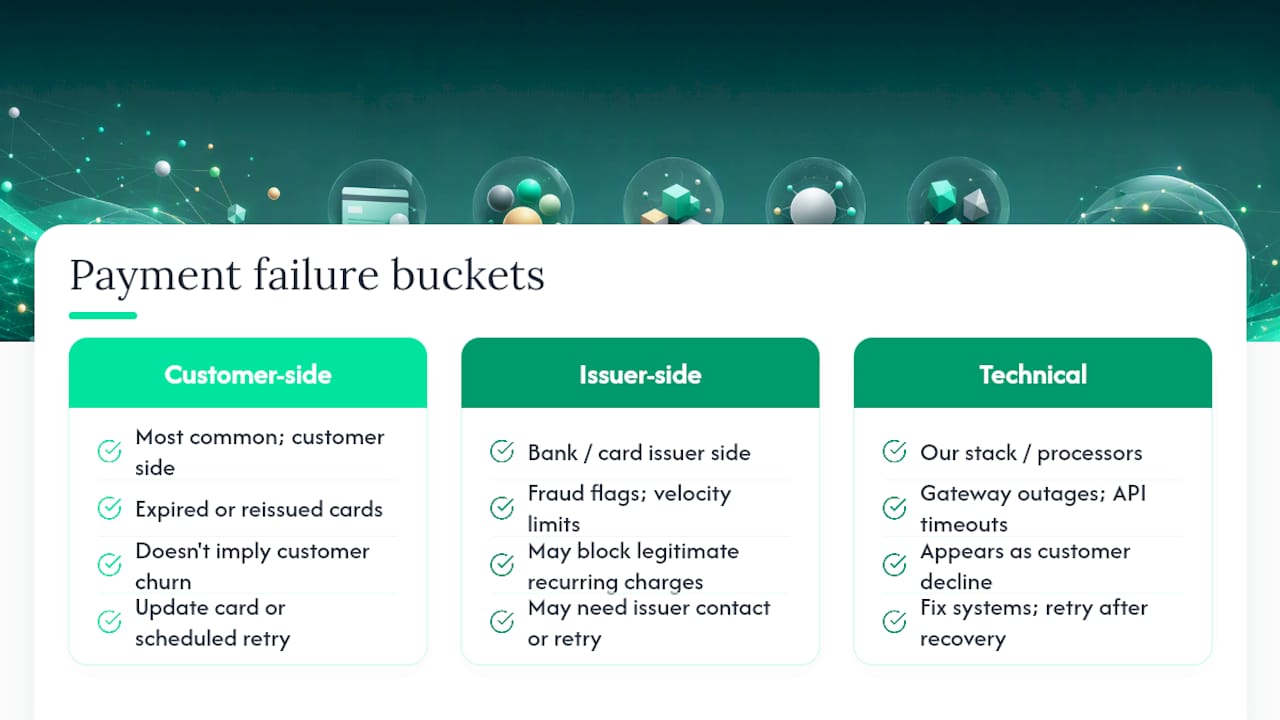
Failures split cleanly into three buckets, and knowing which bucket you're in determines whether automation or a phone call fixes it.
Customer-side causes are the most common and often the easiest to resolve. Expired cards, reissued cards after a fraud incident, insufficient funds, and spending limits triggered by the customer's own bank all fall here. None of these mean the customer wants to leave.
Issuer-side causes happen on the bank's end. Fraud detection systems sometimes flag a legitimate recurring charge as suspicious, especially after a large or unusual transaction on the same card. Velocity limits, where a bank caps how many charges hit a card in a short window, and regional issuer policies that treat cross-border subscription billing differently can also block a charge that would otherwise clear fine.
Technical causes sit entirely on your side of the stack. Gateway or processor outages, network timeouts, misconfigured APIs, and expired SSL certificates all produce declines that look identical to a customer-side problem in your dashboard, but have nothing to do with the customer at all.
The distinction that matters most operationally is soft versus hard decline. A soft decline (timeout, temporary insufficient funds, issuer system hiccup) usually resolves with a well-timed retry. A hard decline (closed account, reported stolen, do not honor) needs the customer to update their payment method. Retrying a hard decline repeatedly wastes cycles and risks a fraud flag; retrying a soft decline once, at the right time, often just works.
Capturing the actual decline code, not just "success" or "fail," is what lets you route correctly instead of guessing. This is also where redundancy earns its keep. Billing platforms like Paddle handle merchant-of-record billing with built-in retry logic, GoCardless specializes in bank-debit collection with its own failure handling for direct-debit specific issues like insufficient funds, and Butter Payments focuses specifically on failed-payment recovery and orchestration across processors. None of these solve the churn problem alone, but they illustrate the range of infrastructure choices subscription operators weigh when a single processor becomes a single point of failure.
How to Measure Failed Payments and Involuntary Churn
You cannot fix what you don't measure, and most billing dashboards default to metrics that hide the problem instead of exposing it.
Three formulas cover the essentials:
- Failed payment rate = failed attempts ÷ total payment attempts.
- Involuntary churn % = subscribers churned due to failed payments ÷ total subscriber base.
- Payment recovery rate = recovered failed charges ÷ initial failed charges.
Run a quick sanity check with real numbers. A business with $50,000 in monthly recurring revenue and a 15% decline rate has roughly $7,500 in monthly charges failing at first attempt.
Smart, payer-aware retry logic that accounts for issuer signals and payday timing has been reported to lift recovery by 23% or more compared to fixed-interval retry schedules.
Add mean time to recovery (MTTR) for failed payments as an operational SLA. How many days pass between a decline and either a successful retry or a customer update? Track that number and treat it like uptime.
How to Recover Failed Payments and Reduce Involuntary Churn
Fixing this doesn't require a total billing rebuild. It requires sequencing the highest-impact, lowest-effort moves first, then layering in the harder engineering work once those are running.
Start with the fixes that require the least lift and pay back fastest:
- Enable Visa and Mastercard account updater services so expired or reissued cards refresh automatically before renewal, without any customer action.
- Capture a backup payment method at signup or during a low-friction moment, not at the point of failure.
- Send in-app reminders before a card is set to expire, giving customers a chance to update proactively.
- Use one-click payment update links in email and SMS instead of forcing customers to log in and hunt through account settings.
Account updater integration alone is consistently cited as one of the highest-ROI interventions available to subscription businesses, because it closes the single biggest recurring failure cause silently, before it ever becomes a support ticket.
Then move to smarter retry logic. Fixed-interval retries (every 24 or 72 hours, no matter what) ignore everything you actually know about the decline. A payer-aware retry system checks the decline code, waits for a likely payday if the failure was insufficient funds, and skips retrying a hard decline that will only fail again. Businesses combining account updaters, smart retries, and structured dunning report recovering 60% to 80% of otherwise-lost revenue from failed charges.
Dunning sequences need discipline, not volume. A good sequence runs three to four touches, not ten. Keep the tone friendly rather than alarmist, in the customer's inbox and not on their support line. Every message needs a one-click update link and a clear date for when access pauses. That clarity alone prevents a lot of the "wait, my subscription is canceled?" support tickets that eat up your team's week. Signalengine's dunning approach follows proven SaaS dunning sequencing built around exactly this kind of restraint.

Build in payment failover for the failures that have nothing to do with the customer. A secondary gateway or acquirer means a processor outage doesn't take your whole billing system down with it. This is infrastructure work, but it removes an entire category of false "customer declined" events from your dunning queue.
Route by severity, not by default. A soft decline on a $9/month plan can run entirely on automation. A hard decline on your highest-LTV account deserves a phone call or a personal email from someone on your team before that customer ever sees a suspension notice. Segment your outreach by account value and decline type, not a single blanket sequence for everyone.
Reconciliation and idempotency matter more than they sound like they should. Every retry needs a unique idempotency key so a network hiccup during a retry attempt never results in charging the same customer twice. Log every failure code. Reconcile nightly. This is unglamorous work, but a duplicate charge on a customer who was already frustrated about a decline is how you turn a recoverable account into a chargeback and a bad review.
Pro Tip: Prioritize card updater integration before you touch anything else on this list. Then run an A/B test on retry timing with a small cohort before rolling it out fully. Every dollar recovered here is recovered MRR, not new revenue, so the ROI math is almost always faster than any acquisition channel you're running.
Building Payment Resiliency So Technical Failures Stay Invisible
Not every decline is about the customer's card. A meaningful share come from your own infrastructure, and those are the failures you can eliminate entirely with the right engineering controls.
Payment orchestration routes a transaction through backup gateways automatically when the primary route shows sustained errors, using health checks and predefined thresholds to decide when to switch. Done right, failover is invisible to the customer. Done wrong, with thresholds too sensitive, it flips back and forth and creates instability instead of solving it.
A solid engineering checklist covers:
- Redundant processors so one outage doesn't take down all recurring billing.
- Regional routing that respects issuer policies in different markets.
- Idempotency keys on every retry attempt, no exceptions.
- Timeout tuning that distinguishes a genuinely failed transaction from a slow-but-successful one.
- Certificate expiration monitoring, since an expired SSL certificate can silently block an entire checkout flow.
- Nightly reconciliation between your billing records and your processor's records.
Watch authorization success rate, gateway error rate, response time spikes, and the distribution of decline codes over time. A sudden shift in that distribution usually means something changed on the technical side, not the customer side.
Pro Tip: Tune failover thresholds conservatively at first and log every triggered event for postmortem review. Overtriggering failover creates its own instability, and you want data before you tighten the trigger. Platforms like Paddle, GoCardless, and Butter Payments represent different approaches to this problem, from full merchant-of-record billing to direct-debit collection to dedicated recovery orchestration, and reviewing how each handles failover can clarify what your own stack is missing.
10-Step Checklist to Cut Involuntary Churn This Quarter
- Billing: Turn on Visa and Mastercard account updater services this week. Quick win, meaningful impact.
- Growth: Add backup payment method capture at signup or during a low-friction upsell moment.
- Billing: Audit your current retry schedule and flag every fixed-interval retry for replacement.
- Engineering: Build a payer-aware retry system that checks decline codes before scheduling the next attempt.
- Growth: Launch a three-touch dunning sequence with one-click update links, replacing any longer, colder sequence you're running now.
- Support: Set up severity-based routing so high-LTV hard declines reach a human within 24 hours.
- Engineering: Add a secondary payment gateway as a failover route for sustained outages.
- Engineering: Implement idempotency keys on every retry to eliminate duplicate-charge risk.
- Billing: Start tracking failed payment rate, involuntary churn %, recovery rate, and MTTR in one dashboard.
- Growth: Run a 30-day experiment comparing your old retry schedule against the new payer-aware one, and measure the recovery uplift directly.
Assign owners now, not later. Vague ownership is the fastest way for this list to sit untouched for a quarter. Signalengine surfaces the accounts at highest risk automatically, so step 9 doesn't require building a dashboard from scratch.
The ROI Case for Fixing Failed Payments
Consider a subscription business running $50,000 in MRR, a 15% decline rate, and involuntary churn making up 30% of total churn. At those numbers, roughly $7,500 in monthly charges fail on first attempt, and a meaningful share of that becomes permanently lost revenue rather than a delayed payment.
That's before counting the customers who never would have churned at all if the retry had simply worked the first time.
- Account updaters typically pay back their integration cost within the first billing cycle they're active.
- Retry optimization pays back almost immediately since it requires no new infrastructure spend, just better logic.
- A backup gateway costs more upfront but eliminates outage-driven churn entirely, which compounds in value as your subscriber count grows.
The gains extend past recovered MRR. Involuntary churn quietly erodes trust and lifetime value even among customers who eventually get recovered, and every account you save on the payment side is one you don't have to re-acquire through a sales or marketing channel that costs far more than a card updater subscription. A detailed breakdown of how this recovery math plays out shows why finance teams increasingly treat payment recovery as its own line item, not an afterthought inside customer success.
What Operators Consistently Get Wrong About Involuntary Churn
Most teams still lump involuntary churn in with voluntary churn on the same dashboard, which is the single biggest mistake I see. A customer who canceled because your product wasn't worth the price and a customer who lost access because their card expired are not the same problem, and blending them hides where the real fix lives.
Start by watching your decline-code distribution the way you'd watch server uptime. A shift there tells you something changed, often before a single support ticket mentions it. Instrument recovery rate as a real KPI with an owner, not a vanity number nobody checks.
The sequencing that works: account updater and backup payment capture first, because they're nearly free and catch the biggest failure category. Then smart retries. Then failover infrastructure once the basics are solid. Skipping straight to failover before fixing retry logic is like reinforcing your roof while the front door is still unlocked.
None of this works as a solo project. Billing, product, and support need a shared SLA for payment recovery, because right now, in most companies, nobody actually owns this problem.
Ready to Stop the Revenue Leak?
Signal Engine gives small and local businesses 31 AI-powered tools to score leads by buying intent, predict churn before it happens, auto-generate email and SMS campaigns, and recover missed calls automatically — all in one dashboard starting at $49/month.

Most billing tools stop at "payment failed, retry in 24 hours." Signalengine goes further, scoring every subscriber's churn risk automatically so you know which failed payment is a card that just expired and which one is a customer already halfway out the door. That distinction changes how you respond, and it's the exact gap most account updater and retry tools leave open. Check out the churn prediction software built for small business to see how it flags at-risk accounts before the next billing cycle even runs.
Start your free 7-day trial — no credit card required. Setup takes 5 minutes.
Sources
- Involuntary Churn: What It Is and How to Fix It (2026)
- Subscription Payment Failures Are Costing DTC Brands $47B in Lost Revenue – Online Store News
- Beancount
- Why Payment Failures Are Silent Killers of Revenue & Customer Experience (CX)
- Payment failover — Stripe
FAQ
What Are the Most Common Reasons for Payment Failure?
Expired or reissued cards, insufficient funds, bank-side fraud flags, and technical issues like gateway timeouts or processor outages account for most recurring payment failures. Soft declines are usually recoverable with a well-timed retry, while hard declines require the customer to update their payment method.
What Are the Main Causes of Customer Churn?
Customer churn splits into voluntary churn (a customer actively cancels) and involuntary churn (access ends because a payment failed). Involuntary churn from payment failures accounts for 20% to 40% of total subscription churn in many subscription businesses.
What Does a 20% Churn Rate Mean?
A 20% churn rate means one in five subscribers leaves within the measured period, whether monthly or annually. If a meaningful share of that is involuntary, tools like Signalengine can help separate payment-driven losses from genuine cancellations so teams fix the right problem.
What Happens if a Payment Fails?
A failed payment typically triggers a retry attempt, followed by dunning communications, and if the customer's payment method isn't updated before the grace period ends, the subscription gets suspended or canceled. Roughly 62% of customers who see a payment error never return on their own, which is why proactive recovery matters more than waiting for the customer to fix it.