

TL;DR:
- Defining one activation event and removing unnecessary steps can significantly reduce SaaS onboarding dropout. Implementing a 0–90 day habit-focused playbook with AI-driven interventions improves retention and decreases churn rates. Signalengine's behavior scoring and automated outreach help identify at-risk accounts early and sustain long-term engagement.
The fastest way to cut onboarding dropout is to define one activation event, strip everything that doesn't lead there, and run a habit-focused 0–90 day playbook with AI-driven interventions for low engagement. That's it. Everything else is noise.
Here's what that looks like in practice:
- Define one activation event — the single user action that predicts long-term retention (first report run, first invoice sent, first project shared)
- Subtract, don't add — cut every field and step that doesn't move users toward that event; target 3–7 core steps
- Add a progress indicator — progress bars alone increase completion rates by 30–50%
- Engineer the return habit — wire the product to an existing workflow so users come back after session one
Impact range: Strong onboarding reduces churn substantially and drives activation rates to a moderate to high level. Every small lift in activation correlates with a measurable reduction in churn.
Table of Contents
- What KPIs actually prove your onboarding is working?
- Your 0–90 day runbook to cut dropout starting this week
- UX tactics that actually cut dropout: subtractive flows and progressive disclosure
- How to use behavioral scoring and AI to stop churn before it happens
- How to measure impact and run experiments that prove improvements
- Common mistakes that undo onboarding gains and how to fix them fast
- Three concrete next steps you can take this week to cut dropout
- Key Takeaways
- The onboarding truth most SaaS teams still miss
- What Signalengine does for your onboarding retention
- Ready to Stop the Revenue Leak?
- Useful sources and further reading
- FAQ
What KPIs actually prove your onboarding is working?
Your activation event is the single user action that statistically predicts month-three retention. "Completed onboarding" is not an activation event. "Closed one ticket using the AI agent" is. Define it as a specific, observable behavior — then build every KPI around it.
Primary KPIs to track:
- Activation rate — target 40–60% (industry median sits at 36%)
- Time-to-value (TTV) — under 5 minutes for self-serve single-player products
- Onboarding completion rate — target 60–85%
- 7/30/90-day retention — customers who hit first value inside 14 days retain at 80%+ at month 12
- Cohort churn rate — segment by acquisition channel and paid vs. free
| KPI | Healthy Benchmark | Churn Signal |
|---|---|---|
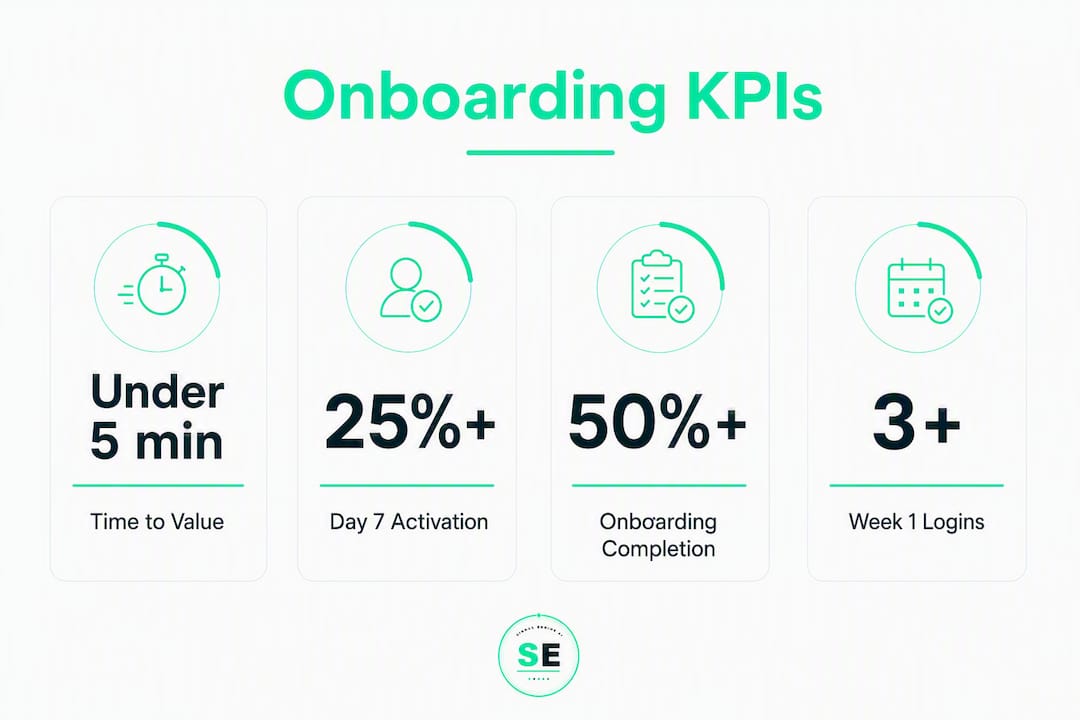
| Time-to-first-value | Under 5 minutes for self-serve | Over 15 minutes indicates retention risk |
| Day-7 activation rate | 40–60% | Under 25% indicates churn risk |
| Onboarding completion | 60–85% | Under 50% indicates churn risk |
| Week-one login frequency | Multiple sessions (over 3) | Fewer than 3 sessions indicates churn risk |
| Feature adoption (14-day) | Multiple core features used | Few features leading to churn |
For an SMB workflow example: if your activation event is "first report generated," map TTV from signup to that action, track the day-7 activation rate by cohort, and flag any account that hasn't hit it by day 3 for automated outreach.
Your 0–90 day runbook to cut dropout starting this week
This is the operational playbook. Assign owners, set the triggers, and run it.
Week 0–1: orient and activate
- Ask one intent question at signup — "What's the #1 thing you want to accomplish?" Use the answer to route users to a personalized onboarding path.
- Pre-fill sample data — seed the account with editable templates so users interact with value immediately instead of staring at a blank dashboard.
- Show a 3–5 step progress checklist — start it at 20% complete (Zeigarnik effect) and end it at the activation event.
- Send a welcome email within 5 minutes — single CTA, one action, no feature list.
Days 2–14: reinforce and habit-engineer
- Trigger a behavioral email at hour 48 if setup is incomplete — short, specific, one link
- Surface contextual tooltips at each new step, not all at once
- Connect the product to an existing workflow (calendar sync, Slack, email) to create a return trigger
- Flag accounts with week-one login frequency under 3 for human callback
Pro Tip: Use email automation for behavior-triggered nudges, not time-based blasts. Behavioral triggers achieve 4.5x higher engagement than scheduled broadcasts.
Days 15–90: expand and lock the habit
- Send role-based nudges tied to habit density signals (feature adoption depth, session frequency)
- Trigger team invite prompts once the primary user hits the activation event
- Celebrate milestones — a simple in-app acknowledgment meaningfully lifts continued activation
- At day 30, send a micro-survey to active users and an escalation offer to inactive ones
- For accounts above $15K ACV, flag stalled accounts for direct CSM outreach
60–70% of annual SaaS churn is decided in the first 90 days. Treating onboarding as a 90-day product, not a one-week checklist, is what separates teams with durable retention from teams constantly refilling a leaky bucket.
UX tactics that actually cut dropout: subtractive flows and progressive disclosure
Subtractive onboarding is more effective than adding more guidance. The goal is to remove every step that doesn't move a user toward the activation event. Target 3–7 core steps. Each extra required action reduces completion by 7–12%.

Progressive disclosure prevents cognitive overload. Reveal features only as users demonstrate need. Use contextual tooltips at the moment of need, not a front-loaded feature tour. Make tours resumable and role-aware, ending at the activation event. Interactive walkthroughs where users perform real actions reduce time-to-value by ~40% versus passive tours.
Empty-dashboard fix: pre-populate accounts with sample data or starter templates. Grammarly drops users into a pre-populated document with intentional errors — value arrives in 30 seconds. That's the model.
| UX Change | Expected Lift |
|---|---|
| Reduce to 3–7 core steps | 20–40% completion increase |
| Add progress bar/checklist | 20–50% completion increase |
| Pre-fill sample data | Eliminates blank-state abandonment |
| Interactive walkthrough vs. passive tour | ~40% faster time-to-value |
Pro Tip: Instrument every skipped step. Skipped steps are your highest-signal redesign targets — they tell you exactly where users are deciding the setup cost isn't worth it. Use that data to optimize your onboarding process before running A/B tests.
How to use behavioral scoring and AI to stop churn before it happens
Behavioral signals tell you who's about to leave before they cancel. Wire these triggers into your automation stack now.
Sample triggers and responses:
- No return within 48 hours of activation → send a personalized re-engagement email with one specific next step
- Habit density below threshold at day 7 (fewer than 3 logins, fewer than 2 features used) → trigger in-app message + CSM alert
- Repeated error events on the same step → surface a contextual tooltip or a "need help?" prompt
- Week-one login frequency under 3 → flag as at-risk and escalate to human outreach
Automation playbook: signal → action
- Low habit density at day 7 → automated email + in-app nudge
- No activation by day 14 → personalized video from a named team member
- Stalled account above $15K ACV → CSM direct outreach
- Activation achieved → celebration trigger + next-step prompt
Signalengine's churn prediction scores customer behavior automatically and flags at-risk accounts before they cancel. It fits directly into this stack: capture step-level events, feed them into the scoring model, and let the automation fire the right intervention at the right moment.
Compliance note: capture email/SMS consent at signup and log all outreach for auditability.
Pro Tip: Tune false positives by setting a minimum signal threshold before triggering outreach. Firing too early trains users to ignore your messages. Start with a 48-hour no-return window and adjust based on measured intervention lift.
How to measure impact and run experiments that prove improvements
"Every 1% increase in activation correlates with roughly 2% lower churn. For a product at the 36% median, every 10 points of activation improvement is roughly 20 points of downstream churn reduction." — SaaS Mag, 2026
A/B test checklist:
- Randomize at the account level, not the user level
- Primary metric: activation rate or TTV
- Guardrail metrics: support ticket volume, Customer Effort Score (CES) by step
- Run at least 2–3 onboarding experiments per week; review the signup-to-activation funnel on a weekly cadence
Cohort analysis steps:
- Separate cohorts by acquisition channel and paid vs. free
- Track retention curves at 7, 30, and 90 days
- Compute time-to-habit vs. time-to-value for each cohort
- Correlate step-level drop-offs with 30- and 90-day retention — prioritize fixes where the largest drop-offs occur
Daily dashboard leading indicators: week-one login frequency, step-level drop-off rates, CES by step, and day-7 activation rate by cohort. These are your early warning system. Lagging metrics like monthly churn tell you what already happened; these tell you what's about to.
Common mistakes that undo onboarding gains and how to fix them fast
Red-flag checklist — act immediately if you see any of these:
- Completion rate under 50%
- TTV over 15 minutes
- More than 12 steps in the critical path
- Week-one login frequency under 3
- High volume of skipped steps in your instrumentation data
Fast remediation playbook:
- Pull your step-level drop-off data and identify the single biggest stop point
- Remove the offending step, pre-fill it, or defer it until after activation
- Add a contextual nudge or human outreach trigger at that exact step
- Re-test with a new cohort and measure activation rate change
The most common bad reaction to high dropout is extending the onboarding checklist or adding more email drips. That's the wrong move. More guidance without habit engineering just delays the same churn. The fix is subtractive: find the drop-off, remove the friction, and create a return trigger. Longer onboarding without a habit hook produces longer time-to-churn, not retention.
Three concrete next steps you can take this week to cut dropout
-
Instrument step-level drop-offs — set up event tracking on every screen and form field between signup and your activation event. Identify the single step with the highest abandonment rate. (Owner: product or engineering; time: 1–2 days)
-
Remove or pre-fill the blocking step, add a progress indicator — cut the field, pre-populate it with a sensible default, or defer it post-activation. Add a visible progress bar showing current step and total steps. (Owner: product/UX; time: 1 day)
-
Set up one behavioral trigger — configure an automated email or SMS that fires when a user hasn't returned within 48 hours of signup. Single CTA, one link, specific to what they started. Use Signalengine's automated outreach to wire this without custom code. (Owner: marketing or CS; time: half a day)
Expected quick wins: activation rate improvement of 10–25 percentage points (toward the 40–60% industry benchmark) within the first two cohorts. Measure by comparing day-7 activation rate before and after each change.
Key Takeaways
Activation-first, subtractive onboarding paired with AI-driven habit signals is the highest-leverage way to reduce SaaS dropout and cut churn by 20–50%.
| Point | Details |
|---|---|
| Define one activation event | Pick the single observable action that predicts month-3 retention and build every step toward it. |
| Subtract before you add | Cut to 3–7 core steps; each extra required action reduces completion by 7–12%. |
| Progress indicators work | Progress bars and checklists increase completion rates by 20–30%; start checklists at 20% complete. |
| Habit engineering beats drips | Front-loaded churn means 60–70% of annual churn is decided in the first 90 days; engineer return triggers, not longer email sequences. |
| Signalengine scores the signals | Signalengine auto-scores customer behavior, flags at-risk accounts, and fires automated outreach — fitting directly into the 0–90 day runbook above. |
The onboarding truth most SaaS teams still miss
Most SMB SaaS teams treat onboarding as a one-time setup task. They build a checklist, write a welcome email, and move on. Then they wonder why churn spikes at month two.
The teams winning on retention have figured out something different: onboarding is a product, and it runs for 90 days. The activation event is not the finish line. It's the starting gun for habit formation. A user who hits the activation event but never builds a return habit will churn just as reliably as one who never activated at all — just a few weeks later.
What actually works is wiring the product to something the user already does every day. A calendar integration. A Slack notification. A weekly report that lands in their inbox whether they log in or not. That's the hook. Everything else — the progress bars, the behavioral emails, the CSM outreach — is scaffolding around that central goal.
The measurement implication is equally underappreciated. Step-level drop-off data is more valuable than any survey. It tells you exactly where users decided the product wasn't worth the effort. Fix that step first. Not the welcome email. Not the pricing page. The specific moment where your users stop.
What Signalengine does for your onboarding retention
Your onboarding playbook is only as strong as the signals feeding it. Signalengine watches every customer interaction, scores behavior in real time, and tells you exactly which accounts are drifting before they cancel.
For SMB SaaS teams running the 0–90 day runbook above, Signalengine delivers:
- Behavioral churn scoring — auto-flags accounts with low habit density before day 14
- Automated email and SMS campaigns — behavior-triggered outreach fires the moment a risk signal appears
- Pipeline and retention analytics — see activation rates, drop-off points, and cohort curves in one dashboard
- At-risk account alerts — escalation ladder from automated nudge to CSM alert, wired automatically
Revenue intelligence for SMBs starts at $49/month. No agency retainer. No six-month implementation. Setup takes 5 minutes, and your first at-risk account alert fires the same day.
Want to see it live? Book a demo and walk through the churn-scoring setup with your own data.
Ready to Stop the Revenue Leak?
Signal Engine gives small and local businesses 31 AI-powered tools to score leads by buying intent, predict churn before it happens, auto-generate email and SMS campaigns, and recover missed calls automatically — all in one dashboard starting at $49/month.
Start your free 7-day trial — no credit card required. Setup takes 5 minutes.
Useful sources and further reading
Signalengine resources:
- How to Reduce Customer Churn: A Practical Guide for SMBs
- How AI Detects At-Risk Customers: A 2026 Playbook
- Automate Churn Intervention Outreach for SaaS Teams
- The 7 Churn Signals Every SaaS Founder Ignores
- SaaS Renewal Rate Improvement Workflow: 2026 Guide
Research and external reading:
- Time-to-Value: The New SaaS Retention Battleground — SaaS Mag
- How Better Onboarding Reduces Churn — RetentionCheck
- SaaS Onboarding Best Practices for Retention — ChurnWard
- How to Reduce SaaS Onboarding Drop-Off — Acquaint Soft
- The 90-Day Churn Window — Signal
FAQ
What is the fastest way to reduce SaaS onboarding dropout?
Define one activation event and remove every step that doesn't lead there. Subtractive onboarding targeting 3–7 core steps, combined with a progress indicator, consistently produces the largest and fastest dropout reductions.
How does onboarding affect SaaS churn rates?
Strong onboarding reduces churn by 20–50%, and every 1% lift in activation rate correlates with roughly 2% lower churn. Customers who reach first value inside 14 days retain at 80%+ at month 12.
What leading indicators predict onboarding-driven churn?
Week-one login frequency under 3, day-7 activation rate under 25%, and onboarding completion under 50% are the clearest early signals. Step-level drop-off data pinpoints exactly where to intervene.
How can Signalengine help with SaaS onboarding retention?
Signalengine scores customer behavior automatically, flags accounts with low habit density before day 14, and fires behavior-triggered email and SMS outreach — covering the full 0–90 day intervention ladder without manual monitoring.
How long should SaaS onboarding actually run?
Treat onboarding as a 90-day product. Roughly 60–70% of annual SaaS churn is decided in the first 90 days, so habit engineering through day 90 is what converts early activation into durable retention.