

A service referral program is a simple system: a happy customer sends you a new customer, you log it, and you reward the referrer once the new job is done and paid. The programs that work are small, specific and tied to a completed job. They ask the right customers at the right moment and track every referral to revenue. This guide gives you the full build, from goal to reward to ask to tracking, so you can launch one this month.
TL;DR
- Start with one measurable goal, such as qualified referrals per quarter, and pay rewards only after the referred job is completed and paid.
- Reward both sides. More than three-quarters of customer referral programs are double-sided, and store credit is the most popular reward.
- Keep rewards modest. In one study of business referral programs, the $41–$100 range had the best success rate.
- Ask right after a good job, and ask the right customers first. Timing and targeting beat blasting your whole list.
- Track from the first call. Capture who referred whom, or you can't pay, measure or improve anything.
Table of Contents
- What a service referral program actually is
- Decide five things before you launch
- Choose a goal you can measure
- Set a reward that motivates without eating your margin
- Build the program in eight steps
- Ask at the right moment
- Target the customers most likely to refer
- Track what matters
- Stay on the right side of the rules
- Put your referral engine on rails with Signal Engine
- FAQ
- Sources
- Ready to Stop the Revenue Leak?
What a service referral program actually is
A referral program turns word of mouth into something repeatable. For a service business, such as HVAC, plumbing, cleaning, dental, landscaping or auto repair, it follows one loop:
- A past customer recommends you.
- The new customer books and names who sent them.
- You log the referral.
- The job is completed and paid.
- The referrer gets the promised reward.
That loop is the whole machine. Everything else in this guide makes each link in it stronger.
Referral programs come in a few common shapes. In a single-sided program only the referrer is rewarded. In a double-sided program the referrer and the new customer both get something. You can also add tiers (bigger rewards for more referrals) or points. For a small business, start with double-sided and flat. Add tiers once you see who your repeat referrers are.
Why bother? Referred leads tend to be warmer than cold ones. Amplifinity's 2016 report on business referral programs found referral leads converted to customers at 13% across programs, compared with a 0.78% average lead-to-deal rate in a Salesforce study it cites. That report is older and the numbers will differ by trade, so treat them as direction, not a promise. The pattern still holds for most local service businesses: a recommendation from a neighbor beats an ad click. If you want the broader business case, read why referral revenue matters for business growth.
Decide five things before you launch
Most programs stall because nobody wrote down the rules. Dillard's Digital's guide for service businesses boils the pre-launch work down to five decisions. Here they are, with how to answer each.
1. Who can refer? Start with customers who already love you: repeat buyers, five-star reviewers, long-term maintenance-plan members. Launch to them first, not to everyone.
2. What counts as a qualifying referral? Define it tightly. A solid definition is a new customer at a new address whose first job is completed and paid. Without this line, you'll argue over every claim.
3. What does the referrer get? Pick the reward and the trigger (see the next section).
4. Does the new customer get a welcome offer? Optional but usually worth it. A small first-job discount makes the referrer's recommendation feel like a favor, not a sales pitch.
5. When is the reward paid? Only after the referred job is paid. This protects your margin and kills most gaming.
Write these five answers in plain English on one page. That page becomes your program terms.
Choose a goal you can measure
"Get more referrals" is a wish, not a goal. Pick one number you can check every month, for example:
- 20 qualified referrals per quarter from active customers
- 10 new referred customers per month, each tied to a first paid job
- 15% of new jobs coming from referrals by year end
One goal keeps the program simple. It also tells you what to track. Clicks and shares are useful signals, but they are not revenue. The number that matters is referred customers who booked and paid.
Set a reward that motivates without eating your margin
The reward question is where owners overthink. Use these guardrails.
Keep it proportional. WordStream's referral marketing guide suggests capping rewards at roughly 10–20% of the gross margin on a referred customer. Do that math on your average ticket first. A $25 credit on a $400 job reads very differently than a $200 payout.
Don't assume bigger is better. In Amplifinity's 2016 data, the average reward was $111. Rewards in the $41–$100 range had the highest success rate, 13%, against 5–6% for rewards above $100. The data is from business referral programs a decade ago, but it matches what most small shops find: a meaningful, easy-to-redeem reward beats a huge one.

Match the reward to the service. Percentage discounts suit recurring work such as cleaning, lawn care and maintenance plans. Fixed dollar amounts suit one-time or high-ticket work such as plumbing, electrical or roofing. Free add-ons, like a deep clean of the oven or a fertilizer treatment, cost you less than their perceived value.
Pick a currency your customers like. The same Impact report found store credit was the most popular reward for both referrers and new customers, with gift cards and cash next for referrers. Credit toward your own services is also the cheapest option, because it brings the referrer back.
A worked example
Say you run a plumbing company with an $800 average job. A reward of about 5–8% of the ticket, or $40–$64, is a sensible starting range. Offer a $50 service credit to the referrer and $50 off the first job for the new customer. Pay the credit once the referred job is paid. If one referral costs you $50 in credit and $50 in discount, you've spent $100 to land an $800 job. Compare that with what your paid ads cost per booked job. That comparison is the real test of the program.
Build the program in eight steps
Here's a practical build you can finish in a few weeks.
- Confirm customers like you. If your reviews and repeat rates are weak, fix service first. Referrals amplify the experience you already deliver.
- Pick the one goal from the section above.
- Choose the structure. Default to double-sided and flat for your first quarter.
- Set the reward within the margin guardrail.
- Pick your tracking method. A spreadsheet, a CRM or a simple form with unique codes works at small volume. Give each referrer a code or link, or at minimum a field in your booking flow that captures the referrer's name.
- Write the terms. One page, plain English: who qualifies, what the reward is, when it's paid, any annual cap.
- Promote it where customers already are. That means your post-job email or text, invoices, estimates, your website and your review requests.
- Review monthly at first. WordStream suggests watching results monthly until the numbers stabilize, usually 60 to 90 days, then quarterly.
If you're building on a tight budget, you can automate more of this later. Customer onboarding automation shows which follow-up steps can run on their own and which should stay personal. For lead capture and email follow-up, see how automating lead capture and email can cut manual work.
Ask at the right moment
Here's the quiet problem with most programs: customers are willing, but nobody asks. HoneyBook's guide reports that 83% of customers say they would refer after a good experience, but only about 29% do. Often they were never asked, or the process was unclear. Treat that as a rough industry figure, but the lesson is solid: the ask is your job.
Time it. The best moment is right after a visibly good outcome:
- The tech finishes the repair and the customer says thanks.
- A customer leaves a five-star review or a 9–10 survey score.
- A maintenance plan renews.
- A recurring client hits a milestone, such as their tenth cleaning.
For emergency and repair work, ask within hours. For installs and bigger projects, give it a day or two. Don't wait weeks, because the good feeling fades.
Make it easy. One click or one text reply. A link that works by text, email or copy-and-paste. No account creation, no long form.
Use one consistent script. For example: "Glad we got it fixed today. If a friend or neighbor needs help, send them our way. You'll each get $50 off." Train every tech, receptionist and office manager to say it the same way.
Capture the referrer at first contact. Add a required "How did you hear about us?" field to every intake form and a line in your call script. Referrals that arrive without a name attached can't be rewarded, and unrewarded referrers stop referring.
Target the customers most likely to refer
Not every customer is equally likely to send you business. Your best referrers are usually repeat customers, happy ones and ones who know people like themselves. Blasting your entire list wastes the ask on people who just had a bad week and risks irritating them.
That's where data helps. If you know who is buying again, who is going quiet and who just had a great experience, you can send the referral ask to the first group and a service-recovery message to the second. Our guides on analyzing prospect engagement and automated outreach sequences show how to sequence follow-ups so the right message reaches the right person. If you need the foundation first, start with CRM, GA4 and scheduling for a small business sales tech stack.
Track what matters
A program you can't measure turns into a favor you do for people. At minimum, track:
- Referral leads received
- Referrals booked
- Referrals completed and paid
- Revenue from referred customers
- Rewards issued and their cost
- Your most frequent referrers
Two habits keep the data clean. First, decide in advance how you handle duplicates: if two customers claim the same referral, pay the first recorded claim. Match duplicates by phone number. Second, compare your cost per referred customer with the cost per customer from paid ads or directories each quarter. That's the number that tells you whether to expand the program.
Also watch the long game. Referred customers often stick around longer. A study of 5,000 bank customers found referred customers were less likely to leave and worth more over time, though a bank's numbers won't match your van route. Track retention on your referred customers separately and you'll see whether yours do the same.
Finally, audit the program at the 12-month mark. Look at your top referrers, thank them personally and consider bonuses at milestones such as 3, 5 and 10 referrals. Most programs die because the novelty fades and tracking gets sloppy, not because the idea fails.
Stay on the right side of the rules
A few US rules apply when you pay people to recommend you. This is general information, not legal advice.
- Disclosure. Under the FTC's Endorsement Guides, 16 CFR Part 255, a benefit such as cash, credit or a discount counts as a material connection. When a referrer shares your link publicly, for instance on social media, that connection should be disclosed clearly. Give referrers a ready-made line such as "I get a reward if you sign up through my link."
- State rules. Check state rules before paying referral fees, especially in licensed trades. Some trades restrict who can be paid for a lead.
- Taxes and prizes. Rewards can have tax reporting implications, and random-prize promotions can trigger sweepstakes rules in some states. Ask your accountant or attorney before you launch anything beyond simple credits.
Nonprofits and churches have a different version of this. Rewards often don't fit, so frame it as an invitation: members bring a friend or family member, and you follow up with a warm welcome. The same rules apply on timing and tracking.
Our take on referrals
Referrals are not a marketing trick. They are a signal that the customer relationship is healthy. When someone is willing to put their name behind you, it tells you they are engaged, satisfied and likely to stay.
That's why we build around the customer, not the campaign. Signal Engine scores every customer on buy-readiness, flags who's about to churn and drafts the next action, then holds it for one-click approval before anything reaches a real customer. The best referral ask goes to a customer who is happy and active, and the worst goes to one who is quietly drifting.
For a small team, that matters. You don't have time to dig through spreadsheets to figure out who to ask. Our view is that a referral program should run on clear priorities: ask the engaged customers, save the at-risk ones, and never let a good lead or a missed call go cold.
Bernard
Put your referral engine on rails with Signal Engine
A referral program lives or dies on follow-through: who to ask, when to ask, and what happens to the leads that come in. Signal Engine is an AI revenue intelligence platform for small service businesses. It scores customers on buy-readiness, flags churn risk, drafts the next action and recovers missed calls automatically, with email and SMS campaign automation in the same dashboard. Everything waits for your one-click approval before it reaches a customer. It comes built for 17 industries, including HVAC, plumbing, dental, real estate, logistics and landscaping, plus a Church/Ministry mode, and an onboarding AI builds a custom mode if you don't fit.
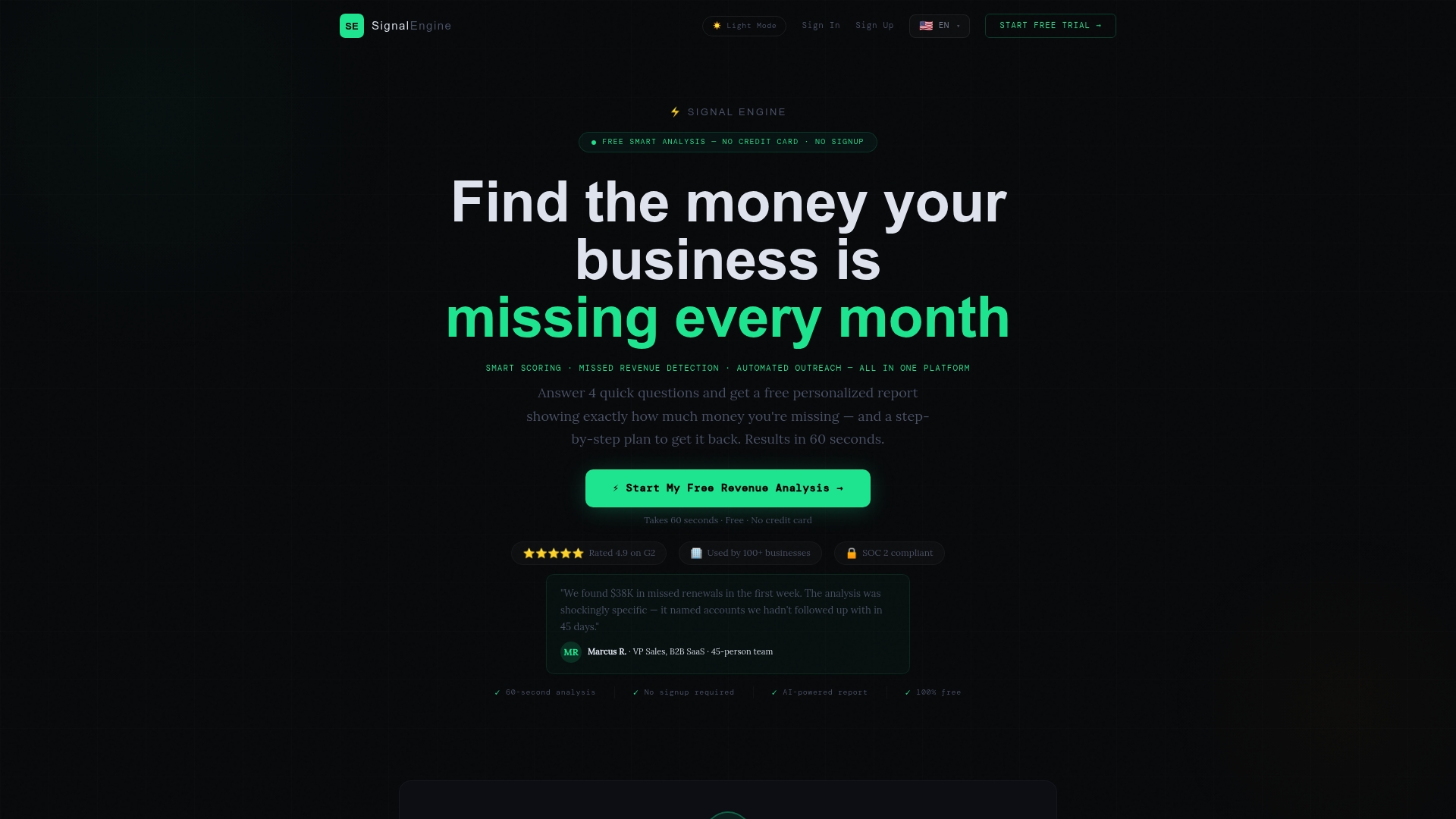
See how it works on the revenue intelligence page for small business, compare plans on the pricing page, or try the live demo.
FAQ
How much should I pay for a referral?
Start with about 5–8% of your average job ticket, and keep the total within 10–20% of the gross margin on a referred customer. On an $800 job, that's roughly $40–$64. Test a small increase only if referrals stall.
Should I reward the new customer too?
Yes, in most cases. Double-sided programs are the norm, and a small welcome offer makes the referrer's recommendation feel generous instead of pushy. A first-job discount or a free add-on keeps your cost low.
When should I pay the reward?
After the referred customer's job is completed and paid. Say so in your terms. Paying only on completed, paid jobs protects your margin and avoids paying for leads that never turn into work.
How do I get more referrals without a big budget?
Start with a spreadsheet or your existing CRM, one clear reward and one consistent ask script. Send the ask right after a good job to your happiest repeat customers. Track every referral from the first call, and add automation once you see the pattern working.
Does a referral program work for a church or nonprofit?
It can, in the form of invitations rather than paid rewards. Ask engaged members to bring a friend, record who invited whom, and follow up personally. Timing and tracking matter just as much.
Sources
- The State of Referral Marketing Report 2024 (Impact)
- State of Business Customer Referral Programs 2016 (Amplifinity)
- How to Set Up a Referral Program for a Service Business (Dillard's Digital)
- Referral Marketing Guide (WordStream)
- FTC Endorsement Guides, 16 CFR Part 255 (eCFR)
Ready to Stop the Revenue Leak?
Signal Engine gives small and local businesses 31 AI-powered tools to score leads by buying intent, predict churn before it happens, auto-generate email and SMS campaigns, and recover missed calls automatically — all in one dashboard starting at $49/month.
Start your free 7-day trial — no credit card required. Setup takes 5 minutes.