

Next best action (NBA) is a way of deciding, customer by customer, which single step to take next: a follow-up call, a retention offer, a reminder, or nothing at all. BCG defines it as a customer-centric approach that picks the most relevant action for an individual based on their context, preferences and needs. This guide explains how NBA models choose, what data they need, how to prove they work, and how a small business can run the idea without an enterprise data team.
TL;DR
- Next best action means one recommended step per customer, chosen from several candidates, instead of one blast to your whole list.
- An NBA model scores the options by likely response and value, then ranks them. Rules decide what is allowed.
- Test it. Research shows a helpful-looking recommendation can backfire, and the highest-risk customers are not always the best ones to target.
- Small businesses can start with three signals: buy-readiness, churn risk and missed contact. Approve actions before they go out.
Table of Contents
- What next best action actually means
- How a next best action model chooses
- What data and rules you need
- Types of next best actions that pay off
- Why you must test every recommendation
- Perspective: why we think NBA belongs to small businesses too
- Putting NBA to work with Signal Engine
- A 30-day plan to start
- FAQ
- Sources
- Ready to Stop the Revenue Leak?
What next best action actually means
NBA, short for next best action, started in large enterprises such as banks, telecoms and insurers. Their call centers and marketing teams had millions of customers and dozens of possible offers. The question was always the same: of everything we could do for this person right now, what should we do?
The answer can be an offer, a piece of content, a service step or a retention intervention. In BCG's service example, a customer who calls with a problem gets useful information first. An offer appears only when it supports what that customer needs in the moment.
That last point matters. NBA is not "send more messages." It is a decision about whether to act, what to do and through which channel. Sometimes the best action is to leave a customer alone.
It also explains why NBA shows up under different labels: next best offer, next best experience, decisioning. The core idea is personalization at the level of the decision. If you want the broader case for tailoring what customers see, why personalized content matters for engagement is a good companion read.
How a next best action model chooses
An NBA model sits between your customer data and the moment of contact. Firstsource describes the standard pipeline in five moves:
- Aggregate the customer's history, behavior and context.
- Estimate how likely each action is to get a response.
- Calculate the expected value of each action.
- Rank the eligible actions.
- Feed the outcome back so the model improves.
That last step is what separates a model from a static playbook. Every result teaches the system which action worked for which kind of customer.
The three kinds of models inside the engine
McKinsey's 2025 research on next best experience breaks the machinery into layers:
| Model type | Question it answers | Example |
|---|---|---|
| Propensity | How likely is this customer to upgrade, churn or respond? | Churn score for a monthly subscriber |
| Channel | Where should we reach them: email, text, in-app or voice? | Text for a customer who never opens email |
| Value | What is this customer worth in lifetime or near-term revenue? | Prioritizing a high-value account |
A decision-orchestration layer then combines those outputs with operating rules. McKinsey's example: customers at high churn risk go into a retention journey, while low-risk customers with high upsell probability get upgrade messaging.
Three ways to select the action
BCG's 2026 research on the science behind NBA programs describes three additive layers. Propensity and uplift scoring estimates response likelihood and incremental value. Contextual bandits learn which actions work in which contexts. Agent-based reasoning uses foundation models to read unstructured content, such as call notes, and compose combinations of actions.

You do not need all three on day one. Most small businesses get real value from the first layer alone, applied consistently.
What data and rules you need
The McKinsey piece lists the requirements plainly: integrated customer data, predictive models, an orchestration layer that applies operational logic, and a delivery platform connected to your customer channels. Impact is measured with control groups and A/B tests.
For a local service business, translate that into a short list:
- A single customer record. Name, last service, last payment, open quotes, calls and texts in one place.
- Activity signals. Opened the estimate, called twice, went quiet after a quote, missed an appointment.
- Rules. Never text after 8 p.m., never offer a discount to a customer who just complained, cap contacts per week.
- A way to send. Email and SMS tied to the same record.
- A way to measure. A group that does not receive the action, so you can see the difference.
Messy data is the usual blocker. If your customer list lives in three spreadsheets and a phone, fix that before you worry about model choice.
Types of next best actions that pay off
McKinsey's examples of NBA recommendations for retention include retention interventions, service improvements, loyalty offers, proactive upgrades and channel selection. In a small business, they look like this:
- HVAC or plumbing: a customer's maintenance plan lapses. The action is a call from the office, not a coupon.
- Dental or medical practice: a patient has a pattern of late cancellations. The action is a text reminder the day before.
- Salon or barbershop: a regular is 10 days past their usual rebooking window. The action is a rebooking nudge.
- Real estate: a lead opened three listing emails this week. The action is a personal follow-up while interest is high.
- Church or nonprofit: a regular attendee or donor goes quiet. The action is a personal check-in from a staff member.
Each is one decision for one person at one moment. That is the whole idea.
Why you must test every recommendation
This is where most NBA content stays too optimistic. Two academic findings are worth knowing before you automate anything.
The riskiest customers are not always the best targets. A study on retention futility found that targeting customers by how sensitive they are to an intervention beat targeting by churn risk alone. In two field experiments, sensitivity targeting cut churn by an additional 4.1 and 8.7 percentage points. Some customers are leaving no matter what you do, and spending effort on them can waste it.
A helpful-seeming action can backfire. In a field experiment on proactive plan recommendations, customers who were told about cheaper plans churned more. Three-month churn rose from 6% in the control group to 10% in the treatment group. Reminding people what they pay can prompt them to shop around.

A 2026 quantitative study of NBA systems in CRM adds a method: screen policies offline on historical data, then run an online randomized evaluation. Historical logs alone cannot guarantee a causal effect. It also lists the usual traps: delayed outcomes across several touches, spillovers between customers, missing or inconsistent logs and changing eligibility rules.
A simple test a small business can run
- Pick one action, for example a rebooking text for customers 10 days overdue.
- Randomly hold back a share of eligible customers, say one in five.
- Send the action to the rest.
- Compare rebooking or retention between the two groups.
- Keep running past the launch bump. BCG's measurement research warns that novelty can inflate early results and says programs typically need to run 8 to 12 weeks, depending on the purchase cycle.
If your volume is small, results will be noisy. Treat them as directional and repeat the test, rather than declaring victory after a week.
Perspective: why we think NBA belongs to small businesses too
We built Signal Engine for owners who do not have time to dig through data. A plumber, a dental office manager or a church administrator does not need a decision-science team. They need to know who to contact today and what to say.
Here is our view, after looking at how enterprise NBA is described:
- The idea scales down. The infrastructure does not have to. The core of NBA is a ranked list of customers with a recommended step. You can get that without a months-long integration project.
- Approval beats blind automation. The research above shows actions can backfire. That is why our platform holds every drafted action for one-click approval before anything reaches a real customer. You stay the final filter.
- Your industry changes the right action. A missed call means something different to an HVAC dispatcher than to a church office. We ship modes for industries like HVAC, plumbing, dental, real estate, logistics and landscaping, plus a Church/Ministry mode. If your business does not fit, our onboarding AI builds a custom mode.
- Risk is not the same as responsiveness. A churn flag tells you who may leave. Testing tells you whom a call actually saves. Use both.
If you want to see how the churn side works in practice, our playbook on how AI detects at-risk customers walks through the signals.
— Bernard
Putting NBA to work with Signal Engine
Signal Engine scores every customer on buy-readiness, flags who is about to churn, finds gaps in competitors' offerings and drafts the next action for you. Nothing is sent until you approve it.
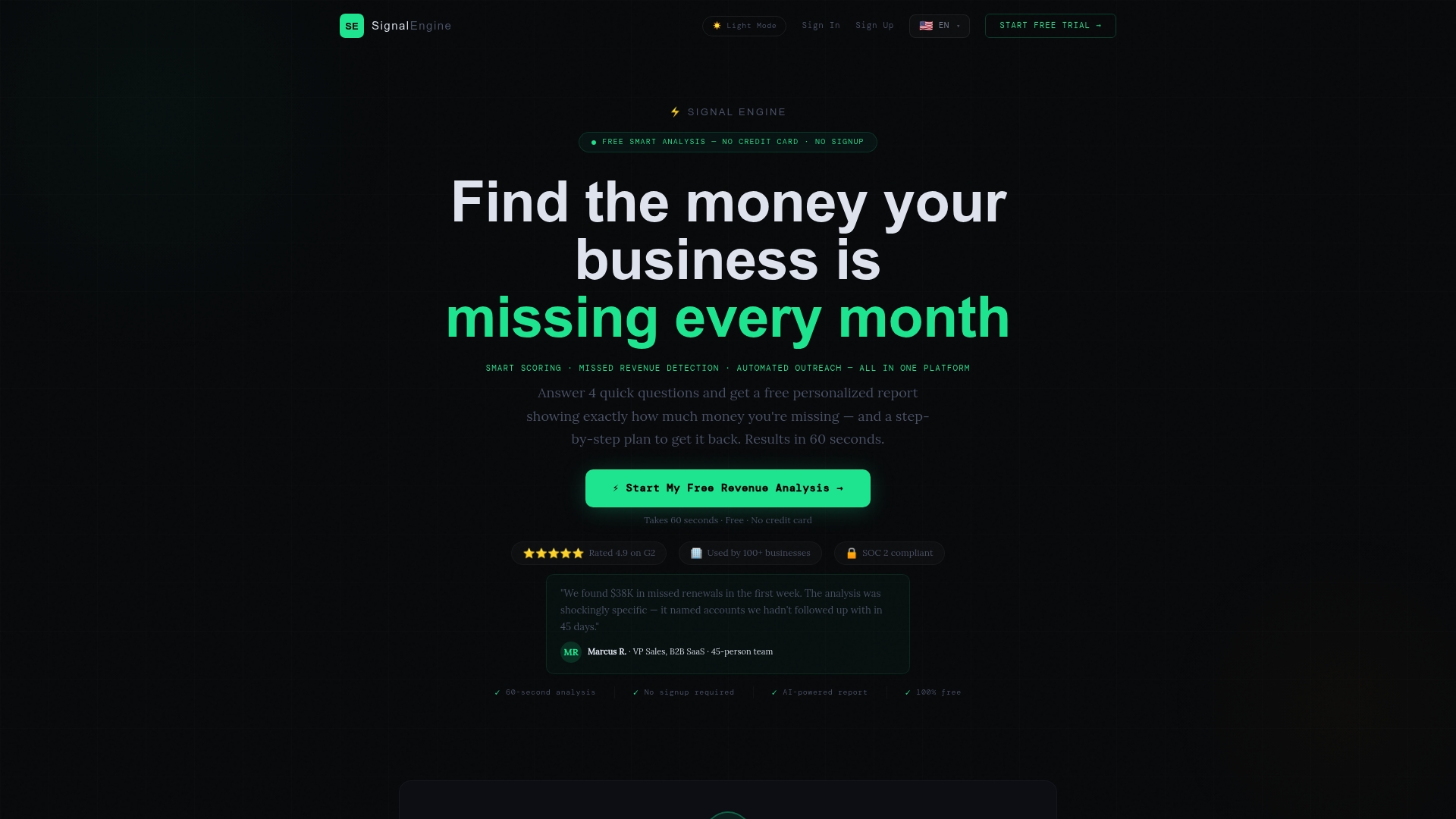
The Growth plan is $149 per month and Scale is $297 per month, as published on our pricing page. There is also a Free plan and a Starter plan. Our positioning is that all features come in every plan, with no per-seat pricing. If you want to dig into the outreach side first, read about the benefits of automated customer outreach for small businesses, or how AI supports revenue recovery.
A 30-day plan to start
Week 1: clean the list. Merge your customer sources. Mark active, lapsed and open-quote customers.
Week 2: choose two actions. One for growth (follow up on open quotes) and one for retention (contact overdue customers). Write the rules: timing, channel, frequency cap.
Week 3: launch with a holdout. Approve each action by hand. Keep a group that gets nothing.
Week 4 and beyond: read the gap. Compare outcomes, drop actions that do not beat the holdout and add the next one. Keep measuring for at least 8 to 12 weeks before you trust the numbers.
FAQ
What is a next best action model?
It is a model that gathers customer data, predicts the response and value of each candidate action, and selects the highest-ranked one. The action can be an offer, content, a retention step or a service task. Business rules then filter what is allowed.
What does NBA mean in marketing and sales?
NBA stands for next best action. It is the practice of recommending the most relevant step for an individual customer based on context, preferences and needs, across marketing, sales and service.
What is the 3-3-3 rule for marketing?
One current guide defines it as three messages, three audiences and three channels, a general marketing planning framework. It is not part of next best action. NBA decides per customer, while the 3-3-3 rule structures a campaign.
Do I need AI to use next best action?
No. You can start with simple rules, such as contacting customers 10 days overdue. AI helps when you have enough customers and signals that scoring by hand becomes impractical, and it can learn from outcomes over time.
How do I know my recommendations work?
Keep a randomized holdout group and compare outcomes over 8 to 12 weeks. Do not assume an action helps just because it seems customer-friendly.
Sources
- BCG: What Is Next Best Action?
- Firstsource: Next Best Action (NBA) glossary
- McKinsey: AI-powered next best experience for customer retention
- BCG: The Science Behind Next-Best Action Programs
- BCG: Measuring Incrementality in Next-Best Action Programs
- Retention Futility: Targeting High-Risk Customers Might Be Ineffective
- Using Plan Recommendations: Evidence from a Field Experiment
- Next-Best-Action Systems in CRM: A Quantitative Study
- The 3 3 3 Rule in Marketing
- Why personalized content matters
Ready to Stop the Revenue Leak?
Signal Engine gives small and local businesses 31 AI-powered tools to score leads by buying intent, predict churn before it happens, auto-generate email and SMS campaigns, and recover missed calls automatically — all in one dashboard starting at $49/month. Start your free 7-day trial — no credit card required. Setup takes 5 minutes.